Women at Forefront Of Egypt’s Revolutionary Wave

This piece initially published in  Al-Monitor

On June 30, the thunderous chanting of Egyptian women protesting against Mohammed Morsi, demanding that he leave office, echoed through the streets. Their voices were louder than their fellow men, adopting a collective firm, assertive tone that asserted their determination. Some female protesters carried very telling signs, expressing phrases such as “We are the coup,” their way of emphasizing their frustration with what many of them perceive as Morsi’s regressive policies.

In March 2013, despite the mounting opposition, the Muslim Brotherhood decided to shun half the society by releasing a strong statement condemning a United Nations declaration draft calling for an end to all forms of violence against women, claiming that it would lead to the “complete disintegration of society.” Such overtly regressive views have reaffirmed what many Egyptian women feared: The Muslim Brotherhood’s modern, progressive image is as hollow as its democratic credentials.

Although the Muslim Brotherhood has an active female branch, women members are forbidden from ever holding the position of Brotherhood guide and can’t even participate in the counsel office. Its most prominent cadres can hardly be described as feminist, even according to the most generous of definitions. Take Azza al-Garf, for example. One of only nine women elected in the short-lived post-January 2011 lower house of parliament, she severely criticized the right of a woman to divorce her husband and objected the ban on female genital mutilation, a practice that still claims innocent lives.

Continue reading here


Posted in Egypt | Tagged , , , , , , , , | 2 Comments

Egyptian Aak-Week 29. The Brotherhood’s Nakba

 Main Headlines

 Monday

Tuesday

Wednesday

 Thursday

Friday

Saturday

Sunday

A Few Thoughts

The Brotherhood’s Nakba

A few months ago, on one of the private TV channels, the presenter asked Hani Salaheddin (a presenter on the Muslim Brotherhood affiliated Misr25 TV) what he thought of Tamarod. He smirked and replied that it is a positive step; at least it is peaceful, better than the violence of the Black bloc. He added that they should play politics, not violence. Ex-Jihadi Tarek el-Zomor, founder of the Building and Development Party, on the same program, agreed, hinting that if Tamarod has reached its target and collected millions of signatures, then President Morsi should listen to the public. Weeks passed and Tamarod announced it had collected two millions signatures. At this poing, Salaheddin changed his tune, and started to accuse Tamarod of forging signatures and deceiving the public. He remained uncomvinced that they would succeed, he was also full of praise for the army, dismissing any differences between General Sissi and President Morsi.

A week before June30, I wrote “for the Islamist, June 30 will be a chance to deliver a final blow to the opposition. A defeat for the opposition would be the political equivalent of 1967 military defeat that will take years for any sort of non-Islamist recovery.” What followed was the exact opposite; the army’s coup has delivered a heavy blow to the Muslim Brotherhood, a kind of a political “Naksa,” which they are still struggling to come to terms with.

Thus far, their response resembles Nasser’s response after the six-day war: A war of attrition by 1) flooding their followers with a propaganda campaign, accusing the others of being traitors, and full of sectarian narratives; 2) Organizing marches in various districts of Cairo and other regions, besieging media city, even attacking Cairo’s psychiatric hospital; 3) back-door negotiations with international mediators to clinch some sort of a face-saving deal.

The obstacles that are facing the Brotherhood are many. First, the sit-in is unsustainable. Local media are full of rumors of scabies and other infections at Rabaa sit in; residents are tired and fed-op. Second: Internal divisions, although not public are inevitable. If Baheyya is already listing Morsi’s unfortunate mistakes, then I am sure many others are already doing it, particularly inside the group’s senior ranks, or those of them who are still free; undoubtedly, they are pondering what to do next.

The Brotherhood needs to formulate immediate, intermediate, and long-term plans. It is a colossal task to say the least, for now, I doubt they think more than the next few weeks ahead. They need some sort of victory that they can sell to their tired, exhausted faithful followers. Their move to commemorate the 1973 victory is, in a way, a desire to achieve an equivalent political achievement even if it is symbolic or partial, but what would be that victory? Last week, there was a chance for a bargain; this chance is diminishing by the day. The army and the interim government are cementing facts on the ground that is getting harder to reverse. By cancelling a series of grants and loans to Egypt, the EU has already lost most of its leverage, and the Brothers’ EU mediators may not have many tools to twist the Junta’s hands. The idea floated by Omar Ashour for Obama to be a mediator or guarantors is highly unlikely to happen. At best, the Brotherhood may get a conditional release of their senior members, with a promise to release Morsi later, and a promise of fair elections

If mediations failed, which is a high probability, then a confrontation would be the other alternatives. The Brothers will continue to protest, and march in the street of Cairo until the army decides to end the sit-in forcibly. This scenario may sound disastrous, but can be ideal for the Brothers; as they already made the transition from “rulers to protestors,” it make sense to finish it of with another transition to an oppressed, under-ground movement. This will cement the image of bad Cops versus Good Democrats, and give a chance to the tired group to lick their wounds within their comfort zone, and away from scrutiny and blame.

On the other hand, the Junta is not necessarily wiser. I was taking aback with the many angry statements that many retired generals gave to local TV. They are as self-righteous as their Islamist enemies. The daily tension in Sinai has clearly had an impact on their psyche. The risk is they may grow impatient and try to end Rabaa’s sit-in by force. The writing is already on the wall; local residents have already had enough, rumors of health issues are already spreading in local media. Pardon my cynicism, but I fear a mini- Tiananmen in Rabaa. I hope and pray I will be proven wrong.

It is unfortunate that the Brothers do not have a crafty leader like Sadat, however, I think even if they have one, they will dismiss him, just as they dismissed Abdel Monueim Aboul Fetouh . I also doubt that even over the long term, the group will not be capable of reform, I humbly agree with analysts’ forecast of the future of the Muslim Brotherhood, there is no doubt that Islamism will survive in Egypt, but regarding the Muslim Brotherhood; at best, they will conduct some tactical reforms to keep them afloat, but a successful second coming need a major structural and ideological reforms that even if it happens, it will make them anything, but a Brotherhood.

On a different note:

I doubt the protestors in Rabaa would have a sit in during Ramadan, and relentless protests around Cairo if the army ousted a non-Islamist like ElBaradei. Let’s not kid ourselves that this sit-in is about legitimacy; if Army sided by Morsi and arrested the NSF leaders and Tamarod leaders o June30, Sissi would be hailed as the best General ever. So I hope the Islamists stop playing the “democrats.” Card.

It is tragic, and painful to admit, but democracy has failed in Egypt and we may never be able to regain it simply because we yet to have true democratic forces that cut the road on any military interference.

Nonetheless, there is a simple fact that all parties, including the mighty experts keep forgetting, no one ruled Egypt without the consent of its people. Baheyya asked a very good question: “If men with guns and tanks can simply arrest an elected president, then what’s to keep them from doing it again and again?” The answer is simple. The people will. The army will never has done it without the people; a fact that many chose to ignore. If Morsi responded to the demands of the public, he could avert the current stand off.

It is ironic that both our autocrats, fake democrats, observers, analysts, claim that Egyptians are great people, yet they patronize, mock, and accuse them of being either traitors or idiots. I beg to differ. I trust my people, and trust that the spirit of Tahrir has not died.

Good Read

Finally, here are Jayson Casper‘s prayers for Egypt.

Posted in Diary of Aak, Egypt, June30 | Tagged , , , , , , , , , | 7 Comments

Kirkpatrick and the Myth of Egypt’s “Liberals”

 If you would like to read a perfect example of a monochromic simplification of the complex Egyptian political scene, take a look at David Kirkpatrick’s piece in the New York Times: Egyptian Liberals Embrace the Military, Brooking No Dissent.

 His opening paragraph begins with, “In the square where liberals and Islamists once chanted together for democracy, demonstrators now carry posters hailing as a national hero the general who ousted the country’s first elected president, Mohamed Morsi, of the Muslim Brotherhood.”

 Like many western analysts, Kirkpatrick has redefined the various shades of non-Islamism in Egypt as liberalism. It has become a lazy way to lump together anyone with the slightest unease about the Muslim Brotherhood’s failed policy within one broad, simple definition. In a rather absurd way it labels in one big condescending swoop both ex-regime supporters and army supporters as “liberals.”

 He continued by saying, “Liberal talk-show hosts denounce the Brotherhood as a foreign menace and its members as “sadistic, extremely violent creatures” who are unfit for political life.” He went even further to mention a “leading human rights advocate,” who allegedly blames “the Brotherhood’s “filthy” leaders for the deaths of more than 50 of their own supporters in a mass shooting by soldiers and the police.”

 Although Kirkpatrick openly mentioned some by name, such as Khaled Montaser and Esraa Abdel Fattah, it is interesting that he chooses not to mention others (the talk show hosts or the so-called human right activist) by name. Nor does he provide a link to their quotes. In this new world of hyper information, this lack of information begs the question: Why? Is it done to hyper inflate the story and to give a sense of a widespread pattern? Since when have Egyptian talk shows become a beacon for impartiality and balance?

 More importantly, how does Kirkpatrick determine and judge the liberal credentials of these people?  As I have written before, the so-called liberals in Egypt are, at best, an eclectic mix of leftists, socialists, and even anarchists with no coherent solid goal or strategy. Not a single politician in Egypt disapproves of Article 2 of the Egyptian constitution that enshrines Sharia as “the” main source of laws in the country. In fact, part of the tragedy in Egypt is the absence of a true, liberal project that counters Islamism and provides the public with a reliable alternative.

 It’s telling that Kirkpatrick cites Muslim Brotherhood narratives without even the slightest challenge. He notes the following: “ Brotherhood leaders say their organization has not condoned violence in Egypt since the days of British rule. They say private media outlets have worked for months to stir up nationalist sentiment against them.”

 While tossing out this quote without any further elaboration, Kirkpatrick is not providing some crucial perspective for the reader. He does not mention other Morsi supporters, the non-Muslim Brotherhood Islamists who engaged in a long history of violence, including the assassination of Sadat in 1981. Many of them were later embraced by president Morsi, and even invited to the 2012 October war celebration. How does Morsi later appoint an ex-Gamaa Islamya (an ex-terrorist group) as governor of Luxor, a move that drew worldwide criticism.

Just quoting snippets here and there really fails to describe how private media, both pro- and anti-Morsi, pushed their own media platforms and both were guilty of spreading unconfirmed reports before June 30. It may be trivial, still it is worth mentioning that only a few weeks before (June 30), the Minister of Information banned the song of the singer Amal Maher, allegedly because it was deemed as supporting the rebel movement, Tamarod. Further, Islamist private channels were waging a campaign against June 30, labeling the anti-Morsi rebels as infidels. Commenters at a distance can easily fail to properly convey the narrative on the ground.

Ironically, Kirkpatrick inadvertently highlighted the biased, (and undemocratic) perceptions of some of the pro-Morsi supports, “Mr. Morsi ‘should have been tougher with the media…they were disrespecting him all over the place.’” Disrespect? I guess the partial amnesia, make many, not just Kirkpatrick forget that Morsi was tough with the media; remember Bassem Youssef’s arrest for disrespecting president Morsi?

 Finally, who are “the euphoric hyper nationalists”?  A look at the photo attached to Kirkpatrick’s piece gives us a clue. The photo was taken at a juice bar in Cairo with two men posing by a photograph of Gen. el-Sisi. A quick glance at the photo reflects the real fans of the army leader; mainly apolitical ordinary Egyptians, who witnessed the crumbling of state institutions, and view the military as the only united and efficient body who can rule the country at the moment. Are these really hyper nationalists?

 Can this broad mainstream group really be so simply labeled as ‘liberals.” It is a tragic reality that the army is viewed as the placenta that can secure their livelihood, but this is not a sign of their liberalism or a worshipping of autocracy. It is a sign of distress. Many instinctively triaged the situation, and have decided to choose stability as their main priority. As one friend from Cairo aptly explained to me, “If you are starving, you don’t check how clean is the available food.”

 Kirkpatrick is indeed right to expose the bigotry of illiberal forces in Egypt, but to label them as liberals is preposterous to say the least. He naively or deceptively fails to challenge the Islamist narrative. Surely, the American readers, most of who are unfamiliar with Egypt, ought to be aware of reports of torture and detention of activists during Morsi’s tenure, just as most journalists, rightly, mention virginity tests when writing about General Sissi.

To clarify, in Egypt, the anti-Morsi camp is composed of roughly three loose groups:

  • Anti-Morsi, pro-coup: Few, but loud illiberal elite, and a wide apolitical public
  • Anti- Morsi, but ambivalent about the coup
  • Anti-Morsi, and anti-coup; Egypt’s true liberals

 This last group includes the only true liberals in Egypt; not just Hamzawy, Ahmed Maher. Many others are raising the alarm, including the satirist Bassem Youssef  who openly uses his popular appeal to campaign against the demonization of the Islamists.

Egypt is in crisis. Undoubtedly, irrational actions abound. There is blame, counter-blame, and yes, bigotry. There are many on both sides of the fault lines that are neither democrats nor liberals. The vociferous debate among non-Islamists is as old as the January 2011 revolution, and it is a clear indication of their unharmonious nature.  A fact that was consistently missed since January 2011 revolution.

 In short, the problem with Kirkpatrick’s dispatch is the missing wider perspective of events that is inextricably linked. Egypt is in desperate need of balanced journalism; readers from both camps take each published piece as if it is solid evidence to incriminate the other side. It is about time for western journalists to revise their inaccurate terms that create inaccurate conclusions about one side of the conflict, while treating the other side with a biased orientalist lens. Let’s do better.

Also published in French. Click here

Posted in Bahrain, Egypt | Tagged , , , | 16 Comments

Egyptian Aak: Week28. Coup, Plots, and “Useless Idiots”

 Main Headlines

 Monday

Tuesday

 Wednesday

 Thursday

 Friday

Saturday

Sunday

A Few Thoughts

Coup, plots, and useless idiots

 It has been two weeks since Egypt’s massive June 30 mass protest, but the debate is still raging about its narrative, significance, and possible future outcomes. If the 65-year-old Arab-Israeli conflict is any guide, the debate about the coup will continue for years, just as the Nakba/Naksa debates are still ongoing.

 Nonetheless, aside from the coup banter, there are two simultaneous ongoing battles. One is a battle of perception, while the other battle is realpolitik going on behind the scenes between the various parties involved who are trying to find a way out that restores stability and avert violence. Both battles are interrelated and crucial to the final outcome.

 The Islamists

The Brotherhood who initially looked shocked by the ouster of Morsi are now re-grouping and trying to regain the initiative. They work with their non-Brotherhood Islamists allies on two fronts: first, the perception battle by framing the debate about June 30 as democracy versus counter-revolution. They do this while trying to sideline Morsi’s role in the whole crisis and their own past strategic mistakes. On the other hand, Islamists has managed to maintain their sit-in in Cairo, and organized a peaceful Friday protest (although the numbers failed to match June 30). The protest was intended to put more pressure on the military and interim presidency, and strengthen their position in the ongoing, behind-the-door negotiations.

 Although reinstating Morsi is the main official demand of the Islamists, there are three other more serious issues:

1)   Post- coup witch-hunting, which has already started with the ludicrous accusations against Morsi of “spying and ruining the economy.”

2)   Election fairness, and guarantees to honor results, particularly if Islamists win.

3)   Future role of the armed forces, and veto privilege.

 The interim leadership Adly Mansour is trying to focus on the reality of governance, and the formation of a new government. The more they can build facts on the ground, the harder it is for Islamists to “undo the coup.” There is already mounting pressure on General Sissi to release Morsi, with international players joining in.

 The non-Islamists

 Many non-Islamist revolutionary forces are suffering from a crisis of confidence. Their understandable mistrust of army intentions make them divided on what to do next. Opposition forces are also equally divided_____ as they always have been ____ and unable to prove themselves as serious forces on the ground.

 What’s next?

 There are four possible outcomes: A grand bargain, a full-fledged police state, a long uncertain stalemate, or a rebooting of Egypt’s stalled democratic process. The Muslim Brotherhood is banking on their core loyal supporters and also on possible divisions within the military ranks. If it turns out that their assessment is correct, then a bargain will be reached soon, with possible international guarantees to ally their fear about future political participation. However, if the generals turn out to be united, and fully in control of their junior ranks, they may feel tempted to turn conspiracy theories into a harsh reality in order to secure their power, although Army Chief Sissi must remember that Egypt 2013 is not the same as Egypt 1954

 Watching how the fault lines have been redefined over the last few days, I am not optimistic that reconciliation can be achieved in the near future. Egypt could be heading for a stalemate, or at least a hiatus during Ramadan, even if protests continue. Regardless of what will happen, it is important for non-Islamist revolutionaries to understand that they are on their own, underestimated and even despised. Meanwhile, the Islamists have a chorus of supporters of Turkish Ottomans, western leftists, and fellow Islamists, all armed with pundits who are happily magnifying half the story and ignoring the other half. Non-Islamists voices are few and far between.

 Painting a grand plot behind June 30 is sexy these days. We are led to a belief that fashioning a coup was an ongoing master plan since last year. Many are happily linking previously un-linkable “vignettes” to prove this theory. It seems that Egypt’s three deadly sins: selective memory, selective blame, and selective outrage have infested, not just the local Egyptians, but also analysts following Egypt. The Wall Street Journal reported that Egypt’s top generals met regularly with opposition leaders in the months before June 30, and The New York Times reported “Sudden” improvements in Egypt after June 30 as suggesting a campaign to undermine Morsi. Ironically, the piece was tweeted by many respected analysts and observers, but was challenged, not just by a snarky Egyptian parody piece, but also by a rejoinder from Rebel Economy, with the news of the government’s fund to import gasoline, not to mention the countless reports on social media of ongoing electricity cuts and petrol queues. Another grossly misleading report claiming that the US bankrolled anti-Morsi activists, which was rightly described as brain dead by Juan Cole, and refuted by Dan Murphy

 Tamarod-SCAF is at best an alliance of convenience; the fog about June 30 is no different than the many unanswered questions about the January 2011 revolution. Morsi and his public prosecutors have ignored the Wadi Natroun prison escape case, and the allegations of Hamas involvement in the escape of the Muslim Brotherhood leaders from the prison during January 2011 revolution. Nonetheless, it is dangerous to re-open this Pandora box now, as it can ruin the possibility to break the deadlock, and efforts of reconciliations.

 Even if there was a plot, it is pointless to dwell about it now. Instead, revolutionaries must work to counter both claims of exclusive guardianship of their revolution by both the Junta and the Islamists, while working on resurrecting Egypt’s democratic path, amending constitutional declaration, and more importantly fighting polarization. I doubt that reconciliation can really happen now, but mutual acceptance could be a more realistic goal.

Egypt cannot afford army rule, stalemate, or any grand bargain that appeases the Islamists, which could easily mean demoting non-Islamists and their rights. Egypt also cannot afford selective memory that delete why Morsi lost his legitimacy, or why Mubarak was booted out. Egyptians must remember that journalists are paid to find stories, pundits are paid to articulate cool analysis, but none will pay the consequences of failure except ordinary Egyptians. Those youth who inspired the public to protest on June 30 would really be “useless idiots” if they let the country regress back to either a police state or Islamic autocracy.

Good reports

Finally, here are Jayson Casper‘s prayers for Egypt 

Posted in Diary of Aak, Egypt | Tagged , , , , , , , | 8 Comments

Turkey Has a Role in Egypt

Originally published in  Al-Monitor

On July 9, Egypt’s Foreign Ministry summoned the Turkish ambassador over Ankara’s calls for UN intervention in Egypt, following the controversial ouster of President Mohammed Morsi. The sharp deterioration in the relationship between the two nations could not be more different than the warmth Turkish Prime Minister Recep Tayyip Erdogan received on his visit to Cairo in September 2011. The hero’s welcome Erdogan received — which came only a few months after Egypt’s revolution against former President Hosni Mubarak — stemmed mainly from his ability to present the Egyptian public with a possible third way for politics, which was distant from the traditional fight between the generals and the Islamists. Many in Egypt viewed Erdogan as the man who stood against the military, and also offered the right balance between Islam and politics.

In post-Mubarak Egypt non-Islamist Egyptians trusted neither the ruling Supreme Council of the Armed Forces (SCAF) nor the Muslim Brotherhood. The SCAF was perceived as autocrats who ruined the Egyptian transition to democracy, while the Brotherhood was viewed as an illiberal cult wanting to play a democratic game for their majoritarian domination. Erdogan, somehow, managed to convince Egyptians that he had the answer to their problem. Here he was, a Muslim and a civilian democrat who boldly told Islamists, “One must not be afraid of secularism.” Ironically, Egyptian non-Islamists are not exactly secular but they are against the domination of Islamism, and they wrongly assumed that Erdogan is their man.

Following Morsi’s election, the Turkish influence started to grow exponentially in Egypt, including more Turkish financial aid and business cooperation; the Anadolu news agency became the trusted news agency for the presidential team; and even the Turkish suits worn by Morsi. That was all well and good, but many in Egypt were hoping for more from their big sister. Turkey, with its long experience in democracy-building, could easily help Egypt in two main areas: first in the transition to democracy, particularly on how to build an inclusive, wider coalition that includes non-Islamist groups, which would ultimately help to build a solid democratic system; and second, on governance issues, and how to rebuild the country’s institutions in a way that leads to justice and accountability. Continue reading here


Posted in Egypt, Turkey | Tagged , , , , , , , , | 2 Comments

Egyptian Aak. Week 27 -New SCAF vs. Old Islamists

Main Headlines

 Monday

Tuesday

 Wednesday

Thursday

Friday

 Saturday

Sunday

A Few Thoughts

New SCAF vs. Old Islamists

It’s hard to absorb all of the events that took place last week in Egypt. Many details have 3yet to be digested. What is certain, though, is that this was the year’s most crucial week, with far-reaching ramifications. Thus far, we only have disputed assessments from inside and outside of Egypt.

Last year, just before the last presidential election, I wrote a piece asking has Egypt finally broken with the myth of the good autocrats? Now, a year later, I’m still asking the same question because Egypt continues to struggle between two forces – the Islamists and the military. Both have clear autocratic tendencies, and both are claiming to be the true guardians of democracy, despite evidence to the contrary.

In 2012, many Egyptians (almost 52%) chose to trust the Muslim Brotherhood. In 2013, the tide has turned, and many have chosen to place their trust in the military. The core question is how has this happened and what are the implications for the future. Ironically, the answer is very simple – the military leadership has reinvented itself, whereas Muslim Brotherhood leaders have not.

There is no doubt that the army commander, General Sissi, has been perceived by the public as a man with an abundance of charisma and leadership skills. Sissi’s success stems from various factors.

1) The leaderless revolution: Egypt had resurrected the spirit of 1919, but without a new Saad Zaglool, and Sissi happily stepped in to fill the vacuum. He portrayed his move to oust Morsi as what Amr Hamzawy described as a “Coup de grâce,” a description that appeal to many Egyptians. 

2) Playing it right:  Sissi struck a chord by using the buzzwords of “democracy and support,” because he understood that the public does not and will not accept an explicit military role. This was a key element that helped him to achieve public endorsement.

3) Fulfilling promises (at least for now): Within 24 hours, an interim president was sworn in, cancelling Morsi’s much despised constitution, and ousting the unpopular public prosecutor. It does not matter that the military is now running the show from behind, what matters for the public is that there is a civilian face in front.

4) Mixture of arrests and releases: The arrests of many Brotherhood’s figures were clearly aimed to disrupt the Brotherhood’s chain of command, and the early release of some (pending further investigations) was likely aimed to feed to their confusion, while aborting any blame.

5) Allowing peaceful protests: The main congregations of pro-Morsi forces in Nasr city and Giza were not emptied, and both the Supreme Guide of the Muslim Brotherhood and prominent leader El-Erian were allowed to speak freely, even when inciting action against opponents. Their non-reconciliatory speeches, however, have done little to win them the hearts and minds of the wider public. It is true that the military shot dead four unarmed Islamists protestors, a grave mistake that could easily turn the tide against them, but the later march of some Muslim Brotherhood supporters to Tahrir Square and the deadly clashes that ensued have again proven fatal to the Brotherhood’s image.

6) No curfew (yet): Despite the violence, Sissi has resisted the temptation to declare any military measures, thereby adding fodder to the dispute over the nature of the “coup.”

Meanwhile, the Brotherhood has continued using the same approach that they have been using for the last 60 years – a victimhood mentality. Highly charged statements, accusations of conspiracies, playing with emotions, and claiming to be the representative of Islam are all among the Brotherhood’s favorite cards. This is all without even mentioning the fatwa by their scholar Qaradawi that supports their “legitimacy,” which is a must for every Muslim.

Currently, the Brotherhood has several goals. 1) Prevent fragmentations: it is the Brotherhood’s worst nightmare for their members to start reflecting on events or asking questions; therefore, it is important to keep loyalists saturated with emotion and in a permanent state of anger. 2) They aim to raise the stakes in any behind-the-scenes negotiations. They want fear of bloodshed to be their bargaining power in the negotiations for survival. 3) Underground violent resistance? There is a fear in Egypt of the Brotherhood staging a defection campaign among the army ranks, and creation of a Syrian version of a free Syrian army.  Watching one report from Aljazeera Mubasher has convinced me that it is a valid fear. I doubt they will succeed, but the army is now stretched with its forces spread around Egypt, and is vulnerable to potential terrorist attacks.

Thus far, no one from the Brotherhood has posed the important question: why has the Egyptian public chosen to place more trust in the army than in the Islamists? It is easy to label the public as “dumb fools.” It is harder to admit failure. The failure of the Brotherhood to sense how the military has reinvented themselves, and change tactics could cost them a hefty political price.

Other Islamists are not necessarily smarter than the Brotherhood. Yes, some like Nageh Ibrahim, an ex-Jihadi, have openly admitted that the Islamists committed many grave mistakes, however, the Salafi Nour party, which was praised by many for approving the military move has again shown shortsightedness by rejecting Nobel Laureate Mohamed ElBaradei as interim Prime Minister. Actually, this is a dead-end job without much influence in writing the future constitution or shaping Egypt’s future. Their rejection reflects a party on the edge, eager to achieve early short-term gains, all the while worrying about the loyalties of their cadres.

As funerals of victims continue around Egypt, it becomes blatantly clear that the country is still being held hostage by many old guards who are neither able to defeat nor capable of reconciling with each other. The “new” army has the upper hand for now, against the “old,” sulky Islamists, but questions remain; for how long and at what price?

Good Reports

Good Read

Plus Video of a 12 years old Egyptian explaining events in Egypt

Finally, here are Jayson Casper‘s prayers for Egypt

Posted in Diary of Aak, Egypt, June30 | Tagged , , , , , | 1 Comment

Here’s why Egyptians are glad the military ousted their president

This piece originally published in The Globe and Mail, I republish it here in case you missed it.


It may seem illogical or even reckless. Why is this huge crowd in Egypt celebrating as they watch their democratically elected president being deposed by the army? There is no simple answer. Egypt’s scene is multidimensional and therefore hard for onlookers to understand immediately.

To start, let’s agree that it was a military coup, but a coup with public consent; a coup backed by a civil uprising and millions of Egyptians protesting in the streets of all regions of Egypt demanding the ouster of President Mohamed Morsi.

We should also clarify the context. The first step is to appreciate the factors involved in the uprising. First, Mr. Morsi had only managed to secure 25 per cent of votes in the first round of the presidential election, and he won the second round of the election only after many non-Islamists and revolutionary forces had backed him; however, he slowly betrayed them and failed to fulfill his promises.

Second, throughout his one year in power, Mr. Morsi failed on all fronts: politically, economically, and in terms of security. Egyptians felt that their lives didn’t improve but became worse than they had been under dictator Hosni Mubarak. The demands of the January, 2011 revolution – bread, justice and equality – were not fulfilled, and there were no hints of future improvements. Mr. Morsi insisted on appointing men whom he could trust, but these men were not necessarily experienced or professional.

Third, what was more alarming for most Egyptians was the slow trend of changing the identity of the state from a tolerant, diverse society to a more rigid Islamist society linked to a wider Islamist project and not to a national Egyptian movement.

Fourth, Egyptians watched as countries such as Qatar and Turkey had more influence on the presidential team than local political forces. The joke in Egypt was that Mr. Morsi only served his “tribe,” the Muslim Brotherhood, and was not interested in the rest of the nation.

Fifth, minorities started to feel threatened and intimidated; the main Coptic cathedral was attacked during Mr. Morsi’s reign, and Shia were threatened and murdered; he didn’t do enough to calm the raging sectarian flames.

On the other hand, the opposition was divided after years of oppression under Mubarak, and failed to unite or formulate a joint plan to fight the Islamists.

Facing a harsh economic situation, political deadlock, failed opposition forces, and more importantly a risk of Islamization and a change of identity and way of life, the Egyptian youth decided to take the matter into their own hands, and initiated a massive signature campaign to impeach the president. They managed to collect 22 million signatures in this country of 80 million. Despite the skepticism of many, they managed to deliver an impressive rally on June 30.

The second step in understanding the context is to comprehend the forces at work in the army.

First, it is important to highlight that the army fulfilled its promises and handed power to Mr. Morsi once he was elected. Second, the army also accepted Mr. Morsi’s decision to dismiss Mr. Mubarak’s men – Defense Minister Mohamed Tantawi and Chief of Staff Hafez Anan – last August.

Third, Mr. Morsi appointed the current defence minister, General Abdel-Fattah el-Sissi, who on Wednesday announced the president’s ouster and the suspension of the constitution. General Sissi initially appeared compliant to Mr. Morsi’s leadership, but it did not last. The relationship between the two grew increasingly tense, particularly after the killing of 16 Egyptian soldiers in Sinai last year by Islamist groups and Mr. Morsi’s apparent reluctance to arrest the perpetrators, who are still at large. Fourth, earlier this year, another group of military personnel were kidnapped and then mysteriously released, yet the kidnappers were never arrested.

Fifth, on the political front, General Sissi offered to mediate between Mr. Morsi and the opposition, yet Mr. Morsi firmly rejected the army’s offer.

And what finally broke the last link between Mr. Morsi and the military was Morsi’s call for the Egyptian people and army to support the Syrian revolution; the military was not willing to be dragged into such a reckless foreign adventure.

It is fair to say that rebels and the army had joined interests to oust Mr. Morsi, but there is no evidence to support claims that the army explicitly or implicitly supported the rebellion during its campaign.

Would the rebellious protesters have been able to oust Mr. Morsi without the army’s intervention? Surely, the answer is no. Mohamed Morsi clearly articulated his stance as one of defiance, and he thought that if he could survive until the start of Ramadan (July 8), then the protesters might get fed up and go home.

On the other hand, and after sensing Mr. Morsi’s defiance, the army probably felt it had to deliver a quick ultimatum – mainly to avoid an eruption of violence that would be difficult to contain. With Sinai out of control, the risk of Hamas backing the Muslim Brotherhood, and serious wide-spread collapse of law and order, it would have been tactically unwise for the army to join late.

So what’s next? The short answer is that no one knows. There’s no way to know the real intentions of the military junta, or the next step of the Muslim Brotherhood. It is not really accurate to compare this coup with that of 1952; after all, the Egyptian public did not revolt against the late king, but the public later accepted the coup, thanks to the charisma and charm of president Gamal Abdel Nasser; this time, the youth will not be willing to sacrifice their freedom for a few charming words from General Sissi. More importantly, the Egyptians’ main asset, ironically, is their existence, and their ability to successfully assemble and protest in great numbers against their leaders. Gen. Sissi was smart and outmaneuvered Morsi, but Gen. Sissi is not blinded enough by ideology to risk being another Morsi, Mubarak or even Nasser.

For now, Egyptians are celebrating their victory against what many of them perceive as Islamist fascism. Tomorrow, they will have to figure out ways to clamp down on the army’s autocratic tendencies. General Sissi stood on Wednesday night with the Grand Imam of al-Azhar, the Coptic Pope, a Nobel laureate Mohamed ElBaradei, a Salafi leader, and the young leaders of the protest movement. There is no chance that this bunch will stand by him tomorrow if he decides to play a dictator. On the other hand, he will be a fool to think that arresting Brotherhood figures, and alienating their youth, will make his job easier. Oppressing the Brotherhood will only compound the tension, and may lead to an endless cycle of violence or even political assassination.

Egypt has chosen a very risky maverick approach to stop the creeping autocracy of the Islamists, and to achieve a pluralistic democracy, but the outcome depends on learning from past mistakes and avoiding future autocratic temptations.

Posted in Egypt | Tagged , , , , | 5 Comments

It’s the Identity, Stupid

Tahrir 13

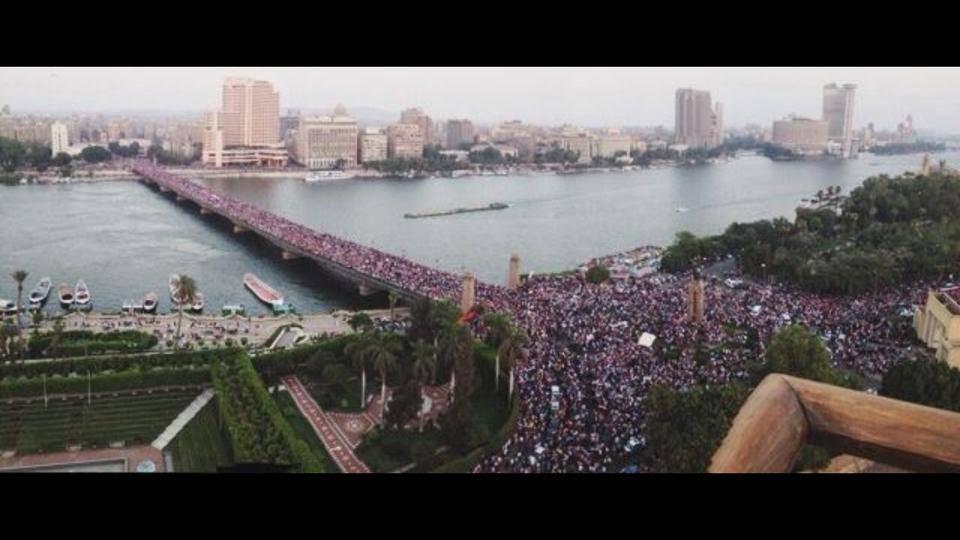
(Photo via of June 30 demonstration in Cairo via Twitter)

Millions and millions poured into the streets of Cairo and other regions of Egypt, calling for President Morsi to resign. The vast, unprecedented numbers of the June 30 demonstrations, which continued well into July 1st with unflagging fervor and tenacity, has defied expectations. The sheer magnitude of these crowds has even defied logic – after all, Morsi was democratically elected. Yet, this is not a revolution to establish democracy; it is revolution to defend an identity. Although there are several political, social, and economic factors behind June 30, the tipping point was what many in Egypt perceive as a new form of colonization by the Muslim Brotherhood; the revisionist party that considers itself the savior of Islam has embarked on a mission to change the identity of Egypt into an Islamist one.

For over 7,000 years, Egyptians have accumulated a diverse mixture of various identities – Pharoanic, Coptic, Arabic, Sunni, Shia, Mediterranean, Nubian, and Bedouin – all brought together in a big mixing pot that is called ‘Egypt’. The people have welcomed newcomers without compromising core values of tolerance and deep relation to the land, which has surprisingly been maintained within roughly the same borders for centuries. Egyptians have a long record of rejecting forced change by autocratic or colonial power; even Nasser’s Arab nationalism fell quickly after his death. Over the last year, Islamists in Egypt have assumed that winning the election was a license to change Egypt’s identity into a new Islamist one – an identity that they can’t even define or outline, and yet they’re consistently yelling at what they reject. This list is long and growing – from ballet to opera to satire.

Once elected, Morsi removed his revolutionary cloak and revealed his Islamist garments. He appointed ministers with Islamic affiliations in powerful positions, particularly in culture, education, and endowment ministries tasked to change curriculums, fighting what they perceive as unacceptable elements of Western culture, and introducing a new type of preaching in mosques. Egyptians started to hear about vigilantes, vice and virtue, halal tourism and other concepts alien to them.

Furthermore, the Brotherhood has adopted what many of their predecessors have done for generations; addressing them as “the great people of Egypt,” but at the same time behaving as if the people are ignorant children unaware of their best interests, with a deeper belief that the wider public is a backward bunch who need preachers to lead and guide.

Sheik Qaradawi’s speech on June 29, addressing the pro-Morsi crowds also mentioned an interesting verse of the Quran; “Obey God, obey the Prophet, and your own guardians.” Qaradawi summed up what many Islamists believe; the president of the country is the guardian of the nation, and should be obeyed as long as he does not commit any sins. If Morsi’s edict last year has delegitimized him politically, those views have ruined what was left of his legitimacy. Egyptians did not elect a guardian but a civil servant. The June 28 and 29 pro-Morsi rally has confirmed the fears of many Egyptians; they watched the chanting, the speeches and the attitude of Morsi’s supporters, ironically, it have cleared all doubts in the minds of many Egyptians about whether to join the protests on June 30 or not; it became clear to millions that Morsi must go simply because he does not represent Egypt, but an international Islamist’s project that dismiss others as infidels or imperfect.

The conflict in Egypt runs deeper than the issues of democracy and election. If pyramids are any inspiration, Egyptians consider their collective diverse identity as the foundational layer of their new modern state; without it, democracy and elections are meaningless exercises.  Egyptians have watched how the Iranian revolution unfolded and how the Islamists hijacked the dreams of many ordinary Iranians who yearned for freedom and equality. They also watched how Hamas won elections in Gaza, only to impose harsh Islamic rule under the pretext of fighting the occupation. Egyptians have realized that unless they fortify their January 2011 revolution with another wave of revolts, they may end up with decades of Islamism that will be difficult to shake or undo.

No one has understood the war of identities better than the Egyptian army; by throwing Egyptian flags from their helicopters towards the protestors in Tahrir Square, and carefully phrasing a statement, full of sentimental and patriotic hints, the Supreme Council of Armed Forces (SCAF) has struck the right cord, and appeal to the jubilant crowds. However, it is wrong to assume that Egyptians have forgotten the mismanagement of the post-Mubarak transition period by the SCAF, their virginity tests, and military trials. The people do not want a new autocracy or a military force that exacerbates an already polarized political scene.  They still want their politicians to rise to the challenge. Any assumption that the protestors are just a mob that worships autocracy and are easily manipulated by SCAF or ex-regime elements, and any attempts to compare them with Turkey or Algeria, is wrong and based on a failure to understand the Egyptian psyche, and the background events.

In 2011, Egyptians promised to return to Tahrir if their politicians let them down, and they fulfilled that promise ___ and in style_ ___ on June 30. I have no doubt that they will rise again, and again, if the army or anyone else dares to undermine them or crash their dream. It is sad to see some Egyptians pundits join Western analysts, and underestimate their political awareness. Make no mistake those crowds will turn against SCAF if they dare to exploit them.

That is why SCAF must choose their next steps carefully as well. Pleasing the public in Tahrir should not translate into targeting the Muslim Brotherhood or arresting their leaders, which is the group’s main fear. It is time for a fresh inclusive start that heals old divisions. Egyptians are willing to accommodate the Islamists; they just reject their domination. Any future road map should be based on a no-winner-no-loser formula; that will lay the foundation of a concrete democracy that is based on pluralism, and reconciliation. That is what worked in South Africa and must be implemented in Egypt. On the other hand, Islamists should swallow some humble pie, and embrace the other side of Egypt that they have consistently rejected. They should use SCAF’s ultimatum as a chance to forge a deal that will secure their rights as partners of democracy and guarantee a graceful exit for Morsi. Violence may temporarily ruin Egypt, but it would destroy the Islamic project forever.

The battle for the soul of Egypt is crucial to the rest of the Middle East as it is essentially the conflict between Islam and Islamism; democracy and autocracy will either settle the score forever or continue to rage for generations to come.

Posted in Egypt, June30 | Tagged , , , , , , , | 19 Comments

Egyptian Aak: Week 26-Part A. A Tale of Two Egypts

I divided this week report into two parts; here is part one, while part two will be released  late Sunday with special coverage of events of June30 in Egypt

Main Headlines

Monday

Tuesday

Wednesday

 Thursday

 Friday

A Few Thoughts 

 A Tale of Two Egypts

The split TV screens showing images of both pro-Morsi and anti-Morsi rallies have exposed the deep divide in Egypt; a country that is bruised and struggling to move forward following decades of oppression under Mubarak. To explain what is going on, let’s go through some basic facts:

1)   Mubarak’s legacy  (as Amr Hamzawy once said) is of a strong regime and a weak state. The Muslim Brotherhood exploited this weakness to expand its network around the country, but did this while staying well underground and hiding the details of its ideology from the rest of  Egypt. Other Islamists followed suit. A slow wave of Islamization unfurled while non-Islamists were detached and disconnected from what was happening in rural areas and many deprived suburbs of Egypt’s major cities. The result was a fractured society with many disconnected sub-societies, each living in their own bubble.

2)   It is fair to say that Islamists had a clearer vision and opinion about what a wider Egyptian society should look like than non-Islamists. Non-Islamists were instead more focused on their own mini-circles and never articulated what they are against. Islamists always considered other Egyptians as “imperfect Muslims,” brain washed by the regime’s “secular propaganda.” In contrast, while many ordinary Egyptians viewed Islamists with suspicion, they also had sympathy, mainly because they were oppressed and intimidated by Mubarak’s regime.

3)   The bubble finally burst in January 2011. Gradually all parties started to come together in a lose unity against Mubarak. This unity was short lived, as different visions collided in the early post-revolution phase. In this early period both sides disagreed on whether a constitution or an election should come first.  Again, it is fair to say, the Islamists were more focused and knew what they wanted than the other parties. Non-Islamists were euphoric, yet for the most part, confused about what to do next.

4)   Although the Muslim Brotherhood won a majority in the parliamentary election, it was the first phase of the presidential election that finally exposed the extent of their core supporters within society, roughly 25%. Morsi ‘s victory in the second phase was in a way, a reflection on how many Egyptians were still not fully aware of the potentials risks of the Muslim brotherhood’s ideology on the wider society.

5)   Morsi’s one year in power has finally helped Egyptians to fully discover and understand what is Islamism, and what exactly the Muslim Brotherhood and other Islamist parties stand for. It was a painful eye-opening experience that enforced fault lines between what is Egyptian   and what is Islamist. The result was reflected in two campaigns, one anti–Morsi Tamarod and the other pro-Morsi Tagarod. Each represents a different vision, not just in what democracy and legitimacy should be, but a wider vision of what Egypt should be as a state and as identity. Unlike Mubarak, Morsi ‘s legacy was a weak regime and a weak and divided state.

I am a big believer in destiny; things happen for a reason, history evolves in a certain logical way. Morsi’s behavior throughout last year is a reflection of the ideology of his group more than his flaws as a leader. Those Egyptians who were cool, balanced, and politically correct, and expected compromise from Morsi, have failed to grasp this simple fact. The Muslim brotherhood cannot compromise. This is not available in their program. How can they compromise with the other Egypt that they despise and want to abolish?

What we witnessed on Friday June 28 were the final preparations for a final showdown between two different forces fighting for the soul of a nation. The contemporary history of Egypt as a state, and the history of the Muslim Brotherhood as a group, indicate that this collision was inevitable. The question is not if it will happen, but simply when. Morsi’s victory was essential for this collision to happen, and is paramount for the evolution of Egypt as a society. I humbly disagree with Michele Dunne, the conflict in Egypt is mainly a binary struggle, the old state is the only the exploiter, but not the main player. Old regime would not be able to exploit if the gap between other two was not that wide.

Will the country now move towards being a modern, tolerant, multicultural society or a tyrannical Islamist society with an Egyptian flavour?

It is too early to predict what will happen in the next few days, however if the Muslim Brotherhood prevail, they will win the battle, but lose the wider support from Egyptians that once helped them to survive as an oppressed underground group. They will also inherit a “black cake” full of mud and blood that may poison their lives for years to come.

Good report

Good Read

Finally, here are Jayson Casper prayers for Egypt.

Posted in Diary of Aak, Egypt | Tagged , , , , | 6 Comments

Morsi Condemnation Of Lynchings Not Enough

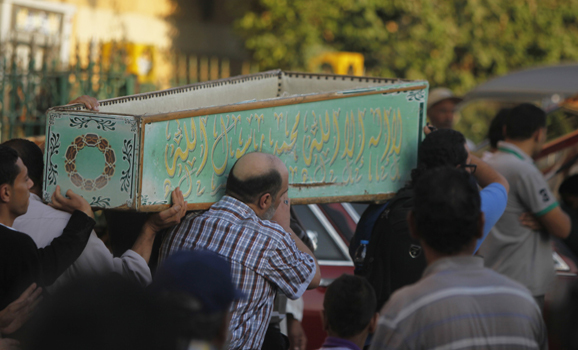
Egyptians carry the coffin of a Shi'ite victim, who was killed in sectarian violence, after funeral prayers in Cairo

(Egyptians carry the coffin of a Shiite victim, via Reuters)

I wrote this piece for Al-Monitor

My guidebook described it as “the ideal mosque in Las Vegas.” This odd statement motivated me to visit Sayyida Zeinab‘s shrine in southern Damascus. Immediately, I understood what the travel writer meant; the stunning shrine with its golden dome and blue tiles, its spectacular design and elaborate architecture and the happy, animated crowd were simply overwhelming. Yes, it was like a pious version of what we might find in Las Vegas, minus the black garments and religious services. Shiites are always elaborate in their happiness as well as in their sadness; their attitudes, mosques, core theology and historical narrative differentiate them from their fellow Sunnis. These differences are as old as Islam and have fueled a centuries-old conflict that was often bloody and ruthless. Egypt luckily had not experienced what countries like Iraq have endured for years; alas, the barbaric mob attack against Shiites on June 23 — which left four dead in the town of Zawyat Abu Musalam in Giza governorate, south of Cairo — has brought the ugly Shiite-Sunni sectarianism to Egypt in an undisputed way.

My travels to Syria, Lebanon and later to Iran gave me my first introduction to the deep and occasionally hidden tension that has always been part of the Levant. It also brought home to me how ignorant we Egyptians are about Shiite Islam. The successive governments of the most populous Arab nation have never bothered to educate its people about a section of its minority, its history and many historic aspects of its religion. Our history books describe events in a very dry, abstract and carefully phrased way. For example, books accurately describe that Al-Azhar mosque was founded in 970 by Fatimid Caliph Al-Muizz Lideenillah, but neglect to highlight that the highest seat of Sunni religious authority was originally a Shiite place of worship — and it was closed for 10 years by Saladin to wean it from Shiism and reintroduce it as a Sunni university. Such whitewashing of history has nurtured the chronic ignorance that was later exploited and led to the persecution of the Shiites in Egypt. It also gave Egyptians a false sense that they are somehow immune from intersect sectarianism. Continue reading here

Posted in Egypt, Iran | Tagged , , , , , | 5 Comments