Diary of Aak, week13: The Kaboos

Bassem Youssef

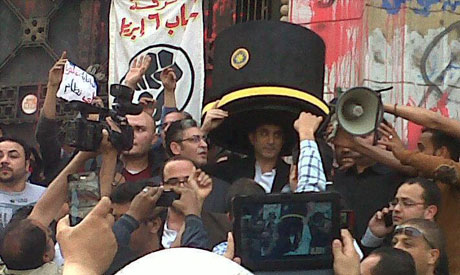
TV host Bassem Youssef arrives at high court on Sunday  (Photo: Ahram)

Main Headlines

Monday

Tuesday

 Wednesday

Thursday

Friday

Saturday

Sunday

A Few Thoughts

Egypt lives a surreal nightmare, or kaboos in Arabic, full of random fights, meaningless chaos, foreign fingers, saboteurs, two public prosecutors, and satire that “allegedly” went badly wrong.

Mr. PP:

The Cairo Court of Cassation ruling on Wednesday annulled the presidential decree appointing Talaat Abdallah as Egypt’s public prosecutor (PP). Like many previous verdicts, it was mired with ambiguity, and has created much angry debate about the many questions that arose after the verdict. Should Abdallah leave and appeal, or stay and appeal? Should the ex-prosecutor return or not?

Ironically, no one asked similar questions when Mubarak was sentenced to jail, and in fact, everyone expected him to go to jail, and appeal later. It is simply called common sense, but Egypt lost its common sense, and is now divided between supporters and opponents who are trying to find anything within the legal loopholes to justify their political stances, and it is not a new development, but it is getting sillier and frankly sickening, particularly when the same prosecutor, with legitimacy in dispute, has continued to issue several arrest warrants for various activists, solicitors, and journalists. Mr. PP is one of the main players in our kaboos, with his performance that is full of audacious defiance and abuse of the law. The Brotherhood are not governing Egypt, they are just desperate to prove that they are in control.

 Bassem Youssef

Welcome to Egypt’s flawed, subjective constitution. Here is article 31: “Insulting, or showing contempt to any human being is prohibited.”

I guess we should look at the bright side; Egypt is 15000 Egyptian pounds richer ($2,190) after Bassem Youssef’s bail, however Egypt has lost the respect of the 1Millions Twitter followers, 2 Millions Facebook fans, and 20 million YouTube viewers of Bassem Youssef.

A closer look at the details of the Bassem Youssef case could shed some light at the dark side of Egypt justice system: The prosecutor office has “allegedly” summoned Youssef last week, but Egypt’s most famous public figure, whom his address cannot be missed has denied in a TV interview that he received anything.  This is the oldest trick in the Egyptian legal system; alleged miss of the summons, followed by arrest warrant. Regardless, Bassem arrived at the prosecutor’s office donned in an oversize academic hat mocking one, which Mr Morsi wore recently when he received an honorary doctorate in Pakistan. The defiance of Bassem Youssef, it seems, did not go well, the mood has changed after initial welcome by lawyers and policemen at the office who wanted their picture taken with him, according to al-Misri al-Youm news portal, the judge asked him to remove his tweets written during the questioning, and released him on bail for 3 legal cases, and a fourth one is still ongoing. The real crime of Bassem Youssef is not insulting President Morsi, or denigrating Islam, but his ability to challenge old attitudes and mindsets. His arrest warrant is, in my opinion, a form of legal bullying, and as Abdullah Kamal wrote: “It is a sign of a regime in quandary.”

If I had one bit advice to offer President Morsi, I would recommend that he appear on the Bassem Youssef show, Al-Bernameg, as it would probably be the smartest move he can make to win the heart and minds of all Egyptians.

 Autumn Election?

According to president Morsi, the parliamentary election could possibly be next October. In other words, we are heading for a spring and summer of Molotov cocktails, burning, and lynching. Can Egypt tolerate more violence? The answer is no, but that doesn’t necessarily mean that the violence will stop. The political deadlock, the stubbornness of the leadership, the weakness of the main opposition will continue to breed new groups that will commit to various acts of violence. In Egypt, there is no need for a crystal ball to predict future ugliness; the debate is just about how ugly it will be.

 The mystery of the undersea cable:

As Christopher Dickey  wrote, maybe the three scuba divers were just idiots. Or spies. Or saboteurs. It is hard to tell. Although the incident highlights how vulnerable global communications are, it also highlights the foggy scene in Egypt, where reliable independent news is in short supply. Looking at the photo of the three divers, they look like any poor Egyptian fishermen, not spies or saboteurs. They have all denied the charges, and the whole case will probably be forgotten in a day or two. It’s likely that the truth will never be known. This is the core reason behind our problems; we indulge in myths, rather than a pursuit of facts. Meanwhile, I strongly recommend this piece by Daniel Nisman.

 Sheik Mazhar Shaheen:

It is not all doom and gloom in Egypt, as long as there are people like Sheik Shaheen. He is the true face of Egypt, a peaceful, tolerant country that continues to fight hard against those who are undermining its spirit and identity. I have only one word for this honorable Imam: respect.

 Good Read

Finally, here are Jayson Casper prayers for Egypt

Happy Easter and Happy Passover 
Posted in Diary of Aak, Egypt | Tagged , , , | 1 Comment

Egyptian Aak: Week 12

“Above all, don’t lie to yourself. The man who lies to himself and listens to his own lie comes to a point that he cannot distinguish the truth within him, or around him.” (Fyodor Dostoyevsky, The Brothers Karamazov)

Moqattam( Photo Reuters, via ahramonline )

Main Headlines

Monday

Tuesday

Wednesday

Thursday

Friday

 Saturday

Sunday

A Few Thoughts:

The frivolous violence continues to unfold in Egypt; this week’s episode took place in Moqattam, near the main headquarters of the Muslim Brotherhood. It is hard and painful to comment on such a sad day but there are few points that are worth mentioning:

  • Moqattam’s Brotherhood headquarters is a symbol of their intriguing journey from an underground, unlawful movement to the most powerful group in the country. However, Friday’s violence reflects the Brotherhood’s fast decline and the contempt that many have for the group that has begun to behave like Egypt’s high commissioner.
  • Violence was expected: Any one claiming that the intention was peaceful demonstrations or peaceful defenses of the Brotherhood Headquarters is either naïve, has unrealistic expectations, or is simply not telling the truth. Both sides were willing to fight if attacked and both did not trust the police to restore law and order.
  • The difference in this episode is what were seemingly pre-emptive attacks by some non-Islamist protestors on the Brotherhood’s buses (that usually bring their supporters from other provinces), parked away from main building in Nafoura square; this seemed to take the Brotherhood by surprise, and hence, there were several casualties among their ranks. On the other hand, many opposition figures like Ex-presidential candidate Khalid Ali were also injured.
  •  Although many groups called for Friday’s protests, the National Coalition Front (NSF) did not call for Friday march to the Brotherhood headquarter, therefore, it is unfair to classify the NSF as “spoilers” in the current  complicated  scene in Egypt. Nonetheless, their silence is morally and politically damaging, as it can cost them their integrity and credibility among the public. Therefore condemnation of violence by the April 6th Movement, and by opposition figures like Amr Moussa, and Sabbahi should be welcomed, although it came a bit late.
  • On the other hand, some activists still justify the violence as understandable, as this quote from Egypt Independent: “If you think our moves should respect the rule of law, or at least seek the rule of law, then you will have to find a way to pressure the state, the regime and the Muslim Brotherhood to respect the law.” The activists who label the Brothers as “sheep” and “nodding dogs” to their masters are behaving like wild bulls. This “quid pro quo” attitude is not the most progressive sort of behavior, and it is dangerous and destructive, to say the least. Two wrongs do not make a right; it will only drown the country in a reckless cycle of revenge.
  • The use of Takbeer and religious slogans in Friday’s fight is another example of disgracing religion. The Islamists should stop pretending it was a holy fight; this was a fight for a group and not for God.
  • The Brotherhood and President Morsi were silent when violent erupts on several occasions in the past, yet they were both swift in condemning the violence against their own  people.
  • President Morsi’s speech on Sunday with his implicit and explicit threats to the opposition is probably a response to the apparent growing resent  among the junior cadres within the Brotherhood. It also indicates that he accepted the Brotherhood’s narratives as the whole and complete truth.
  • In short, both side systematically mix many cards with detangled collection of truth and blatant lies. What is more dangerous; they both have started to believe their own lies.

 President Morsi met Mr. 10%:

Many Egyptians may not know that the PM of Pakistan’s nickname is “Mr.10%”; the controversial political figure has spent several years in jail on charges of corruption, which is precisely why it is baffling to see Morsi keen to reinforce his relationship with such corrupt leadership. Morsi’s speech at Pakistan’s National University of Science & Technology (that included many factual errorsmay shed some light on the aim of the visit; it was simply propaganda. For Morsi, creating a perception that he seeks to resurrect the “Muslim Ummah,” even if it means allying with a corrupt leader and inviting his elite to invest in Egypt, is more important that its actual benefit. His tour of the Indian subcontinent and his hope for Egypt to join BRIC one day are  mediocre attempts to revive the non-alliance movement. It won’t work, even on the economic front; BRIC’s success story is based on two key elements that Egypt lacks—stability and reforms.

Egypt and Libya:

The relationship between the two neighbors seems to be going through a rough patch recently. This week’s arrest of Ghaddafi’s cousin in Cairo is another interesting development; Ghaddaf el-Dam was not hiding in an unknown destination but in the upmarket district in Zamalek, which poses an important question concerning his legal status in Egypt in the last 2 years. Why did the Egyptian authorities not arrest him before and why the change of policy now? The government version that suggests a possible  prisoners swap was not be the whole story, particularly following Sunday’s news of a possible US$2 bn from Libya to Egypt. Many immediately linked the two stories, and Tom Gara had the best comment on Twitter.

Hamas

The leakage of the name of Hamas’s members who were allegedly involved in the murder of 16 Egyptian soldiers in 2011, and by a government-owned newspaper like Ahram, has apparently rattled Hamas. This week’s meeting between their leader, Moussa Abu-Marzouq, and Egypt’s Sabbahi seems to be part of a new charming offensive to regain some of their popularity among the public that plummeted recently. The symbolism in their choice of a Nasserite like Sabbahi indicates a sense of desperation. Ironically, Nasser would be staunchly anti-Hamas if he was still alive today.

Gamal Saber blindfolded:

The photo of the Salafi Gamal Saber blindfolded during his arrest has created uproar among the Islamists. Many cited their humiliation at the hand of the ex-regime’s notorious security forces.  This is a valid remark that should be considered but it is outrageously hypocritical coming from the same groups who were quiet when police were shooting at the eyes of protestors in Mohamed-Mahmoud, and when the police officers who committed that despicable act were only convicted with a light sentence of 3 years in jail. Don’t our Islamists think that losing sight is a graver crime than temporary blindfolding?

Rand Report:

 After analysing post-revolution voting in Egypt, RAND, a US think tank, reports that Islamists are losing ground in Egypt. It also reveals that Islamists showed their strongest performance in Upper Egypt, North Sinai and the “sparsely populated” governorates in the west, while non-Islamist parties proved popular in Cairo, Port Said, South Sinai and the Red Sea governorates. You can read the full report here

Good Read:

Also, please read this tragic account: “I was raped in Tahrir.”

The problem in Egypt is not just sexual assault; the country is now being raped by everyone—from its elite to its thugs. Post-revolution Egypt is a tragic tale of hypocrisy, bigotry and shortsightedness. The truth has been lost among tales, spins and mixing cards, with many have started to believe their own lies. In Egypt, there are many losers, but no winners.

Finally, here are Jayson Casper prayers for Egypt

Posted in Diary of Aak, Egypt | Tagged , , , | 1 Comment

The Muslim Brotherhood’s treatment of women reveals its agenda for Egypt

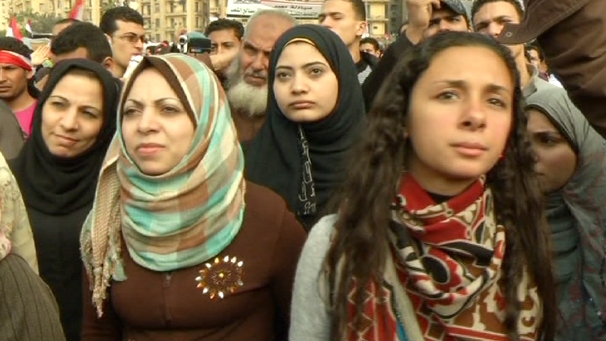
Egypt-women-day-demonstration-080311s(photo, EuroNews)

This piece was initially published in The Globe And Mail

On Saturday in Cairo, a young Egyptian female activist, Mervat Moussa, was slapped to the ground by a member of the ruling Muslim Brotherhood. Her only crime was demonstrating in front of the Brotherhood’s main headquarters. Rather than apologizing for the appalling behavior of one of its members, some officials from the Brotherhood went on the offensive, claiming that their headquarters was attacked by “a number of demonstrators who devoted their efforts to insulting and cursing the Muslim Brotherhood and its leadership using the dirtiest swear-words, provoking our young people in front of their headquarters.”

The incident occurred only a few days after the Brotherhood released a strong statementcondemning a draft United Nations declaration calling for an end to all forms of violence against women, claiming that it would lead to “complete disintegration of society.”

The two episodes are closely interlinked. The Brotherhood apparently thinks it is okay for a husband to rape his wife and asserts the need for his consent before she can travel or even use any form of contraception. It also seems to view Egyptian girls and women who protest their rule as bad Muslims – that is, Muslims who dare to challenge the social code of conduct that the Brotherhood wants to impose on society.

Despite their facade of modernity and their self-described “renaissance project,” the Brotherhood has always held very regressive, even misogynistic views on social and women’s issues. Apart from offering loud rhetoric of equality and freedom, the Brotherhood has never put serious effort into tackling violence or discrimination against women, and has viewed with suspicion any perceived efforts to address women’s problems – such as deriding the UN Declaration’s proposals to protect women as “misleading calls to decadent modernization and paths of subversive immorality.”

Rather than embarking on a serious mission to reconcile Islamic values with the contemporary challenges that Muslim women face, the Brotherhood opted for an easier path of using its female members on two convenient fronts: Locally to garner support among female voters; and abroad as part of its media offensive to improve its image in Western countries and paint an illusion of moderation, even liberalism.

The appalling assault on Ms. Moussa, a conservative Muslim who wears the Islamic headscarf, has finally exposed the myth that the battle for women’s rights in Egypt is between liberals and Islamists. In reality, it is a battle between one camp that uses religion as a tool and another one, equally pious, that wants to detach religion from the political equation.

Mervat Moussa did not head out to the Brotherhood headquarters to reject Islam, or to demand sexual freedom, but to protest the Brotherhood’s arrogant alienation of other political parties and its oppression of political debate. The slap on her face, in a way, symbolized a bigger slap and a sense of betrayal felt by a wide section of society. Egyptians witnessed how their elected Muslim Brotherhood president and his party have opted for domination rather than consensus in their gallop to consolidate their power, and in the process have adopted many of dictator Hosni Mubarak’s policies. Egyptian women were the first to bear the brunt of those policies.

Since the collapse of the Mubarak regime, the Muslim Brotherhood has not made a serious attempt to confront any of the mounting challenges that Egyptian women currently face; instead, it has used these challenges as weapons in its battle against its opponents. For example, with regard to thesexual violence that has become a daily peril for women in Egypt, the Brotherhood blames the opposition parties for failing to secure their demonstrations and allowing “thugs” to attack women.

In addition, the Brotherhood has refused to condemn other Islamist parties that went even further, instead blaming the women themselves for the harassment, claiming that women go to Cairo’s Tahrir Square not to protest, but to be harassed.

The differences between the Muslim Brotherhood and other Islamist parties, such as Salafists, are merely tactical, not ideological. The Islamists may allow women to wear colored garments and to expose their face (as opposed to the all-concealing niqab demanded by the Salafists), but beneath the surface, their core values and attitudes do not differ fundamentally.

According to a Brotherhood family expert: “A woman needs to be confined within a framework that is controlled by the man of the house.” He also added: “If a man beats his wife, she shares 30-40% of the fault.” Such views are endorsed and affirmed by various Salafist groups, and they confirm the fears of many that women will be the first to pay a hefty price for the rise of the Islamism in Egypt.

Ironically, Saturday was also National Women’s Day in Egypt; on that day in 1919, 300 women led by Hoda Sha’arawi joined the revolution against British occupation, and saw the death of Hameida Khalil, the first woman to die in the uprising. Four years later, on the same day, Hoda Sha’arawi called for the first Egyptian Women’s Union.

It took Egyptian women years to gain their full rights, and they have no intention of giving up on them. Nor do they have any desire to conform to a new oppressive social code that is based on twisted misinterpretation of Islamic values.

Islamists can slap one woman or denigrate others, but sooner or later, they will have to come to terms with the simple fact that Egypt is bigger than their project, and most of its tenacious women will continue their fight against all form of discrimination.3

Posted in Egypt, Islam | Tagged , , , | 20 Comments

Egyptian Aak (Week 11): When Fecklessness is An Attitude.

Bakers(Bakers protest in front of Ministry of Supply via  Elijah Zarwan)

Main Headlines

Monday

Tuesday

Wednesday

Thursday

Friday

 Saturday

Sunday

A Few Thoughts 

“Egypt is hanging by a thread.”  I doubt anyone inside or outside of Egypt would argue with Steven Cook’s views. However, if he asks Egyptians and other pundits for reasons why the Egyptian revolution has reached such an abysmal state of affairs, a wide divergence of opinions would quickly surface. Potential answers would include: the Islamist leadership, the opposition, the army, the list is going on and on. Again, Steven Cook was right in his piece last week when he described the opposition as feckless. Indeed, they are, but they are not the only ones. Fecklessness has become a common attitude in Egypt, and virtually all of the players in Egypt’s political arena are acting this way. In fact, this fecklessness is largely behind the sprout of violence that risks dragging the country right into the deep end.

The so-called citizen’s arrest power is just one example of this “creative fecklessness.” The decision of the public prosecutor to grant citizens the right to arrest vandals was warmly welcomed by nearly all Islamist political groups and parties, who passionately defended it as “an effective” alternative to secure Egypt in the absence of a “reliable” police force. Their argument appealed to some Egyptians, who already distrust the police and the entire security apparatus, while many others have raised the alarm bell, citing the dangers of such a move. For example, al-Gamaa al-Islamiya now deploys its members in the city of Assiut, south of Egypt to “maintain security.”  Ironically, that is the same group that killed 21 policemen in the same city in the early eighties.

The whole debate has reminded me of Naguib Mahfouz’s novel, “Children of Gebelawi,” with its stories of “the Fetwa, or the good thug,” who restores law and order in his neighborhood. Some of the Islamists who detest Mahfouz, have even described him as an infidel for writing the above novel, but yet have decided to resurrect a few chapters from his book and implement it on the Egyptian streets. Their passion for defending the idea highlights a lack of understanding of the simple basic roles of governance. If any man with good muscles and “good intention” can play the “good cop role,” then all countries should close their police academies and save money on training a police force. The pitfall of this dangerous approach is what happened sunday in Mahalla is evident in this gruesome video.

Meanwhile, there is still no public inquiry into the death of Egyptian soldiers in Sinai, despite a leaked report blaming Hamas. Hamas has denied the accusations, and the Egyptian government seems unwilling to challenge their claim. Interestingly, Hamas leader Khalid Meshaal met the Supreme leader of the Muslim Brotherhood (and not any formal Egyptian official) on Saturday, and  vow non-interference in Egyptian affairs.

The Islamists’over-simplistic views extend to every other tenets of the modern state. Morsi’s edict (regardless of his intention) reflects a disturbing ignorance on what legitimacy means and what a democratically elected president should or should not do. Even in matters related to the economy, the recent witch-hunt against the most successful businessmen in the country, the Sawaris family, has raised many question about the fairness of Egypt‘s current leadership. As Naguib Sawaris tweeted, “Why did the revenue office not investigate other companies in the same situation?” It seems that the Islamists have forgotten that Egypt, as a country, is impossible to run with the same simple, crude roles that govern a grocery shop or a vegetable stall on the corner of a Cairo street where raw prejudice, and dirty fights are the prevailing theme.

The recent Muslim Brotherhood’s statement against the draft proposal of the UN Declaration on Women’s Rights is another stark example. Beside the fact that the Brotherhood thinks it is ok for a husband to rape his wife, they believe that if a man beats his wife, she shares 30-40% of the fault. Interestingly, and as Mahmoud Salim wrote, “their objections are more inferred from the spirit of the draft document than from the document itself, and object to topics that weren’t even mentioned in the draft.” The Brotherhood’s seemingly pre-emptive attack against the draft declaration, aimed at rallying other Muslim states has backfired, exposed their real disturbing, misogynistic ideas as well as their hypocritical approach. At the end, Muslim States, including Egypt agreed to the UN document, and the Brotherhood embarrassing rant has led to nothing, but minor modifications to the original draft. If that is not feckless, then I do not know what fecklessness is.

The same attitude has also spread to youth groups. For example, Issander el Amrani wrote about the Ultras and how they have become “little more than anarchists.” Other groups are equally guilty; violence gradually has become permissible, just as sexual harassment became permissible among some. Slowly, Egyptians are shredding their centuries-old peaceful values to justify despicable behaviors under various excuses.

Underneath a cloud of fecklessness, ordinary Egyptians are struggling to feed their children amid a growing fuel crisis, while watching their dreams evaporate. For them, there is no light at the end of the tunnel and the future appears to be a choice between black, bleak and beyond.

Egyptian political life has always been as arid as its desert. Now, Egypt is now facing one of the biggest sandstorms of its political history. Rather than protecting the country from the impact of such storms, the Islamist leadership is using the dust to fight their perceived enemies.

Indeed, Egypt is hanging by a very brittle thread; the question is, who will step forth and save it? Or cut it?

Good Read

Also, here are Jayson Casper prayers for Egypt.

Finally, I leave you with this video of a Muslim Brotherhood supporter slap a female demonstrator near the Brotherhood headquarter in Moqattam. I shall leave it to you to judge:


Posted in Diary of Aak, Egypt | Tagged , , , , , | 1 Comment

Tweets and Maladies: The Case of Samira Ibrahim

Samira photo2

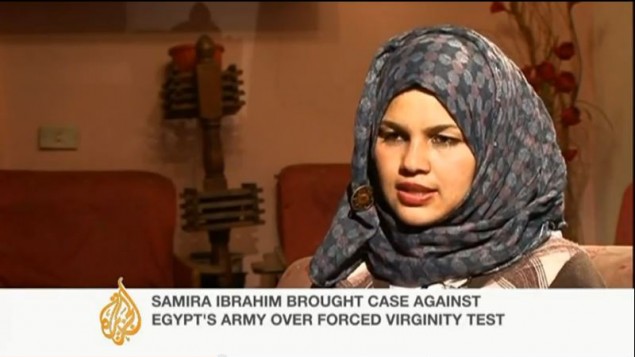
(Photo Al-Jazeera English)

Initially published in  Tahrir Squared

Samira Ibrahim: a tragic tale of courage and bigotry. As a young Egyptian activist, she stood up against sexual exploitation and the virginity tests in Egypt carried out by army personnel under the rule of the Supreme Council of the Armed Forces (SCAF). As such, many eyebrows were raised when Samuel Tadros, research fellow at the conservative think-tank, the Hudson Institute, published an article on Ibrahim’s anti-American and anti-Semitic comments, leading to her name being dropped from consideration for the U.S. State Department’s International Women of Courage award. After returning back to Egypt, empty handed, Ibrahim said in an interview to an Egyptian TV channel: “I admit my fault: I should not have accepted the award in the first place.”

In another twist, the New York Times’ Robert Mackey, who also reported on the story, latertweeted Tadros, enquiring about his religious background: “Is it correct to say you’re from Egypt’s Coptic Christian community? If so, does that inform your criticism of Islamists?” The exchanges that ensued on Twitter went far beyond Mackey and Tadros, and included some Egyptian activists online as well.

There are quite a few lessons to be learnt from this unfortunate episode, which go far beyond one or two people.

First: we must admit that Ibrahim is not an isolated example. The level of anti-Semitism has sharply risen in Egypt over the last few decades; a phenomenon that has emerged after decades of oppression and ignorance, as well as effects from the Arab-Israeli conflict. Coupled with conspiracy theories, this has resulted in a hateful discourse that was neither addressed, nor corrected, by large swathes of Egypt’s political and religious leadership. It was interesting to watch Ibrahim saying: “I did not know that there is a difference between Zionism and Judaism, and I don’t hate Judaism as religion.” It is a weak argument – and one that ought to have been critically evaluated by the presenter. Cheering for any death is unacceptable in Egypt’s cultural traditions, as well as its religious ones, including Islam.

Second: it is crucial to remember that Ibrahim is now part of a bevy of others who have tried to deny their own invective comments. She joins many Egyptian politicians, including President Morsi himself, who only a few weeks ago claimed in Germany that his anti-Semitic remarks “had been taken out of context.” Such lack of courage is part of the poisonous parcel of post-Mubarak Egypt, where too many, from members of the political establishment to the activist youth, do not have the courage to admit their own mistakes. Ibrahim, however, went even further. Not only did she refuse to renounce her comments, she claimed that her account had been hacked. After she realized her hacking claim was unsustainable, she then claimed she, “refused to apologize to the ‘Zionist lobby’”. That has only lost her more respect, and cast further doubt on her integrity.

Third: the suggestion by some that it is possible to honour Ibrahim’s battle for her stance against the military, while condemning her anti-Semitic remarks, is simply wrong. Although we might want to honor the action, the award and the associated prestige ultimately go to the person. Just as in professional life, a fall from grace may not just result from an unprofessional mistake, but also from scandal and individual failings. Can an award for courage be given to those who try to cover up their mistakes? Moreover, could the Department of State in the U.S. congratulate someone who exhibited such public and vehement anti-American sentiment?

Fourth: rejecting conspiracy theories. The role of the U.S. administration (if any) in managing post–Mubarak Egypt has been a subject of wild conspiracy theories by both Egypt’s Islamist leadership and non-Islamist opposition. If both camps reflect on Ibrahim’s case, it highlights the mismanagement of both the State Department, and the U.S. embassy in Cairo. Both failed to do basic background checks about Ibrahim, which would have avoided them this embarrassment. Surely, such performances do not merit the notion that the United States has such deep knowledge about what is truly happening within Egypt, or that the U.S. has the seemingly limitless power that many conspiracy theorists attribute to it.

Fifth: while the exchange between Mackey and Tadros was hardly an internal Egyptian affair, it did touch on Egyptian internal dynamics – mostly positively, ironically. Egyptian activists saw the exchange, and jumped in, criticizing Mackey’s Tweets. In calling him to account, they also showed that some members of the Egyptian activist and Twittersphere communities have certain principles. Mackey indirectly labeled Ibrahim as an Islamist, in all likelihood because of Ibrahim’s religious conservatism indicated by her wearing of a headscarf. The activists debunked that false correlation, making it clear that the idea political Islamism is actually Islam is false. Egyptians are generally conservative; many women, like Ibrahim, wear the Islamic headscarf; but the same women, like Ibrahim, are not necessarily supportive of Islamist parties. There is a fundamental difference between Islam or religious conservatism, and Islamism – and Egyptians are not wont to confuse between them. In a time when political Islamists try so hard to make them equivalent for political goals, this is another positive move.

More inspiring than that was the insistence of some Egyptian activists online to criticize Mackey on his enquiring about Tadros’ religious affiliation. A journalist of Mackey’s caliber ought to know better than this – surely he would think twice before writing a similar tweet to a Jewish American researcher?  Furthermore, Mackey tried to link between Ibrahim’s Tweet about Coptic Egyptians prior to this episode, and a report Tadros wrote. While Mackey later explained that he was trying to “understand the dynamics,” and to find out “whether tension between the Muslim and Christian communities in Egypt was a backdrop to the story”, the response was clear from manyEgyptians in the Twittersphere. On both counts, Mackey received resounding criticism from many Egyptians, who rejected the engagement of sectarian dynamics in such an issue – that in itself is something to be positive about.

Finally: people’s affiliations, and whether or not they ought to be relevant to the impact of their work, or how their work is assessed. Some Egyptian activists raised the affiliation of Tadros with Hudson, perceived as a conservative and pro-Israel think-tank, in the midst of this episode – is this really relevant? Had the same story been broken by the American Civil Liberties Union, for example, would it have made a difference? All of these are legitimate questions, which no one has really sought to address.

In a way, Ibrahim’s fall from grace reflects how some of the members of the protest movement that began in Tahrir Square have lost their once dignified and romantic image. Egyptians are brave, courageous, and willing to explore taboos; but they also are not saints. Rather, they are the byproduct of oppression, ignorance, and an often-poisonous environment. Their various strengths and weaknesses have collectively led to the current mess engulfing Egypt.

The whole episode of Ibrahim’s saga should be taken as a learning opportunity. It is also a chance to appreciate the complexities of Egypt; to honor integrity, and fight the maladies, including bigotry, left over from Mubarak’s miserable heritage. The quest for freedom will not be achieved until all Egyptians confront their own demons, and learn from their mistakes. Thus far, it seems Ibrahim, and many others, are learning the wrong lessons.

Posted in Egypt | Tagged , , , | 1 Comment

Egyptian Aak: Week 10

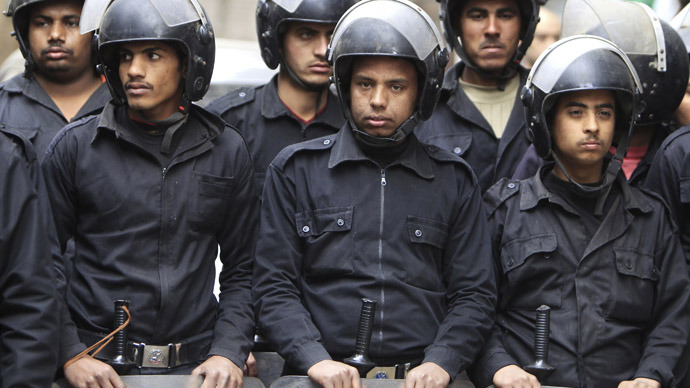
egypt-police-chief-strikes.si(Egyptian riot police, Reuters/Mohamed Abd El Ghany)

Main Headlines

Monday

Tuesday

Wednesday

Thursday 

Friday

Saturday

A Few Thoughts

This week, I would like to introduce you to a new Egyptian term: ‘Bazramit,’ which mean a collection of clashing ingredients in a one tasteless recipe. As I have already have written about the military and the opposition parties in separate pieces, I would like to devote this week’s thoughts to another key ingredient in Egypt’s unique Bazramit: The Police and the security apparatus.

There are evolving, volatile dynamics inside Egypt’s police and the security apparatus. On one hand, the clashes between the police and protestors continued throughout the week; on the other hand, there is an internal struggle between police officers and the Muslim Brotherhood-appointed Interior Minister. The strike of police officers is a unique development in the history of Egypt.

The collective outcome is the inevitable collapse of law and order with businessmen (or what is left of them) and the general public resorting to paying protection money (usually to thugs and gangs) to defend their private properties.

The Islamists’ solution came in the form of calling for the formation of “popular committees” to maintain law and order in the absence of police forces. They cite the 28th of January, 2011, as a previous successful example of this experience. It is true that Egyptians stepped in to fill the security vacuum when ex-Interior Minister Habib al-Adly withdrew the police from the streets during the 2011 revolution; however, it is crucial to understand that it was a very short-term situation that only lasted a few days, and is impossible to reenact now in a society divided and extremely polarized. It will only lead to rough justice that can easily compound the anarchy and result in a bloodbath.

It is worth noting that the violence in Port Said has eased off, despite high tension following Saturday’s court verdict after the army’s quiet take-over of the city from the police. This calm is in stark difference to the on-going violence in Cairo, where members of football fans (Ultras) are still clashing with the police. Also it is crucial to highlight that the army’s control of Port Said happened without a formal announcement from the President’s office, an event which raised the question of whether the Ministry of Defense has acted alone or in coordination with President Morsi.

The story of Eric Trager (Fellow in the Washington Institute) and the Muslim Brotherhood leader Beltagy, about his possible role in restructuring the Interior Ministry (covered here by Zeinobia ), has attracted a lot of attention in Egypt. Beltagy accused Trager of twisting his words but Trager calmly confronted him on the Egyptian TV Channel ONTV, where Beltagy behaved in a very unprofessional manner, even piling on some racist hints. At the end of the saga, many in Egypt were convinced that Beltagy did not speak the truth and Eric Trager gained more Egyptian followers on Twitter.

A few points I may add to the story:

  • Beltagy was a member of the parliamentary committee that was supposed to start discussing restructuring the Interior Ministry.
  • Beltagy failed to convince the public that what Trager said was untrue. Interestingly, Rotana Masryia TV and its presenter, Tamer Basouny, reported that Beltagy was spotted several days last week in the Administrative oversight officeFor those who don’t know Egypt, this is the place to start any future plan “for restructuring and reform” of any part of public service, including the security apparatus. It also houses the files of all public servants, including all police officers.

Reading through suggested plots and rumors can also shed some light on the situation. There are two postulated scenarios:

Scenario A: The Muslim Brotherhood has been encouraging the chaos to replace Mubarak’s police force with their own “militias.” In this scenario, there is the suggestion that the Brotherhood views chaos as an opportunity for acquisition of lands, buildings, hotels and factories at rock bottom prices. Many frightened business owners cannot afford paying ransom and some of them may give up and desperately try to sell (it is already happening). In addition, the police strike can provide the Brotherhood with the opportunity to dismiss all police cadres that they view as non-compliant or that have loyalties to the ex-regime.

Scenario B: this scenario is basically the opposite of scenario A;  the ex-regime, along some opposition figures and outside players, are supporting anarchists to induce chaos that will ultimately leave the army with no choice but to return back to politics and force Morsi out of power.

All these scenarios are illogical; Egyptians’ obsession with creative chaos stems from their faith in a Supreme Being. They tend to reject the concept of random chaos and see it as illogical. For them, someone, somewhere must be pulling the strings, and of course that “someone” must be from their perspective enemy; no wonder their imagination goes wild.

Interestingly, those in power indirectly admit that they are not in control, while the outsiders refuse to believe the weakness and impotence of their leaders. Moreover, all have failed to appreciate how Mubarak’s Egypt was weak and how his security apparatus was the main pillar that kept it functioning.

Police reform is a must, but timing and methods and professionalism are detrimental during such a crucial procedure in a country on the verge of chaos. The myopic assumption that simple replacement of “their guys with ours” as the solution will only undermine Egypt’s security and create another “torture machine” under new leadership. Personally, I doubt that reform can and will happen anytime soon; I also doubt it will be able to save the country from its current havoc.

Meanwhile, watch this excellent coverage by Ian Lee (‪@ianinegypt), who reports on the food crisis in Egypt. I hope it provides a rude wake-up call to those in power that one day they may found themselves ruling a pile of explosive rubble. To watch click here.

Good Read

Finally, here are Jayson Casper prayers for Egypt.

Posted in Diary of Aak, Egypt | Tagged , , , , , , | 1 Comment

To Boycott Or Not To Boycott : That Is The Question!

I wrote this piece for Tahrir Squared before today’s court verdict to suspend Egypt’s upcoming parliamentary election, still I think it is relevant and I hope it provides the leaders of opposition parties in Egypt with some food for thought. Let me know what do you think; I welcome your feedbacks and comments.

Opposition2

(Photo: AP)

“Juvenile,” “self-defeating,” “myopic,” “not smart” — since Egypt’s main opposition coalition, the National Salvation Front (NSF), has announced that they will boycott the next parliamentary elections, a sustained, ferocious barrage of criticism has been unleashed against them. The Egyptian opposition is not currently at an enviable place: youth activists are frustrated, pundits are critical, Islamists are piling accusations, and the U.S. leaders are not impressed, not to mention the valid fear of breaking ranks from one or two of the partners within the coalition umbrella.

There are good reasons to criticize the Egyptian opposition; their performance since the fall of Mubarak’s regime has been shambolic, to say the least, for many reasons: the lack of clear strategy, being led by the protest movement, and the inability to provide the Egyptian public with a viable alternative to the Islamist project. There are also legitimate questions about the validity of a boycott as an effective tool for political gain; the experience of boycotting in Latin America for example, could be used to highlight the risks of boycotts. Even the Egyptian experience over the last two years demonstrates how a campaign of active boycotting may not be successful or even popular among the public.

However, it might be more beneficial to look at the issue from a different perspective and discuss what the opposition would gain from participating in the upcoming parliamentary elections. This might help settle the question of whether a boycott should occur, while avoiding the pitfalls of faulty parallels.

There are three possible outcomes for the NSF if they decide to run in the elections:

A bad loss: This would be the case if the NSF fails to match the previous results of the 2011 election, when the parties within the NSF gained about 25% of the seats. This is a very plausible outcome, despite recent hopeful speculations of better results:

  • Although there is a growing resentment against the Brotherhood among the public, there is not enough evidence that this resentment will be channeled towards more votes to the NSF. The opposition, with its current fragile structure and internal divisions, stands a greater chance to perform badly in the next election, as many of its supporters are not impressed with its current performance. Additionally, to many, the NSF remains either an unknown entity or an unpopular one: according to a recent new poll by the independent Egyptian polling group Baseera, some 35% of Egyptians have never heard of the NSF, and among those who had, only 35% said they supported the opposition group. This dissatisfaction may be compounded if the NSF revokes its boycott without gaining any compromises from President Morsi on their already-stated demands.
  • Some may argue that the division among the Islamists and the recent fall out between the Salafi Nour party and the Muslim Brotherhood could benefit the NSF. This is unlikely for two reasons. On one hand, the presence of liberal opponents fighting for seats in the parliament would encourage the Islamists to rise above their differences, and unite against the liberals in every contested seat. On the other hand, the core supporters of the Islamists may prefer to shop around between the Muslim Brotherhood and the various Salafi parties; abandoning the Islamic project and voting for a non-Islamist party is highly unlikely.
  • Undecided voters are another factor; there are many speculations about how this significant section of the Egyptian public will vote. Some may swing to the right and vote for any of the Salafi parties, which is a very viable scenario in rural areas where disenchantment with the government is high; others, may decide to stay at home and not vote at all. There are no reasons to believe that the turnout in the next parliamentary elections would be better than that of the constitutional referendum (32%). Bearing in mind the wave of civil disobedience, particularly in the Canal region, a de-facto boycott with less than 25% participation is a valid possibility. Can one imagine an election campaign in Port Said or Mansoura? It is difficult to entertain such an eventuality.

A loss but with consolidated gains: Can the NSF match their 2011 performance or even do better? The notion that the opposition may make significant gains in the elections is highly unlikely to become a reality if the Brotherhood refuses to compromise and insists on rejecting the main demands previously put forward by the opposition’s representatives. Therefore, it is very important that the NSF secures some pre-election gains to boost its popularity among the public.

Even if the public rallies behind the opposition and they manage to gain a decent number of seats, how would this benefit the opposition? Will being in parliament be better than their current political existence, restricted to TV studios and press conferences? Again, this is doubtful. Surely, the bickering would move from the TV studios to the parliament but the outcome would remain unchanged. Any perceived liberal clause in any proposed law will be contested, and vetoed by the Brotherhood and the Salafists.  It is hard to conceive that the opposition would stay united after the election, playing a successful role in dividing the Brotherhood and the Salafis under the Parliament’s dome, when they have clearly failed to do so outside of the parliament.

An election victory: The NSF scoring an election victory is highly unlikely. A united NSF that manages to gear enough support to beat all Islamist parties and win the majority of seats in the parliament (even with a narrow margin) would be an improbable outcome. It is also doubtful that a victory by the NSF would save the country or end the turmoil for many reasons, including:

  • The first outcome of any opposition victory is its formal disintegration, and endless bickering among its parties about what to do next. There is no common vision between the leftist, liberal, and ex-regime (Felool) parts of the NSF, other than their vehemently anti-Muslim Brotherhood stance.
  • An opposition-dominant parliament would still have the Presidency to deal with, and would also have to deal with the Islamists parties that will almost certainly dispute the results, blame it on the current wave of violence, and engage in a ferocious fight to regain power.
  • On the other hand, the most important challenge for a victorious opposition would be inheriting the current government’s mess, with the ticking bomb of the collapsing economy and the disintegrated law and order. It is almost impossible that the drained opposition after a fiercely contested election would have the time to provide a clear alternative plan to deal with both eminent challenges without turning the public against it.

Egypt is living proof that one cannot manufacture an ideal government or an ideal opposition; rather, one must deal with what one has at the moment and make decisions that could be painful and even risky. Judging by Egypt’s haphazard politics, the NSF’s fragile unity, and without serious compromises from the Brotherhood’s leadership that can diffuse the current inflammatory dynamics, a tactical boycott of the upcoming parliamentary elections by the NSF appears to be a wise option.

Nonetheless, it is crucial to understand that a boycott will not stand any chance of success unless all opposition parties are united in adopting it. Any last-minute break of the ranks, with one or more parties deciding to run in the election, would be suicidal with irreparable, long-lasting damage.

In this scenario, a boycott can be viewed as a form of sabbatical leave to break up with the politics of bickering and violence, and to allow the opposition to reset their own playbook away from the current majoritarian game of the Brotherhood. The opposition must dissociate itself from the growing wave of violence in Egypt, and initiate a different, well-orchestrated, “peaceful,” civil disobedience campaign, including an economic boycott of products, and businesses of the Islamist elite and their interests around the country. Such a campaign would help each sub–group within the opposition umbrella to boost its popularity base. It would also convince the public that the NSF is not just after any victory, but after effective, cleaner politics away from the Islamists’ opportunism and monopolistic approach. Such a boycott campaign is not without its risks, but the same can be said for participation in a dodgy, violent election process. Islamists have sucked the oxygen out of Egypt’s political scene; it is about time for the opposition to reorganize and come back with some fresh air.

Posted in Egypt | Tagged , , | 1 Comment

Egyptian Aak: Week 9

pro-army demo

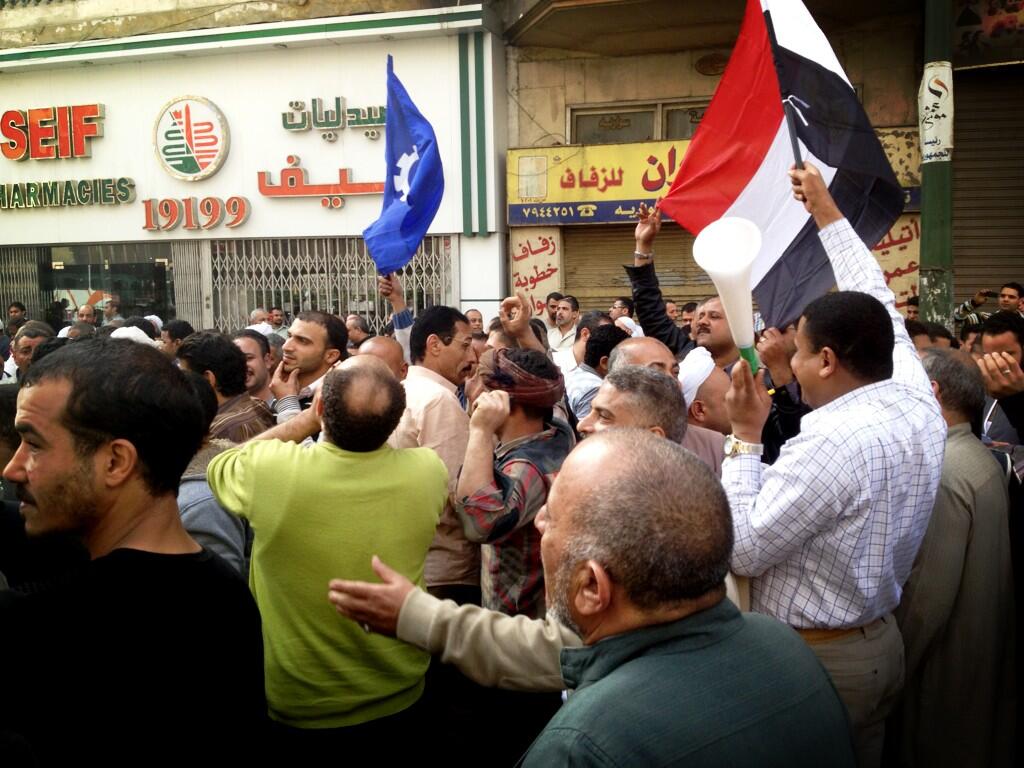
(Friday Protestors demanding the return of Military rule. Photo, the Daily News Egypt)

Main Headlines:

 Monday

Tuesday

Wednesday

Thursday

Friday

Saturday

Sunday

 A Few Thoughts

Who wants the Military?

 Have a look at the above photo; are those the liberal elites of Egypt? It is a myth that only liberals demand and hope for the military return to political life. In fact, it is the ordinary Egyptians who are struggling to get their basic daily needs met, and view the army as the only disciplined party that can restore some law and order back.

 One of the best metaphors I heard this week was about the Port Said stadium tragedy and how it represents the current political arena, where politicians abandon the rules of the game and resort to bloody, dirty tools to win.

 The symbolism of signing proxies and petitions should not be overlooked. In 1919, Egyptians collected proxies in support of their revolution leader, Saad Zaghloul, who fought against the British occupation. Sadly today, many view the Islamists as occupiers who want to change the soul of Egypt with an ongoing soft revolution against them but there is no Saad.

 I have argued in my last piece that the Military cannot save Egypt and I still stand by my opinion, although I am deeply alarmed by the dismissive attitude of the Brotherhood of the whole pro-military campaign, it reminds me of the pro-Mubarak, and their underestimation of the degree of public resentment against them.

A prominent member of the Brotherhood went even further (check headlines), and accused military leaders of killing its own soldiers in Sinai, this outrageous accusation was later denied, despite a circulated video on social media, nonetheless, it reflects the mindset of some of the Brotherhood members.

 National Dialogue:

 One of the most entertaining events this week was the live broadcast of the so-called National dialogue. Participants have competed with each other to blame the media for nearly all the problems of the political scene. The Salafi Nour party emerged from the “dialogue” as a fierce opponent to the Muslim Brotherhood, in what appeared to be a rehearsal for forthcoming confrontation in the future parliament. Well, good luck!

 Despite its futility and its failure to come up with any results, I still blame the non-Islamist opposition for not attending, at least for the first round; it was a missed opportunity to expose the Islamists in front of the general public.

 Simmering Violence:

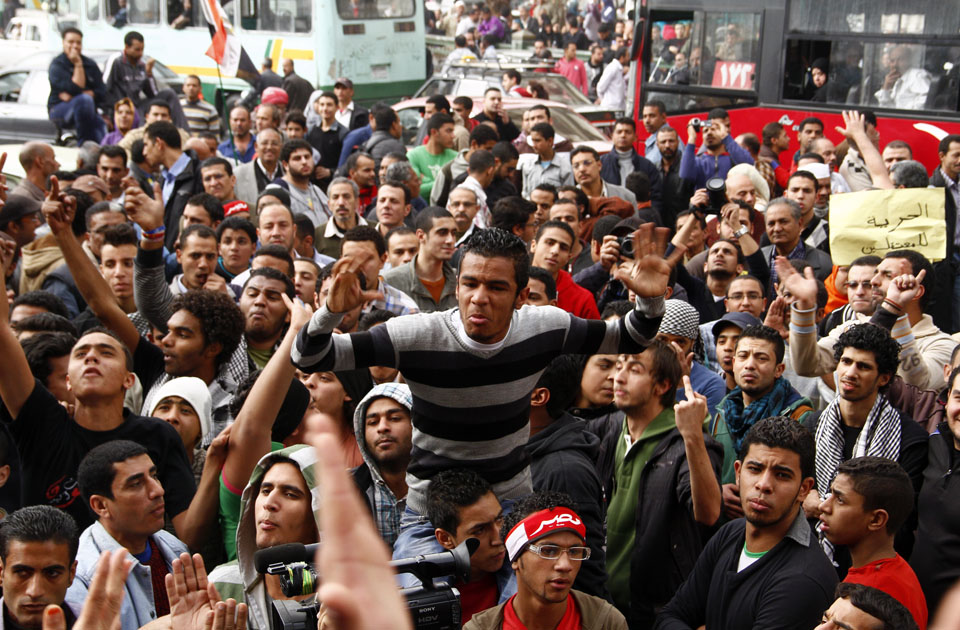
 It is no longer news that violence has become a part of the daily life in Egypt, not just between protestors and the police (Mansoura as one example); but even what was once a civil exercise of a Syndicate election has now been marred by clashes among participants. It is no exaggeration that Egypt has become a tense society and can easily descend to “a nervous breakdown.” Of course, the Brotherhood continues to dismiss the symptoms and signs, and claim that “anti-revolutionary forces” have every intention to derail the country; going with that logic, those evil forces love to be capitated by armored vehicles and tear gassed day and night. The Islamist leadership dismissive attitude toward the growing tension in many of Egypt’s provinces will bread more violence and could disrupt the next election. The assumption that violence will ease on election day is simply. reckless.

Sunday Clashes

Tonight clashes in Port Said mark a new turning point; for the first time and despite formal denial, there are many leaked reports of clashes between the army and security forces. The city is rife with rumours, and it is difficult to know what has happened exactly, but the worse may yet to come, as the final verdict in the football tragedy is expected next Saturday. for more details read  Zeinobia‘s blog piece.

 ID Cards Scandal:

 The intriguing story of a the ID printer that has been lost since the collapse of law and order in Sinai during the January 25th revolution, only to be found by chance when security forces this week raise a legitimate questions; how many fake I.D. cards were printed by this machine? Is there any link between it and the court case filed by an ex-MP that alleged that 9 million votes in the previous referendum were duplicated due to use of a fake I.D. (same person with several different home addresses). The verdict in this case is due next week and I think it will be interesting. Hamas has denied any link with the story. Gaza is not just Hamas, but Hamas is the responsible governing body that rule Gaza.

 Sectarianism

 The ongoing sectarian tension in Egypt is not new; sadly, it has been on-going for decades, remember the church of Imbaba? The differences now are three factors: a powerful Salafi movement, a complacent government, and the collapse of law and order. There are other stories than the church of Kom Ombo that were covered by the English media and another story from Bani Souef was reported in Arabic media. Although the reason for the clashes are well known, usually, they are sparked by disputes over rumors of conversion, Muslim-Christian love affairs and the construction of churches; yet, nothing have been done to solve or prevent it.

 The reason behind sectarianism in Egypt also highlights one fundamental difference between Muslims and Islamists. Muslims believe the right to leave Islam is entrenched in the Quran: “So let him who please to believe, and let him who please disbelieve,” while Islamists deliberately ignore the verse, despite their passion with literalism, and create sectarian fights just because of alleged conversion to Christianity.

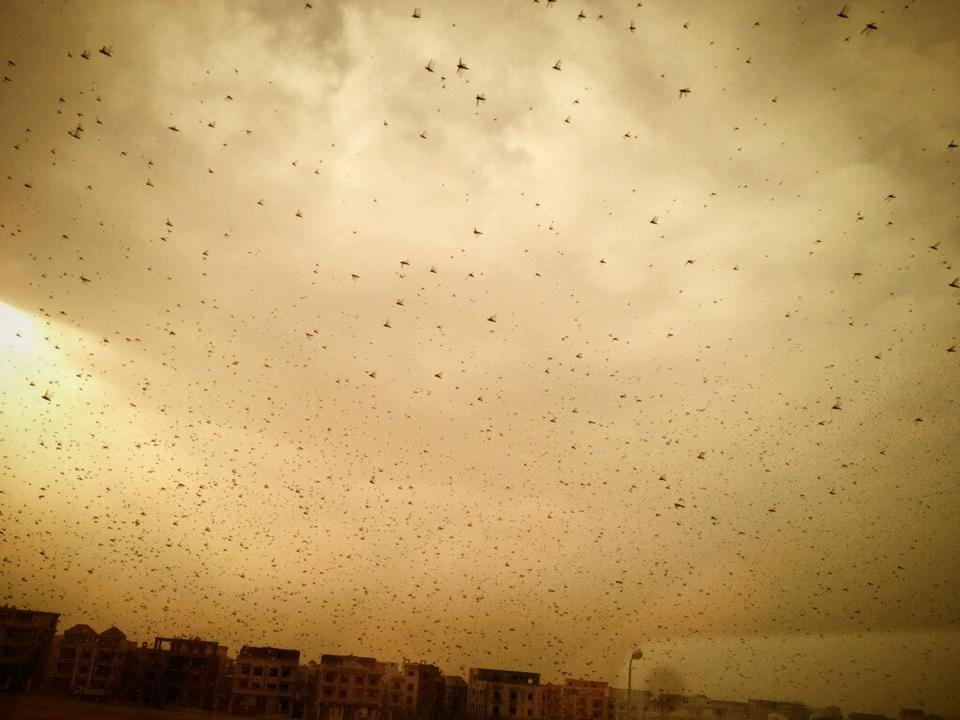
The 8th plague of Egypt?Locusts

 There is nothing more symbolic of the dramatic era that Egypt is currently witnessing more than the swarms of insects that stormed Cairo this weekend. It is new; Egypt had bad infestations in 2004. Why the government did not formulate a preventative plan since 2004?  The  best answer I heard was, Locusts are the soldier of God.

 For Kerry’s visit, and the opposition boycott, I would rather write about these in  separate pieces in due course.

Good Read

Also, here are Jayson Casper’s prayers for Egypt

Posted in Diary of Aak, Egypt | Tagged , , , , , | 3 Comments

The Military Cannot Save Egypt


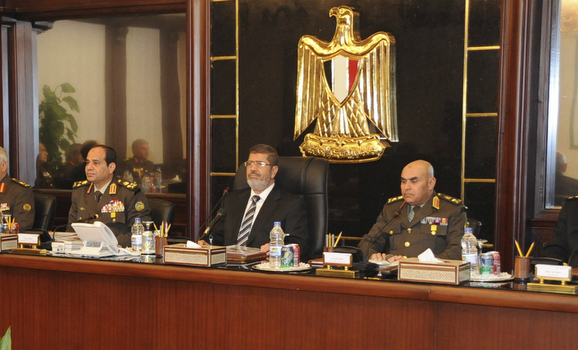
Egyptian President Mohamed Mursi sits next to the head of the Egyptian military General Abdel Fattah al-Sisi and top military and police chiefs during their meeting in Cairo

(Photo by Reuters, Egyptian President Mohammed Morsi (C) sits next to the head of the Egyptian military General Abdel Fattah al-Sisi)

This piece is initially published in Al-Monitor, I hope it can open the debate about the potential army rule in the current crisis in Egypt.

 The political news from Egypt has been dominated by reports of tensions between the powerful military and the country’s Islamist leaders, with news recently leaking that the Supreme Council of Military Forces (SCAF) has been meeting without President Mohammed Morsi to discuss the ongoing political crisis. Cairo is rife with rumors, speculation, and endless debate among the public as well as the political elite about how the military will react to the current turmoil, particularly if the situation escalates and results in more uncontrolled violence and chaos. It seems that many are considering “some sort of intervention” to be almost inevitable at some stage in the future.

Since the election of President Morsi and his surprise firing of Defense Minister Husain Tantawi, the military, with its new leader, Gen. Abdel Fattah al-Sissi, has adopted a well-crafted policy of watching closely from a distance and inserting itself only when deemed absolutely necessary. Al-Sissi, who was initially considered to be the Muslim Brotherhood’s man in the army, has proven to be a man who speaks his mind. He is endorsed by his soldiers and is not shy about vetoing ideas he perceives as inappropriate or dangerous to Egypt’s national interest (at least from his perspective). The ministerial decree turning Egypt’s border with Israel and the Gaza Strip into a five-kilometer-deep closed military zone and flooding the Gaza smuggling tunnels are just two examples.

So what’s next? What if uncontrolled violence erupts? Will the army remain neutral? The options available to the army are not as numerous as many assume. Each has its own risks and dangers and a good chance of failing. To continue reading click here.

Posted in Egypt | Tagged , , , , | 2 Comments

Egyptian Aak: Week 8

week 8 photo

(Protesters outside of prosecutor-general office Feb 22 by Mai Shaheen. Ahram online)

 Monday

Tuesday

Wednesday

Thursday

Friday

Saturday

A Few Thoughts

Election Law:

This week we witnessed another episode from the ongoing legislative struggle between The Supreme Constitutional Court (SCC) and the acting parliament (Shura Council). The SCC ruled many provisions of the proposed Elections Law and Exercise of Political Rights Law as unconstitutional. The Shura Council wasted no time; they convened, and within an amazingly short time, completed the new amendments in less than 48 hours, followed by an announcement from the presidency setting election dates. Egypt’s Source has 2 interesting pieces about the crisis:The unconstitutionality of the election law, and the potential upcoming crisis as a result of article 177 of the constitution.

Another aspect of the court verdict that many overlooked but that Evan Hill mentioned in his comprehensive summary is military service service. It is well known that many Islamist activists were deferred (often permanently) from military service for “security reasons.” The SCC stated that military service is a must for any candidate, thus denying many Islamists the right to enter the parliament because they were once considered risky to national security by Mubarak’s regime; this is a clearly unjust view, but revoking it without assessment of individual cases is not necessarily justice. As the Shura council has decided to ignore the SCC’s verdict regarding military service, Egypt might elect MPs with direct links to terrorist groups including many already flourishing in Sinai.

To Boycott or Not to Boycott?

There is some logic behind the opposition call to boycott the election. Previous experience predicts an Islamist collective majority in the next parliament; therefore, participation would only grant legitimacy to the election, which the Brotherhood will use in the international arena to enforce its image as a group of democrats and secure loans and cooperation.

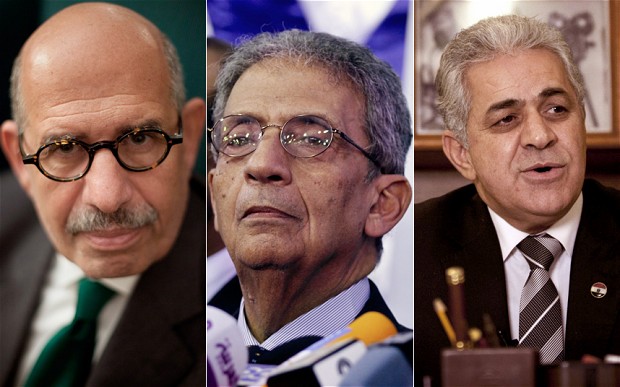
In addition, the Brotherhood has tried to stir division between the reformist and the revolutionary camp within the national coalition, which is why leaders like ElBaradei has opted for unity and sided with Sabahi, who will probably boycott the election regardless of circumstances.

The long election process, together with the current despair among ordinary Egyptians and the wave of civil disobedience (which starts to spread to other provinces) will probably result in a low turnout; the statement of Rafiq Habib regarding civil disobedience reflects the fears of this potential risk. That is why I find the Egyptian case to be exempt from the common wisdom that boycotting is a bad idea, and I think a boycott may be effective this time.

Port Said

The ongoing turmoil in Port Said is a powerful example of Egypt’s failed leadership. As civil disobedience in the city has entered its 7th day, the Egyptian leadership’s response, apart from tired rhetoric of praising “the defiant city,” included an announcement of a development plan with allocated LE400m to the Canal provinces and a proposal to reopen Port Said’s Duty Free Zone. This prompted an angry response from Port Said, as many viewed it as a cheap bribe and wondered if this is the value of their victims in the eye of the Egyptian government. The people of Port Said wanted justice, accountability, and truth regarding what had really happened on the 26th of January following the court verdict that most perceived as unjust, as well as the violence that erupted after, leading to more loss of lives.

Port Said lost not only lost a trade zone, but also the privilege of exclusive trading of 100 items including textile without custom tariff. The parliament’s 2002 law aimed to shut down the free zone within 5 years has been postponing the decision ever since; however, the complicated legal situation meant that most of the privileges attached to the trading zone were effectively stopped.

The way Morsi will deal with Port Said could define his legacy and even his longevity as a president; ignoring the problem with the hope that resentment will dissipate slowly will never work. Port Said’s challenge to Morsi is thus: “either do or die.”

Economy

Discussion about Egypt’s economic crisis has become stale. What is new is the continuing delusional blunder. As the Islamists repetitively stated that loan interest rates are “un-Islamic,” they ignore the complexity of modern economics. What is even more breathtaking is hearing some of them state that Egypt has not yet reached the risky level that justifies acceptance of the lawn under the Islamic terms: “Necessity justifies the forbidden.” Clearly, news like that about the wheat supply  has not yet filtered in their minds. In addition, they maintain their obsession with Islamic bonds (that once were rejected by Al-Azhar as un-Islamic) as the Holy Grail of economic salvation.

Al-Azhar:

Another alarming trend I have noticed among political elite is to call on Al-Azhar to ratify government decisions. If we really want to avoid emulating the Iranian model, it is important not to drag Al-Azhar into day-to-day decisions. Egypt has a constitution that was made to measure Islamist demands − is that not enough?

A Question of Priorities

Remember the Brotherhood’s charming offensive during their visit to the U.S.? “I asked skeptically about alcohol, peace with Israel, and the veil. Sondos, who wears a hijab, insisted that the Brotherhood wasn’t considering any changes in these areas and that its priority is simply jobs.” Now the new ban of selling alcohol reflects the Brotherhood’s broken promises. I am not a decedent person who wants my country to sell alcohol, but I want observers to focus, for a change, on the Islamists’ flawed priorities.

Good Read

and here is Jayson Casper prayers for Egypt

Posted in Diary of Aak, Egypt | Tagged , , , , , | 1 Comment