
Top Headlines
- UAE and Egypt have announced the participation of Abu Dhabi in the Eastern Mediterranean Gas Forum as an observer
- EU Parliament calls for action over Egypt’s human rights abuses
- IMF approves release of $1.67 billion in aid for Egypt
- PA, Jordan and Egypt call for resumption of peace talks
- Egyptian court acquits men accused of stripping naked an elderly Coptic woman
- Two roadside bombs exploded in restive northern Sinai Peninsula killing three members of Egypt’s security forces
- 5,000-year-old Egyptian artefact discovered in cigar box in Scotland
Main Headlines
Monday
- Egypt says studying electricity interconnection with Cyprus and Greece
- Egypt, Jordan, and Iraq discuss peoples’ movement by land between the three countries
- Court sentences Muslim Brotherhood Hassan El-Brens to prison over illicit gains charges
- Man is sentenced to death for raping a woman in front of her husband
Tuesday
- Abu Dhabi Crown Prince Mohammed Bin Zayed to visit Egypt
- Ministry of health increased the production of liquefied oxygen to cope with the possible second wave of coronavirus
- Egypt launches website for citizens to reserve coronavirus vaccine
Wednesday
- Egypt welcomes UAE joining Eastern Mediteranean Gas Forum
- Islamic State steps up Sinai fight with bombs in civilian homes in North Sinai
- Egypt’s Sisi appoints new commander for Air Defense Forces
- Ethiopian forces killed Sudanese troops in cross-border attack: Sudan
Thursday
- Seven men are detained for sexually harassing a girl in Egypt’s Daqahliya
- Egypt expresses its condolences to Sudan over victims of cross-border attack
- Abu Dhabi National Oil Co. is interested in a majority stake in first Egyptian army-held companies being offered to investors
Friday
- Two roadside bombs were exploded in restive northern Sinai Peninsula killing three members of Egypt’s security forces
- Egyptian court acquits men accused of stripping naked an elderly Coptic woman
- Egypt’s prosecutor general orders the studying of appeal for three men who stripped elderly Christian woman
- LGBT conversion therapy: Religious leaders call for ban of “abhorrent practice’
Saturday
- IMF approves release of $1.67bn in aid for Egypt
- European Parliament calls for action over Egypt’s human rights abuses
- Egyptian, Arab lawmakers denounce European Parliament’s statement on human rights in Egypt
- PA, Jordan and Egypt call for resumption of peace talks
- Head of Egypt’s General Intelligence Service visits Libya’s Benghazi
- Governor of Alexandria self-isolates after testing positive for coronavirus
- Egypt demands Italy hand over ex-officials accused of stealing artifacts
Sunday
- Sudan-Ethiopia border demarcation talks set for Tuesday
- Bodybuilding: Egyptian Big Ramy claims the 2020 Mr. Olympia title
Reports
- Human rights breaches in China, Iran and Egypt. The European parliament
- Egypt and Iraq deepen defense ties. George Mikhail
- Egypt revives Khedive Ismail project, turns Egypt’s Downtown into Paris of the East. Baher El-Kady
From Twitter
Thread
Plus
- 5,000-year-old Egyptian artefact discovered in cigar box in Scotland


 Nervana
Macron, Sisi, and Human Rights in Egypt
“Macron says French arms sales to Egypt will not be conditional on human rights.”
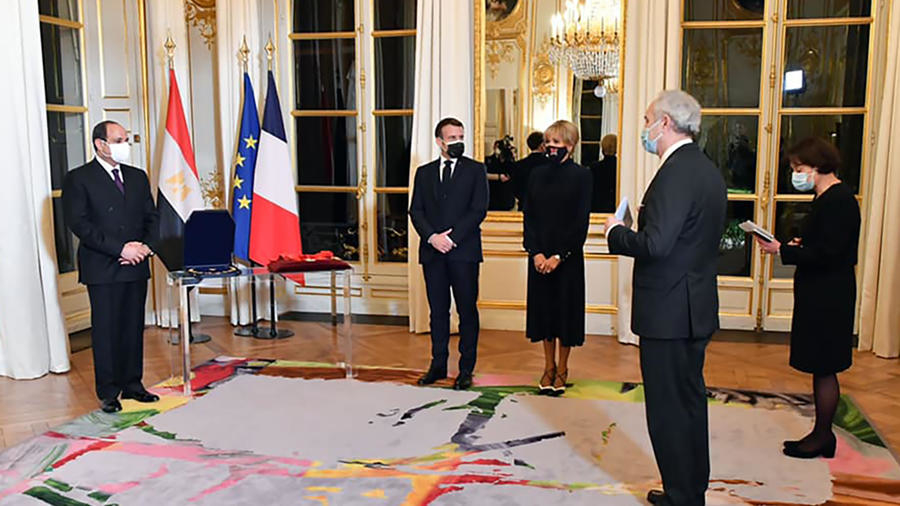
This top headline dominated Western media coverage of the Egyptian president Abdel Fattah el-Sisi’s visit to France. Regional observers took that headline as a proof of the complicity of European countries, particularly France, in oppression against human rights and democracy activists in Egypt. The reality, however, is far more complex.
I watched the joint press conference of Presidents Sisi and Macron, in which the mention of arm deals was one line, and the rest of the French president’s speech and comments to journalists were about democracy and human rights. He particularly mentioned one activist’s name and highlighted how civil society protects and empowers the state; he also passionately defended the superiority of human values above others, including religious values.
It is baffling how his words have been interpreted as a betrayal of democratic values in the Anglo-American sphere. Judging by how he openly mentioned the case of Egyptian-Palestinian BDS activist Rami Shaath, whom the Egyptian government has consistently accused of terrorist links, it is clear that Macron is unwilling to abandon human rights issues, despite his desire to forge a strong alliance with Egypt’s Sisi.
There are two approaches to addressing human rights issues in autocratic states: Either an orchestrated international campaign with threats of boycott, or with a more behind-closed-doors approach.
Human rights activists may prefer the first approach, attributing the latest release of three EIPR NGO activists in Egypt to their global international campaign. The most plausible explanation, however, is the Egyptian president’s visit to France, as Egyptian leadership would be keen to avert a diplomatic embarrassment. It is worth highlighting how similar global campaigns have failed to produce any effective results—for example, the global outrage after the brutal murder of Italian activist Regeni in Egypt. The case is formally closed in Egypt, despite conflicting statements on his death offered by Italy.
Moreover, it is disingenuous to link the French stance solely to an arms deal. According to the same Reuters report, Egypt’s arms deal with France was struck before 2017. It is highly unlikely that Egypt can afford to buy more arms from France in the foreseeable future, not only because of financial constraints, but also due to the Egyptian president’s long-term policy of diversifying military resources and not solely depending on one country for arms imports.
France and Egypt need each other for wide variety of reasons other than arms import. They both see Turkey as a destabilizing force that undermines their mutual national interests, they both see political Islamist groups as a threat to their national security, and both are keen to stop the tsunami of failed states that have plagued the region over the last decade.
The notion that Western pressure will solve human rights issues in Egypt is rather naïve, even disingenuous. Many strong advocates of harsher treatment of Sisi’s regime in Cairo are reluctant to impose sanctions on other countries with poor human right records like Turkey, the top jailer of journalists in the world, and Ethiopia, despite the brutal campaign in Tigarey that displaced hundreds of thousands of civilians. Other Western observers are keen to reach a deal with the ruthless Mullah regime in Tehran while busily bashing the human rights record in Egypt. Highlighting those appalling records of other regimes is not “whataboutism”, but rather legitimate highlighting of how cherry-picking human rights is part of the problem and not the solution. Hard-core regime supporters use it as evidence of Western bias against Egypt.
Nevertheless, if we decided to focus solely on the Egyptian case, then anyone with a basic understanding of Egyptian society would note the marked discrepancy between the loud outcries on Western platforms and the noticeable indifference among ordinary Egyptians to the plight of human right activists imprisoned in Egypt. The case of the three EIPR activists is a stark example of such an alarming gap in responses. In fact, the campaign of Scarlet Johansson has generated nothing but resentment among many ordinary Egyptians, not just regime supporters.
The systemic crackdown on human right organizations in Egypt doesn’t just stem from the oppressive regime, but also from a cocktail of toxic beliefs and confused priorities. Egyptian society has serious problem in terms of confusing human rights, religious rights, personal freedoms, and counter-terrorism. Western pressure will not improve human rights unless Egyptian society starts to care about civil rights more than the dress of a woman posing in front of the Pyramids or by a cartoon published by an irrelevant privately owned French magazine.
Until Egyptians can successfully address those issues, only families and friends of human rights activists will continue to care about human rights issues. That does not mean Western pressure is not welcomed; on the contrary, President Macron has perhaps unintentionally triggered a debate inside Egypt regarding human rights, more so than the flood of articles from Western journalists and think tanks. His closed-door approach combined with tenacious calm addressing the Egyptian public should be welcomed, not discouraged.
Share this: