
Egyptian Aak 2016, Week 32 ( Aug 8-14)

Top Headlines

  • Egypt-IMF reach staff-level agreement on a Three-year US$12 Bln  fund facility 
  • After IMF deal, Egypt’s Sisi says will not hesitate on tough reforms
  • Egypt inflation rate at 14.8% in July
  • Egypt sets jail as punishment for black market forex trading

Main Headlines

Monday

Tuesday

 Wednesday

Thursday

Friday

Saturday

Sunday

Good Reports

  • Egypt needs $5-6 billion in bilateral financing to seal IMF deal: Mission chief Lin Noueihed
  • ISIS is digging up Nazi land mines in Egypt. Peter Schwartzstein
  • The complete guide to Egypt’s 20 most promising Hend ElBehary
  • The Rabea sit-in dispersal: Whom the state is blaming three years on. Mai Shams El-Din
  • The stories behind Egypt’s Olympic Champions. Mai Shams El-Din
  • Nationalism and generosity fuel the defense of Tiran and Sanafir. Beesan Kassab
  • Why do sectarian tensions run high in Minya? Heba Afify
  • Clash: An awkward movie that suits an awkward situation. Andeel

Good Read

  • ISIS brings Egypt and Israel even closer. Yossi Mekelberg
  • Fractured lands: How the Arab world came apart.  Scott Anderson

 From Twitter

https://twitter.com/basildabh/status/764890619013726208


Statement

 Interview

Plus

Photo Gallery

Finally, here are Jayson Casper’s prayers for Egypt


Posted in Uncategorized | 2 Comments

Egyptian Aak 2016- Week 31 (Aug 1-7)

Top Headlines

  • Egypt kills head of Islamic State’s Sinai branch
  • Former grand mufti Ali Gomaa survives assassination attempt
  • Largest Egyptian delegation to date in Rio Olympics
  • Egyptian Nobel Laureate Ahmed Zewail dies at 70

Main Headlines

 Monday

Tuesday

Wednesday

Thursday

 Friday

Saturday

 Sunday

Good Report

Good Read


From Twitter

https://twitter.com/basildabh/status/761641182279589888

https://twitter.com/basildabh/status/761642466336382977

https://twitter.com/MahirZeynalov/status/761947463326445568

Film Review: Clash

 Photo Gallery 

Plus


Posted in Diary of Aak, Egypt, Uncategorized | Tagged , , , , , , , , , | 1 Comment

Egyptian Aak 2016- Week 30 ( July 25-31)

Top Headlines

  • IMF mission arrives in Cairo to discuss Egypt’s loan request
  • Al-Azhar rejects Egypt government decision to standardize Friday sermons
  • Egypt has not received political asylum request from Turkish cleric Gulen
  • Central Bank of Egypt decided to leave its benchmark interest rates unchanged
  • Egypt appeal court upholds 1-year sentence for TV host Behery in contempt of religion case
  • Israel’s Netanyahu celebrates Egypt National Day

Main Headlines

Monday

Tuesday

Wednesday

 Thursday

Friday

 Saturday

 Sunday

 Good Reports

 Good Read

 From Twitter

Plus


Posted in Diary of Aak, Egypt | Tagged , , , , , , | 3 Comments

Re-blog: The Dangerous Stipulation of Islamic Exceptionalism

I re-blog, with permission, this important analysis by the  Middle East Institute scholar Hassan Mneimneh on Shadi Hamid’s recent book “Islamic Exceptionalism.”  I completely agree with Mneimneh: Shadi’s work ” is likely to bolster the rhetoric of and be welcome by the two quarters already sharing his views: Islamophobes and radical Islamists.”


Is the religion of Islam “exceptional” in how it relates to politics? The argument at the center of Shadi Hamid’s new book is that it is. This is not a novel argument, but one likely to be misused.

Detractors of Islam in American popular culture have argued vocally since the 9/11 attacks that the incompatibility between Islam and U.S. democracy is irrevocable, since Islam governs both religious and political behavior. The right-wing call for the exclusion of Muslims from immigration to the United States is grounded in such convictions. Proponents of Islamic radicalism—both violent and non-violent—have energetically concurred with the notion that Islam is exceptional in being a total system in which religion and politics are inseparable, thus reaching the same conclusions as Islam’s American detractors, albeit with a tint of praise for the resulting mandated segregation.

Islamic exceptionalism is also common currency in academia. The original Western academic conception of Islam, based on almost two centuries of philology, confirmed the uniqueness of Islam as a total proposition of religion, politics and beyond. But since the late 1970s, this conception has been accused of essentialism and its dominance has been challenged. Efforts at articulating a critical rebuttal continue, with variable robustness and success. While they have not yet amounted to an integrated counter-vision, these efforts have exposed demonstrable flaws in the philologically-based conception—notably its reliance on the scholastic institution as a privileged, at times exclusive, source of knowledge on Islam, at the detriment of the often unrecoverable lived expressions of the faith and culture. But the partial demise of the essentialist conception in academia did not extend to the policy community. Much of the discourse and formulations in U.S. policy circles continue to be influenced by it. A meaningful side effect has been that the careful attention paid by Islamist militants to U.S. policy briefs and studies has created a feedback loop of mutual validation. The effects of this loop on Islamism’s own internal evolution cannot be neglected.

In fact, Islamism, which solemnly shares the view of Islam as a fusion of religion and politics, has been engaged in a long-term endeavor to promulgate its conviction as normative truth, and has indeed made meaningful inroads in that regard. Islamism cannot claim a total victory in that respect; in an on-going feud, multiple manifestations of resistance to its homogenizing and regimenting vision continue to hamper its efforts.

It is in this complex background of a multi-lateral intellectual debate that Hamid’s contribution ought to be placed. But Hamid largely sidelines this background. His detachment from these intense discussions should not be equated with objectivity. Even as he absolves himself of essentialism, Hamid espouses it in stipulating an incontestable historical (and ideological) core to Islam. Hamid derives this stipulation from an alleged consensus about it in Islamic thought. But his definition of the interlocutors of Islamic thought is limited to Islamist thinkers, of various shades, at the exclusion of others. Islamist voices may be dominant today, and may thus at least partially justify Hamid’s choice for the early 21st century, but much of the 20th century was dominated by liberal, nationalist, and leftist propositions that shaped and influenced how Islamism came to be formulated. Whether pious but outside the scholastic-Islamist tradition, non-religious, or atheist, they are absent from Hamid’s historical analysis. By excluding these voices, Hamid presents the intra-Muslim discussion as an intra-Islamist one, hence validating the Islamist claim of custodianship over Muslim thought.

Hamid diligently avoids any value judgment in formulating his argument. He certainly would not want to bolster the rhetoric of Islam’s detractors. But he is also not sympathetic to the overboard defense of Islam offered by apologists absolving Islam from the horrors of the “Islamic State.” At face value, his field research seems to have ushered him toward the uneasy conviction of an Islamic exceptionalism. On further scrutiny, however, his characterization of “exceptionalism” seems almost tautological, discarding elements shared between Islam and other religions, and restricting itself to aspects in which Islam can be claimed exceptional. While Islam and Judaism may share a highly developed jurisprudence, the claim to Islamic exceptionalism is safeguarded by noting that Judaism has not ruled an empire. In fact, when the Khazar empire is taken into account, this would prove not totally accurate, but even then exceptionalism may be protected by preponderance versus singularity. Ultimately, Hamid’s argument of Islamic exceptionalism is a stipulation, not a demonstration, of Islamic exceptionalism.

His proposition of exceptionalism, however, is not a mere theoretical offering. Hamid’s work can be understood as an invitation to sober the discussion about Islam and politics on two connected fronts: 1) disabusing some Western circles of the reductionist and patronizing notion that Muslim societies will eventually follow the Western template toward liberal democracy, and 2) calling for an acceptance of the depth of the cultural and conceptual differences between Muslim and Western societies. Hamid’s exposition and analysis of elements for such arguments in Egypt, Turkey, and Tunisia, provide a valuable addition to the subject. In summing up his analysis, however, Hamid seems to accept the Islamist notion of the uncontested primacy of a totalitarizing religion, and that “universal” values are basically a Western import.

Hamid’s erudite style is rich in nuances; the take-away from his work is however summed up by its title and extravagant second title, neither of which is demonstrated in the book. Instead, much of the power of the proposition stems from the cultural and professional identity of its proponent: a renowned analyst and well-informed researcher who apparently has reached his conclusions based on the weight of the evidence, not ideological pre-conceptions. His work is, thus, likely to bolster the rhetoric of and be welcome by the two quarters already sharing his views: Islamophobes and radical Islamists.

Posted in Islam | Tagged , , , | Leave a comment

Reblog: Amnesty calls for independent monitors as allegations of torture mount — Human Rights in Turkey

In the aftermath of a failed coup attempt, Amnesty has seen mounting evidence of human rights abuses, including a further clamp down on freedom of expression and mass arrests. The detention of human rights lawyer Orhan Kemal Cengiz and the raid on the satirical magazine LeMan highlight the absurdly broad net authorities have cast. Amnesty’s press release […]

via Amnesty calls for independent monitors as allegations of torture mount — Human Rights in Turkey

Posted in Turkey | Leave a comment

Egyptian Aak 2016-Week 29 (July 18- 24)

Top Headlines 

  • Sectarian violence in Minya in Upper Egypt
  • Egyptian court annuls Ahmed Mortada Mansour’s membership in the parliament
  • Egypt’s central bank governor said that time was not right to float the Egyptian pound
  • More debris from crashed Egypt Air flight washes up on Israeli beach

 Main Headlines

Monday

Tuesday

Wednesday

Thursday

Friday

 Saturday

Sunday

Good Reports

Good Read


From Twitter

https://twitter.com/basildabh/status/757214339053019136


Plus

Posted in Diary of Aak, Egypt | Tagged , , , , | 1 Comment

Egyptian Aak 2016- Week 28 (July 11- 17)

Top Headlines

  • Word “fire” is heard on voice recorder of doomed Egypt Air
  • Egypt orders Muslim preachers to deliver identical weekly sermons
  • Sisi will participate in Beijing G20 summit in September
  • Egypt’s Sisi extends state of emergency in parts of North Sinai
  • Foreign Ministry denies Egypt blocked UN Security Council statement on Turkey

 Main Headlines

 Monday

Tuesday

 Wednesday

Thursday

Friday

 Saturday

 Sunday

  • Foreign Ministry denies Egypt blocked UN Security Council statement on Turkey
  • As relations warm, a new Israeli ambassador arrives in Cairo
  • Doctors Syndicate refers 4 doctors to disciplinary committee for propagating device to cure AIDS, Hep C
  • Senior policeman shot dead in Fayoum
  • A Cairo criminal court extends journalist and researcher Ismail Alexandrani’s pretrial detention for another 45 days

Good Reports

Good Read

From Twitter

https://twitter.com/hahellyer/status/753891714344095745

https://twitter.com/RichardGrenell/status/754448323059351552

Book Review

Picture of the week

 Plus

Finally here are Jayson Casper’s prayers for Egypt
 

Posted in Diary of Aak, Egypt, Uncategorized | Tagged , , , , , , | 1 Comment

Suheir Atassi’s swimsuit and our moral bankruptcy

Suheir Atassi Image

Syria’s Suheir Atassi

Millions of women around the world do this daily without attracting much attention, but recently, Suhair Atassi, a prominent, secular Syrian opposition figure was spotted wearing a swimsuit at a Turkish resort. When photos of her appeared in social media, a vicious campaign, mainly in Arabic, was unleashed.

It was shocking and painful to read the comments on Twitter by many, both men and women, pro and anti-Syrian regime, pro and anti Islamic State, openly insulting Atassi and describing her with disgusting descriptions. It was as if Atassi’s body became a unifying figure for most Syrians, regardless of political stances. They indulged in demonizing and demeaning her, with varying arrays of excuses.

In a brutal civil war, as in Syria, it is perhaps expected that Atassi’s opponents, the Assad regime’s supporters, would brutally attack her politically as part of their campaign to discredit their opponents. What is stunningly sick, however, is to see anti-Assad supporters join in the dirty campaign against Atassi, under the context that she was wearing a revealing swimsuit.

The hemorrhagic fever that infects people against women in swimsuits is an insidious disease in the Arab world, not just in Syria. I personally experience it in many Arab countries, when men stare at women wearing swim attire in an ugly rude invasive way. The same patriarchal mindsets that justify sexual harassment detest women who dare to wear swimsuits. For that mentally ill bunch, which is unfortunately not a minority, women are the ones to blame for bringing such behavior by wearing revealing clothes.

The Atassi’s story also has another disturbing side____ the infringement of privacy. In Islamic teaching, it is not permissible to infringe on a woman’s privacy, and this must certainly include taking photos of her without her consent. Islam respects the privacy of women to a degree that Sharia places an impossible condition regarding the need to have four witnesses to press charges of adultery. This tenet is conveniently ignored by conservative Islamists who are now blatantly infringing upon Atassi’s privacy. That is alone is shocking.

Some have tried to justify the photos because they were taken in a public place (a hotel), as if that is a valid excuse. The fact that Atassi was at a hotel does not entitle any one to take a photo of her without her permission. More disturbingly, the photo was taking in Turkey, the patron of Syrian opposition. This indicates the high probability that whoever took the photo was possibly an opposition supporter. More recently, some opposition figures have expressed support for Atassi, albeit late.

It is worth noting that the Islamic factions within the Syrian opposition have very conservative agendas. The first thing that opposition groups have done in their controlled areas was to enforce conservative dress codes on women, an act that only highlights their shallow definition of freedom and democracy. Atassi has also been criticized for her performance, and she was forced to resign as head of the Syrian National Coalition’s Assistance Coordination Unit in 2013.

Nonetheless, in wartime, people tend to unite against their enemies and leave their differences aside, at least until they prevail and win the war. This hurtful attack, using the flesh of one of their woman as weapon reflects some deep necrosis. A divided opposition cannot prevail against its enemy.

A third opposition group attacks Attasi under the premise of her living a life of luxury in comparison to the suffering of the Syrian people. Yet this bunch ignores the many male wealthy Syrians enjoying their lives in Lebanon and other countries while ignoring their fellow Syrians. Needless to say, for a politician who spends most of her time in meetings, usually in hotels, using the facilities is hardly a luxury.

Meanwhile, most liberal and intellectual Arabs and Muslims have opted to remain silent on the Atassi case, while yelling and criticizing Western countries like Switzerland for banning face veils. Their passionate defense of freedom to cover-up was only matched by their deafening silence for the right of Atassi to dress as she pleases.

The story of Atassi and her swimming attire highlights how our societies have reached an alarming level of moral bankruptcy. Atassi may not be Syria’s best politician, but she should not be judged for wearing a swimsuit. We Muslims have betrayed our basic values as humans and practitioners of this faith. We are now willing to join in a frenzied scrum via the very non-Islamic act of infringing upon a woman’s privacy, solely for political reasons. We have by every definition, reached a new low.


Post script

I will not publish Atassi’s swimsuit photos in this blog because they were taken without her permission.


Posted in Islam, Short Comments, Syria, women rights | Tagged , , , , | 14 Comments

Egyptian Aak 2016 -Week 27 -2016 (July 4-10)

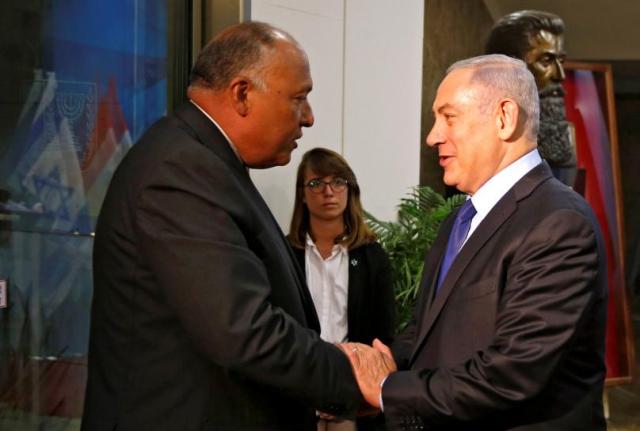
FM in Israel

Egyptian foreign minister visits Israel

Top Headlines

  • Egyptian foreign minister to talk Middle East peace in rare visit to Israel
  • Egypt to receive alleged Egypt Air MS804 wreckage washed ashore in Israel
  • Traders are betting Egypt will weaken the pound as soon as Tuesday
  • Egypt considers retaliations for Italy’s decision to cut military supplies

 Main Headlines

 Monday

 Tuesday

Wednesday

Thursday

Friday

 Saturday 

 Sunday 

  • Egyptian foreign minister to talk Middle East peace in rare visit to Israel
  • Traders are betting Egypt will weaken the pound as soon as Tuesday
  • Inflation rises to 14.8% in June 2016
  • Armed Forces kill 14 militants and arrest 12 others in Sinai
  • Rights lawyer Malek Adly’s health reportedly worsening in solitary confinement
  • Egypt navy forces foil two attempts at illegal immigration to Europe
  • ‪Cairo‪ court sentences Magdy Hussein, editor-in-chief of al-Shaab newspaper, to three years in prison

Good Reports

From Twitter


Interview

 Photo gallery

 Plus


Posted in Diary of Aak, Egypt, Israel | Tagged , , , | 1 Comment

Banning the Niqab is a ban of disguised identity, not Islamic dress code


Niqab photo

Two women wearing niqab face veils (file pic) Peter Macdiarmid/Getty Images

The canton of Ticino, an Italian-speaking region of Switzerland, has banned the Niqab, the face veil worn by some Muslims. The decision came after a referendum in 2013, in which 65% of the population of the region voted in favor of the ban. Niqabs have been a subject of controversy since France outlawed them in 2010. The journey of the Niqab’s evolution began in the Middle East. As those who wear them have travelled to other parts of the world, they have stirred up a controversy—an unnecessary controversy—that is still brewing. Niqab is not a dress code, but a tool to disguise identity. Attempts to frame Niqabs under the freedom of choice is not just wrong, but also disingenuous.

 My experience with the Niqab began while I was attending medical school in Cairo when one of my secondary school acquaintances decided to start wearing the face veil. She changed not only her dress, but also her behavior. The funny, witty, cheerful girl I knew had transformed into a rejectionist of her society, labeling others as infidels and bad Muslims, advocating the banishment of female identity as the right path to what she describes as “true Islam.” We had many intense debates in which she did not concede any of her views; only reluctantly accepting showing one’s face as permissible, but not the “best practice,” as she put it. Her justification was a Quranic verse containing advice to the Prophet’s wives to “hide their identity to avoid being attacked by enemy of Islam.”

Such a literalistic interpretation of Islam’s holy book was shocking and alarming. It simply ignored the order during war time and clearly elaborated that the purpose of the Niqab as disguise of identity, and not a way of life. My Niqabi acquaintance was my first ___ and rather rude___ introduction to various Salafi groups that mushroomed in Egypt in the 80s, under the eyes of Mubarak’s authorities who turned a blind eye to their brainwashing activities. What was even more frustrating was the lack of counter-narrative or challenge of the Salafi’s interpretation. Such intellectual cowardice was wide among both Egypt’s rulers and elite. Both opted for the easy path of ignoring Salafism and pretended it did not exist. They then acted surprised when Salafi groups earned about 20% of parliament seats in the 2012 election. Recently, however, the head of Egypt’s top institutions of higher learning, Cairo University, Gaber Nassar, bans female academic and hospital staff from wearing the Niqab. Furthermore, a court order has upheld the ban. Nassar, is the first brave intellectual to point out the core problem of the Niqab, which is the concealment of identity.

Many Muslims and advocates of women’s freedom of choice claimed that the ban is against freedom of women to choose their dress, ignoring the identity question that lies at the core of pro-Niqab advocates. A Niqab is used for the concealment of identity regardless of color or garment of the woman’s dress. The problem, however, lies within the selfishness of Niqabi women who want to hide their identity but still enjoy the freedom granted to other women who are willing to face the scrutiny of identity checking.

The question then becomes, can Niqabi women have it all? Can they hide and enjoy freedom? The answer is simply no. Not in our current era of terrorism and security checks. It may be okay to be Niqabi in Yemen or Saudi Arabia where the control of women is a pillar of the culture. It will be up to Saudi, Yemeni, or any other woman from a native Muslim country to accept or rebel against the practice. But once any woman decides to immigrate to any other country that requires identity checks, the Niqab should be removed. Why should a country be required to hire an army of female police officers to be placed in all its public building, shopping centers, trains and airports to confirm the identity of Niqabi women so that their sensitivities are not hurt? It is not just asking too much, it is frankly outrageous.

Moreover, it is unsettling to see other Muslims rush to defend the Niqab. Standing with the Niqab plays into the hands of Islamophobes. Defending a practice used by the most oppressive Muslim regimes as well as radical groups such as ISIS empowers the argument that all Muslims are zealous, rigid, and unwilling to integrate into Western societies. Defending the Niqab is as absurd as defending nudity in the Muslim world. Can you imagine Westerners demanding their right to march topless in Muslim cities? Why do we want the West to accept our cultural sensitivities in their societies? I cannot even describe the Niqab as a cultural sensitivity, as it can only be seen as cultural backwardness.

Banning the Niqab is not a move against women’s freedom, but respects Niqabi women choice to conceal their identity. The formula is simple: if a woman opts to conceal her identity, then she has made a conscious choice to hide from the society. That is perfectly acceptable; what is not acceptable, however, is to expect others, particularly in non-Muslim societies, to go out of their way and offer her a freedom that she rejected in the first place.


Posted in Best Read, Egypt, Islam, Saudi Arabia, women rights | Tagged , , , , , , , | 6 Comments