
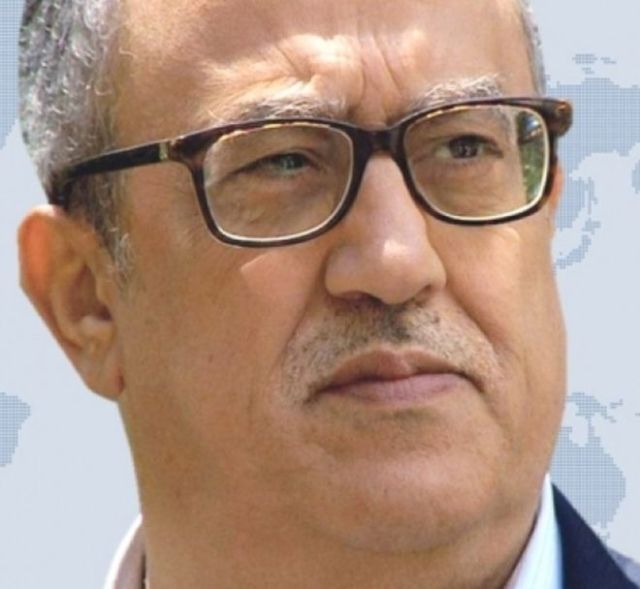
Nahed Hattar, a 56-year-old Christian Jordanian writer has been murdered. He was shot three times outside a court in Amman, where he was facing charges of sharing a cartoon deemed to be “offensive” to Islam. Hattar was arrested in August after posting a cartoon that mocked jihadists on his Facebook page. Mr. Hattar was charged with inciting sectarian strife and insulting Islam before being released on bail in early September. According to several reports, Mr. Hattar’s killer was arrested and police are investigating the murder.
The provocative cartoon depicts an Arab man enjoying himself in Paradise with two women and saying to God (who was checking on him): “Yes Lord, get me a glass of wine and tell Angel Gabriel to bring me some cashews. After that, send me an immortal servant to clean the floor and take the empty plates with you.”
Hattar’s murder is yet another tragic event in a long trail of intimidation and oppression against free thinkers in the Arab and Muslim worlds. In 1992, prominent Egyptian writer Farag Fouda was assassinated for daring to challenge the orthodox interpretation of Islam. In 1994, an Islamic extremist attacked the 82-year-old Egyptian Nobel Laureate Naguib Mahfouz, stabbing him in the neck outside his Cairo home. Mahfouz survived, but only just. The list goes on: Nasser Abu-Zeid, Islam Beheiry, and Fatima Naoot were also accused of insulting Islam and have had to face exile, jail, or legal cases against them. However, this is the first case in Jordan and that is alone is unsettling.
It is easy to portray the death of Hattar as the tragic result of the behavior of one radical criminal who decided to take the law into his own hands. In reality, however, Hattar’s murder sums up the sad state of affairs of religion and politics in our decaying region.
First, Jordan:
What struck me when I visited Jordan is the wide gap between the liberal Jordanian elite and the conservative communities mainly outside the capital, Amman. Although the Jordanian Royal Family has campaigned relentlessly for moderate Islam, and allows Jordan to serve as the principal base of operations for the U.S.-led military campaign against the Islamic State in Syria, their message of tolerance and moderation, however, has not been embraced in some corners of the Kingdom. It is well known that many Jordanians have joined the ranks of various terror groups. David Schenker, of the Washington Institute, wrote how cracks were starting to show in Jordan, and how endemic corruption has been among the ranks of the Jordanian security services over the past year. The murder of Hattar, a conspicuous target for radicals, outside a court in the heart of the capital is embarrassing, to say the least, for the Jordanian intelligence service.
Second, the region
It is well known that Hattar was an outspoken supporter of the Assad regime in Syria. This partly explains his motive behind publishing the provocative cartoon. Hattar wrote on his Facebook page (now shut down) that the God depicted in the cartoon is the ‘God of the Islamic State.” Hattar was right in his interpretation of the radical mindset, but was wrong in using it to justify the ruthless and murderous tactics of the Assad regime. Hattar was intellectually dishonest, but that should not be used as a reason to justify his murder. It is noteworthy that his stance is not an anomaly, and many Jordanians are either indifferent to, or open supporters of, Assad, especially after the influx of thousands of Syrian refugees into their tiny, fragile country.
Now Assad’s pundits are using Hattar’s murder to warn Jordanians about the futility of Jordan’s alliance with the United States and the increasing attacks by ISIS supporters inside the Kingdom. Assad hopes to neutralize Jordan, and to a certain extent, he has already succeeded. The southern Syrian front is almost quiet, unlike the northern one in Aleppo.
Third, and most important, religion:
Undoubtedly, it is easy to attribute Hattar’s murder to political and terror acts, while downplaying the religious aspect of it. That would be a simple act of cowardice. We have to admit that the portrayal of Paradise among Muslims is controversial and problematic.
Personally, I regularly read the Al-Rahman soura of the Quran (The Merciful), and have been doing so every Friday since I was 13. I used to find the description of Paradise unsettling and still do. I have learnt, however, that the literalistic interpretation is the core problem, more than the words themselves. This literalistic approach is prevalent in all mainstream Islamic schools and not just among radicals. Dreaming of an elusive paradise that sanctions sex and alcohol has become an escape route for Arabs and Muslims hoping to evade tough questions about the place of their faith in modern times. The literal interpretation of this Paradise has even prompted some people to kill in its defense.
In short, the murder of Nahed Hattar is a triumph of religious escapism, intellectual cowardice, and political manipulation in a region that has lost its moral compass and descended into a dark space where bad is fighting bad with bad, only to produce more ugliness and despair. We have to have the intellectual courage to admit all the above, and work together to stop more assaults against religious freedom and freedom of speech, otherwise we will be indirectly complicit in the murder of Hattar.



 Nervana
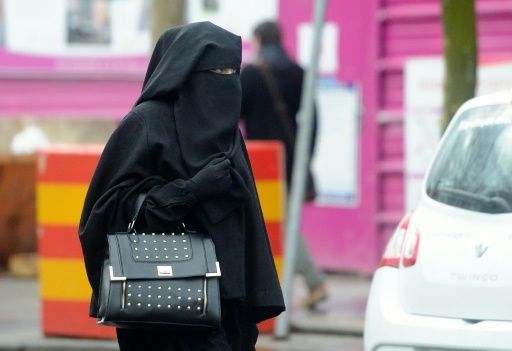
Muslims, France, and the war on shorts
Photo via UK’s Independent/ Getty Images
In the wake of the Burkini war, a violent skirmish of altogether different proportions has surfaced in France. In the southern French city of Toulon, two women wearing shorts were verbally assaulted as they made their way through an eastern neighborhood. Ten young men — allegedly Muslims — began insulting the women, who were out biking and rollerblading with their families, calling them “whores.” When the women’s spouses confronted the men, fighting broke out and the husbands and a male friend were severely beaten. One of the victims sustained severe facial fractures and another a broken nose.
Although two of the attackers were later sent to jail for their part in the brawl, the incident gained prominence on social media under the hashtag #TousEnShort, suggesting a link between the assault and Islam. Adding fuel to the fire was a statement by Julien Leonardelli, Department Secretary for the far right National Front Party in Haute-Garonne. He wrote on Twitter “Again, our freedoms are being severely attacked. Sharia is already installed.”
In early June, an 18-year-old girl named Maude Vallet said she was insulted, threatened and spat on by a group of girls while on a bus in Toulon. Another report claims a Muslim woman assaulted another young woman for bathing topless in Chateauneuf-sur-Charente on August 25.
Ironically, none of the above incidents triggered the attention and global outrage that greeted the Burkini ban. Supporters of conservative Islamism now rush to praise every hijabi achiever, and stand against injustices inflicted against them, but act with indifference when cultural clashes spin out of control and result in such criminal acts as those described in the above incidents.
The root cause behind such attacks is the self-righteous Islamism that promotes conservatism as a tool to maintain Islamic identity among Muslim communities in Western countries. It is hard to teach Muslim youth to respect others’ dress codes while indoctrinating them with the idea that covering the flesh is morally superior. This is a conundrum that will haunt Muslims, as their second-generation youth grow more defiant and detached from their local Western communities.
Some Muslims might find it unpalatable to admit, but this self-righteous Islamism will bring nothing but trouble to Muslim communities, not just in France, but in the wider Western world. Yes, Muslims have won the Burkini Battle, and got support even from the United Nations, which condemned the Burkini ban for “fuelling religious intolerance and the stigmatization of Muslims in France.”
The deafening silence surrounding attacks against local non-Muslims for their non-conservative attire, however, will equally fuel religious intolerance and the collective stigmatization of all Muslims.
Tension in France is already high, and Muslims bear considerable responsibility in helping diffuse the flames of hate. Muslims should stand for freedom and respect. There should be zero tolerance for any attack on non-Muslim women. If the Burkini has to be accepted in the Western world, then shorts, and even nudity, have to be mutually accepted by Muslims living in non-Muslim societies.
Share this: