
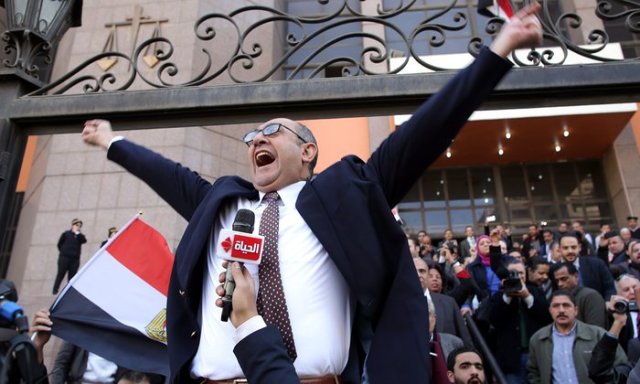
Egyptian lawyer Khaled Ali celebrates outside the courthouse in Cairo after the verdict. Photograph: Khaled Elfiqi/EPA- via the Guardian
The unseasonably warm weather in Cairo, with temperatures of 20°C has been coupled with spring-like excitement. Egypt’s State Council Supreme Administrative Court, in a final ruling, rejected the transfer of two Red Sea islands, Tiran and Sanafir, to Saudi Arabia. An enthusiastic crowd outside the court chanted “bread, freedom, the islands are Egyptian,” summing up a sense of nationalistic pride and celebrations around Egypt.
It is hard to imagine how the Egyptian leadership will survive such crisis unscathed. Regardless of what’s next, it has become embedded in the minds of many Egyptians that their leadership is selling their lands.
The dispute started on April 8th, 2016, after Egypt hastily signed a maritime border demarcation that would transfer Egypt’s sovereignty of the two islands to Saudi Arabia. Egypt has been controlling those strategically placed islands in the Strait of Tiran, near the Israeli border, for more than 60 years. The agreement was immediately followed by a legal contest filed by a group of lawyers, including ex-presidential candidate Khalid Ali. The legal battle has continued until Monday’s verdict.
As I wrote before, the idea that the people of Tiran and Sanafir are not Egyptians is difficult to sell, especially for the many Egyptians who lived all their lives with the story of the Straits of Tiran and the 1967 war as an integral part of their memory. The slogan, “Awad sold his land,” surfaced in Egypt following the signing of the agreement with Saudi Arabia to transfer the two Red Sea islands to Saudi sovereignty. Awad is the name of a farmer in an old Egyptian radio soap opera who sold his land. Opponents of the Saudi deal resurrected Awad’s story in angry protests against relinquishing the two islands to Saudi Arabia. Monday’s verdict enshrines the image of president Sisi as the new Awad who is willing to sell his land.
Beyond the legal side of the dispute, the controversy is pitting Egypt’s pillars of the state against each other. While the government, along with the army and the various intelligence bodies back the deal, the Judiciary and a substantial section of the public are against it. It is also clear that such controversy on a very patriotic issue is damaging the already eroding popularity of the Egyptian president.
Since the verdict, Egyptian politicians and lawmakers have bickered on various talk shows about what should be done next. Members of parliament insist that they should discuss the deal and vote accordingly; some have even suggested a referendum. Others have urged the government to resign. Such infantile bickering will only compound the deep sense of confusion and mistrust among the public.
The crisis has triggered an environment in Egypt similar to 1979, when late president Sadat signed the Camp David peace accords with Israel, which was unpopular among many sections of Egyptian society. Many at that time tried, but failed, to legally challenge the peace treaty. The difference, however, is how Sadat signed a treaty to regain Egyptian land. The current Egyptian leadership is trying to surrender two islands that have been under Egyptian sovereignty for decades to another country (Saudi Arabia).
There is no doubt that this verdict is a huge slap on the face for Egyptian leadership, and it should be taken as an urgent wakeup call. Egyptians can put up with autocracy and harsh economic conditions. Egyptians, however, would struggle to accept a leadership fighting its judiciary to prove that part of their land is not actually their land.
As the anniversary of the January 25th revolution approaches, the Egyptian leadership must embark on a damage limitation path. It is time to accept that this Red Sea islands transfer deal has proven to be a huge error of judgment. If the choice is between losing Saudi patronage or the Egyptian public, there should be no hesitation____ the Egyptian public must be the choice. Egypt cannot afford another upheaval.


 Nervana
Saudi Clerics and Christmas
In an interview last November, Saudi cleric Khaled Al-Felaij said Muslims are forbidden from greeting Christians and Jews on their holidays. He labeled Jews and Christians as infidels and explained that their celebration were “based upon falsehood, heresy, and polytheism,” and that it was haram for Muslims to celebrate this, to greet those who celebrate this, or to give or accept presents from such infidels.
Al-Felaij is not alone, another famous cleric Mohamad Al-Arefe (with 16.4 million followers on Twitter) has issued and tweeted similar fatwa. Other clerics, not just in Saudi Arabia, but also in many Muslim countries advocate the same views. I certainly heard similar views in Egypt. The same clerics and thousands of their followers, however, will shudder in anger if anyone ___ rightly___ points to them that those views are remarkably similar to what the Islamic State and other radical Jihadi groups believe.
Moreover, these clerics fail to see how such intolerant views breeds hatred among Muslims towards non-Muslims, and it also creates a deep torment inside many pious Muslims living in the West who are trying to integrate in their societies while maintaining their religion. Considering their non-Muslim neighbors and colleagues as infidels that should not be greeted during this festive time will only alienate Muslims and make them vulnerable to being recruited by terror groups.
Needless to mention, such intolerant views are embarrassing to the Saudi Royal family, which is trying to deal with radical terror groups flourishing inside the Kingdom. The Saudi Kingdom is trying to modernize the country, but that will not happen without uprooting intolerance from its religious doctrine. A country that considers others in bulk as evil, not just different, is doomed to failure___ rather than progress.
Let’s be clear, greeting others during festive times is simply what it is, a greeting; not a conversion or an embrace. There are millions who put a Christmas tree in their homes for non-religious reasons, only to bring some heartfelt festivities to the end of the year.
Infantilizing Islam is the biggest tragedy of the Muslim world. There is more to Islam than who should be greeted and what tree to be ignored. The Islamic faith has a deeper, mature side that is deliberately sidelined by advocates who have thinking that trivializes a great religion. Furthermore, Muslim scholars have to stop their duplicitous approach towards Islam, citing verses of tolerance when it suits and then taking other verses to spread intolerance when it suits. Enough!
Meanwhile, I have happily decided to defy all the clerics of hatred and wish my Christian and Jewish friends happy Christmas and happy Hanukkah.
May peace and tolerance prevail in our dark grim world.
Share this: