Egyptian Aak: Week 25. Will The Brotherhood Survive June30?

Main Headlines

 Monday

Tuesday

 Wednesday

Thursday

 Friday

 Saturday

Sunday

  • El-Sisi: Military gives Egypt’s political powers a week to reconcile
  • Egypt’s court: Muslim Brotherhood members planned jailbreak
  • Brotherhood calls for “unconditional dialogue” dialogue with opposition
  • Salafist Nour party HQ in Mahalla torched over night. Arabic
  • Jama’a al-Islamiya member killed in political spat in Gharbyia
  • Egyptian Sunni Muslims kill 4 Shiites, charging they were spreading their faith

A few thoughts

 Will the Brotherhood survive June 30?

 It is not easy to read the political scene in Egypt. It is even harder to reach conclusions and predict future outcomes. June 30 is like the finale of a major competition;  players are completing their final preparations and the crowd is excited.

President Morsi rebuts calls for his ouster, his party the Muslim Brotherhood is defiant, and together with some other Islamic parties organized a massive rally on Friday as a display of confidence and popularity. It is not easy to understand the thinking process of the Brotherhood and whether they are truly confident or they are just putting on a brave face. It is safe to assume they are apprehensive about June 30, and the Friday rally was probably aimed as a message of reassurance to their core supporters more than the rest of Egypt. It is also safe to assume that there is a certain degree of confidence inside the Brotherhood’s top leadership. Why? For many reasons:

1)   No good record of successful revolutions: Most Brotherhood members are fond of history ____ in a selective way ____ and one of the most appealing facts in the Brotherhood psyche is Egypt’s long history of autocracy; revolts and uprisings have occurred throughout Egypt’s 7000-year history, and few materialized into successful outcomes. The wide gap between each revolt is also a reassuring factor. Egypt has no record of two successful revolutions within a short period of three years.

2)   Deep-seated contempt toward opponents: Rivalry in Egypt is not between two political camps, but between two completely different visions, which are almost impossible to converge. There are cultural and social reasons that complicate the current political mess. The Islamist resentment of Egypt’s leftists and semi-liberal elite is as old as Egypt’s contemporary history. They view these elite as intoxicated with various western ideas that impede the Islamic project and prevent its success. Therefore, they should be “eradicated,” rather than tolerated.

 3)    Overdose of democracy: As the president’s assistant Pakinam el-Shraqawi has said, “Egypt has an overdose of democracy.” This opinion fits in with the Islamist vision, which I have written about earlier. In other words, democracy should come with caveats. From their perspective, Egyptians have gone wild and must be restrained. It is no coincidence that the slogan of Friday’s mass rally was, “No to violence.” This is not a demand, but a pre-condition that could in their view justify a crackdown and massive arrests on June 30. The Brotherhood fully understands that the ongoing low-simmer violence will not be easy to control. Many youth are angry and despite calls for peaceful protests, some may find it difficult to cope with provocations. Yet the Brotherhood demands no less than perfection from the opposition.

4)   A final blow to the opposition:  Rather than fearing June 30, the Brotherhood sees it as an opportunity to develop a final blow to their weak and divided opponents. For them, June 30 is a gladiator match, a chance to deliver a final blow to the opposition. A defeat for the opposition would be the political equivalent of 1967 military defeat that will take years for any sort of non-Islamist recovery.

 5)   Neutralize third parties:  The Brotherhood probably interprets ____ as many Egyptians did ____ the recent speech of the U.S. ambassador in Cairo Anne Patterson, in which she expressed doubt about June 30, as indicating that the U.S. will not exert any pressure on Morsi’s government to provide concessions to the opposition. They may also safely predict that it is highly unlikely that the army in Egypt, which is seen as supported and equipped by the U.S., will embark on any adventure to overturn Morsi without an American nod. It is worth mentioning that John Kerry is expected to visit Egypt on June25, and it will be interesting to see the outcome of his visit.

 6)   Faith: The Brotherhood has never updated their curriculum. Their teaching manual ___ systematically used for 80 years ___ tells them that they are right, that they were never given a proper chance, that it is not their fault, and that they will eventually be victorious. How can anyone convince them otherwise?

 Mohamed Fouad may be right; the revolutionary mode may not be sustainable, and the outcome of June30 may be doom and gloom. However, the irresponsible attitude of Egypt’s ruling party is what led to the current explosive situation, and it is too late to reverse course. The Brotherhood thinks that history, important players, and most importantly the almighty, are all on their side. So why should they care about the people? The move to Moqattam, a hill overlooking Cairo seems to feed into their apparent disengagement from the public. Seeing Egypt from above can be very deceiving. They may be correct on some points, dislodging regimes in Egypt has never been an easy task, but their view of June 30 is wrong. This is not a new revolution, but a continuation of an unfinished revolution. They are also wrong about the new generation of Egyptians. While the passion may be the same as previous generations, this new generation is more stubborn, and submission is not part of the generation X manual. The Brotherhood may survive June 30, but Egypt, as we know it, may pay a hefty price for their survival.

Post Script:

The timing and the tune of El-Sissi’s statement is very interesting. He phrase it in such a clever way that makes both sides interpret it differently, however, it could be the wake-up call that the revisionists in Al-Moqattam desperately need.

Good Report

Good Read

Video

Egypt’s Bassem Youssef hosts Jon Stewart

Finally, here are Jayson Casper‘s prayers for Egypt
Posted in Diary of Aak, Egypt, June30 | Tagged , , , , , | 1 Comment

Tagarod – The pro-Morsi Campaign

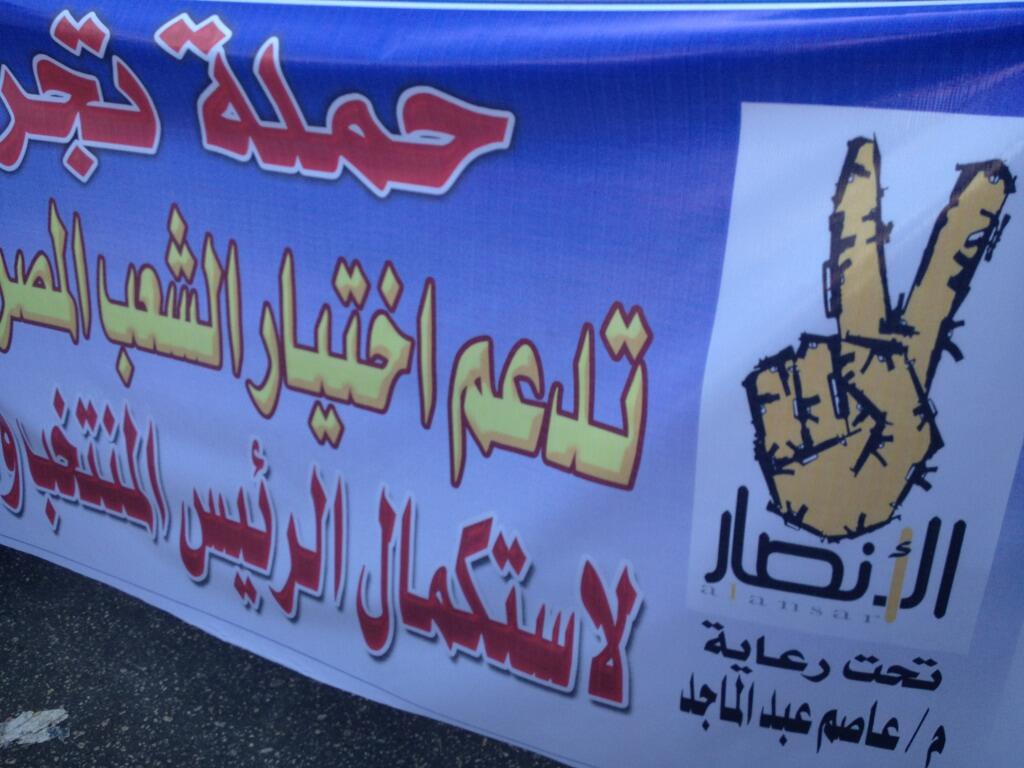
Tagarod photo

(One of Tagarod’s banners with many Kalashnikovs, via Twitter)

It is a bit tricky translating what Tagarod actually means in English. The campaign launched by Assem Abdel Maged, a member of the Al-Gamaa Al-Islamiya in support of the Egyptian President Morsi, to keep the “legitimately elected president in his post,” has a very intriguing title.

 Some translated Tagarod as impartiality, while others claim it is self-abnegation or self-sacrifice in support of “legitimacy.”  In reality it is a tit-for-tat move to counter the Tamarod (Rebel) campaign that was started by a youth group opposed to President Morsi’s presidency last April.  Therefore, T for Tamarod is opposed to T for Tagarod. The true meaning of the term does not really matter; however, reflecting on the name reveals the problematic nature of such a movement.

 The organizer of Tagarod, Al-Gamaa- Al-Islamyia, which is still considered a terrorist organization in Europe and the United States, has fought a long insurgency against the Egyptian government since the late president Sadat signed the peace treaty with Israel, and has continued its violent campaign killing many Egyptians including police officers and even tourists under Mubarak rule. In 1997, the group forged a murky deal with the government that facilitated the release of some cadres from prison. Later, in 2003, more concrete rejections of violence occurred by many of its members including its leader, Nageh Ibrahim. Following the 2011 revolution, the group formed a political party, the Building and Development party, with Aboud and Hany el-Zumor (previously imprisoned for involvement in the assassination of Sadat) as prominent cadres, and the group contested the last parliamentary election, winning 13 seats.

 To understand the meaning of Tagarod, it is better to examine the vision of its founders and their understanding of democracy.

 First, they believe the president of the state should be the Guardian of Islam (Wali-alAmr), which is in simple terms, the legitimate leader chosen by Muslims to rule the nation of Islam under the terms of conduct outlined by Islamic Sharia.  Therefore, in their eyes, President Morsi (an Islamist) elected by the majority of Egyptians is a legitimate Wali-alAmr, and should not be challenged until the end of his “Islamic contract.”  This is, in their opinion, the 4-year term of his office as a president.

 Second, Al-Gamaa al-Islamyia’s democracy is extracted mainly from the Islamic concept of Shura, or consultation. They believe that they are 2-tier Muslims; those blessed by knowledge and wisdom, and those who lack such knowledge, thus should follow and obey. The strict term of Shure means “seeks the opinion of the knowledgeable”; however, this term was stretched by some jurists to justify election participation. Once a leader is endorsed by the knowledgeable and elected by the rest, a contract is forged and it is illegitimate to break or challenge it; therefore, they view labeling the Rebel campaign, Tamarod, as infidels.  They even claimed it resembles the devil’s rebellion against the Almighty.

 Third, formally, the group clarified that Jihad is not the same as violence, where Jihad, in their opinion, is an exclusive term used to fight only external non-Muslim enemies. However, they later stretched the term to include the allowance of fighting against Assad’s regime in Syria and even vigilante groups in Egyptian provinces that sanction lynching of alleged thieves and murderers without proper trial.

 In short, according to Al-Gamaa–Al-Islamyia, Islamist’s democracy should comes with caveats; freedom should be capped under Sharia ceiling, Islamic rules should dominate despite the objection of some, and democracy is merely a majoritarian exercise, provided it is the “right” majority.  Interestingly, the Muslim Brotherhood who have always maintained its moderation and full acceptance of democracy has opted to ally with the Gamaa Islamyia; president Morsi has appointed one of its members to be the governor of Luxor, the same city that endured a massive blood bath against Western tourists in 1997 committed allegedly by the same group.

 Tagarod’s Friday rally has exposed their problematic and alarming attitude: On one hand they raised the slogan “no to violence,” however, their banners were full of guns. Their practice of martial arts exercises before the rally, and the emotional incitement against their opponents did not necessarily aspire peace or democracy. Furthermore, their demands are hardly political, rather an expression of an identity issue, wanting to conform Egypt under a very strict religious identity, which is even disputed by many religious scholars including Al-Azhar who earlier released a statement sanctioning anti-Morsi peaceful demonstrations. They are also the masters of victimhood; in addition to a relentless expression of grievances by the Gamaa –Islamyia cadres against Western Imperialism as the sole reason behind the weakness of the Muslim nations, they claim that the Brotherhood current rule in Egypt was never given a proper chance to govern. Such a lack of self-criticism is partly responsible for the wide gap between Tamarod and Tagarod; Tamarod holds Morsi responsible for his poor leadership, while Tagarod portrays him as a victim of a web of conspiracies.

 In the Arabic language, Tagarod originates from the verb “Yatagarad or to strip.”  That is, in a nutshell, the perfect description of this group, they are the strippers of Islam, who want to rip its deep philosophy and faith off and leave a superficial neo-interpretation of its historical events. Politically, they also strip people from their legitimate rights to hold their leader responsible of his failed policies. Tagarod’s rally has affirmed why many in Egypt oppose the rule of President Morsi; Egyptians (including many Islamists) did not vote for black flags, Kalashnikov as a logo, demonization of political opponents, twisted Sharia interpretations or victimhood as a justification of failure.

Posted in Egypt | Tagged , , , , , , | 6 Comments

Egyptian Aak: Week 24. How Can Tamarod Succeed?

 Main headlines

 Monday

Tuesday

 Wednesday

 Thursday

Friday

Saturday

 Sunday 

A few Thoughts

How can the Rebel campaign “Tamarod” succeed?

 What will happen on June 30? Everyone who has been following Egypt has wondered about this question. There are many possible scenarios and potential outcomes. Both camps, Islamists and the opposition, are expecting violence and even civil war. Rumors are already flying about the possible arming of some opposition groups, even the involvement of the Hamas militias.

 It is pointless to predict or debate the outcome; it is better to focus on a winning strategy at this crucial juncture in the history of Egypt. June 30th is a huge opportunity that the Anti-Morsi camp cannot afford to squander.

 The formula for success should include certain ingredients that, if combined, can maximize the chances of winning a secure victory against Egypt’s currently failing leadership.

 First: Have faith

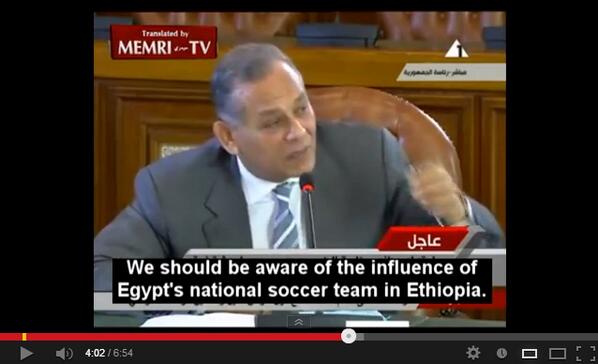
There is a skeptical mood among some activists in the social media. This is understandable and even healthy. Deposing Morsi will not be easy; he believes in his “legitimacy” as the first democratically elected leader of Egypt, and he still has core supporters who are willing to fight till the very end. However, Morsi’s “regime” is not just unpopular, it also lacks creativity. It is still playing its old, overly used populist cards: the loud nationalistic rhetoric against Ethiopia in the Islamist-organized water conference or playing pro-Syria Jihad. The latter has failed to garner more support and expand its core base, which is no more than the 25% that Morsi won in the first round of last year’s presidential election. These tactics have exposed a tense, apprehensive regime that is desperate to divert the problem, because it has no other answers or solutions. The first step against such a rattled regime is to win the battle of perception. The millions of signatures gathered by Tamarod should not just be a confidence boost, it also should reinforce the belief that the movement to depose Morsi is heading in the right direction.

 Second: Tame expectations

The planned nationwide demonstrations on June 30 as part of on-going battle aimed at draining the Brotherhood’s rule and stripping it of its remaining vestiges of legitimacy.  Any high expectations of immediate success can lead to a sharp downward spiral of pessimism and disappointment. This is a battle that will not be won by a decisive knockout, but by an overall collection of points; therefore, any attempt to repeat January 25th will be a miscalculation that may backfire. Morsi will fight and resist any demands for him to leave office. The Muslim Brotherhood did not wait 80 years to leave power after just one year. That is why the Anti-Morsi camp should aim at stirring new direction and creating new realities. It should not be just a demonstration but a start of civil disobedience, and other peaceful, lawful means sanctioned by law.

 Third: Don’t rely on third parties

Egyptians must understand that it is up to them, and not anybody else, to change or remove the current leadership. Any reliance on a possible military coup or US pressure is not just a wild gamble, it’s also a reckless and counterproductive way to defeat Islamism in Egypt. History teaches us that Islamists always thrive on victimhood; therefore, Egyptians must prevent their Islamists from using this easy winning tool that has always played wonders over the last 60 years. Foreign and military intervention will resurrect an already struggling Islamist parties that cannot even secure some of its own core supporters, and that should be avoided at any price. This is precisely why violence  must not be adopted as a strategy by the anti-Morsi rebel camp; If the Islamists adopted violence as a strategy, then let’s them drown in the blood of their victims. Therefore, if the Black bloc wants to join, they should abide by non-violent terms of conduct.

Fourth: Unite 

I know that ‘unity’ is a magical word that is rather elusive in meaning, but for now, it is a must. Egypt’s feckless opposition should understand that if it cannot contribute positively, it must at least not cause harm. Enough “secret meetings,” lousy statements, and useless suggestions; the opposition must understand their own limitations and stop being a hindrance to those amazing youths who organized the Rebel campaign. Instead, the opposition should focus on fielding a unified candidate for a possible presidential election, and provide a shadow government that is ready to rule Egypt in the case of a power vacuum.

 Fifth: Help to prevent chaos

As Islamists keep forecasting that civil war and chaos will result from the June 30 demonstrations, the Rebels should counter this ugly propaganda with a solid plan to counter any violence or collapse of law and order perpetuated by Morsi’s regime, brotherhood, or their supporters. Various teams should be allocated tasks like helping the injured, facilitating traffic, preventing a security vacuum, coping with electricity shortages, and most importantly public helplines through social media and others means. It is crucial for the wider Egyptian public to see the Rebel campaign as a multi-task movement that aims to save and not to burn the country.

 There are several scenarios, based on other countries’ experiences that many predict for Egypt. Although the risks of a possible Algerian or even Iranian (failed green revolution) scenario should not be dismissed, the chances of its occurrence in Egypt are actually very slim. Egyptian military is certainly not pr-Morsi, and there are already  many police officers who resent Morsi and his rule, however, neither the army nor the police are willing to be dragged into violent battles with Jihadis. Both will try to be professional, and secure law and order without interference in the country messy politics, which is definitely what Egypt needs. We do not need a junta or a ruthless rebound of religious authoritarianism.

Tenacity, and peaceful demonstrations are the right ingredients for a mature democracy. In many ways, Tamarod resembles the 1919 revolution. True, it is leaderless movement, we still have no equivalent of Saad Zaghloul; yet, it can set in motion a different dynamic that can potentially create a new leadership. June 30 is a great opportunity for Egypt that should not wasted.

As president Morsi marks one year in power, he should contemplate this Hadith of the Prophet: “The destruction of Ka’aba is better than spilling the blood of Muslims,” before he formulate any plan for June30.

Good Reports

  • Egypt replaces Waziristan as main training centre for militants. The Express Tribune
  • A serious of reports on looting of Egypt’s antiquities: Report 1Report 2 and  Report 3 by Betsy Hiel

Good Read

Finally, here are Jayson Casper prayers for Egypt

Posted in Diary of Aak, Egypt, June30 | Tagged , , , , , | 4 Comments

Islamists and Nudity

mermaid Statue

( Mermaid Statue in Alexandria – before vandalism)

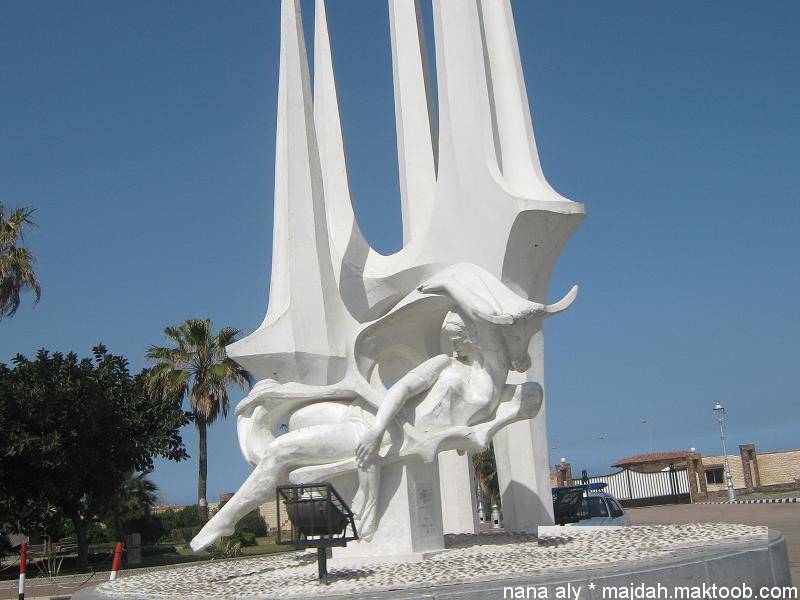
When Salafi Nour Party M.P. Gamal Hamed called for the abolition of ballet performances in Egypt, describing it as “immoral” and a form of “nude art,” many were shocked and questioned his logic and sense of priority. Surely Egypt has more pressing problems than the debate of the appropriateness of ballet. However, Hamid is not alone; President Morsi has previously expressed how he was troubled by “naked restaurants,” like Hooters in the U.S.  Furthermore, for Islamists, nudity is not just limited to people, but also extends to objects; the Mermaid statue in Alexandria, constructed by my uncle Fathi Mahmoud, depicting a Greek God in the form of a bull hugging a beautiful mermaid as symbol of Mediterranean Alexandria, and its Greek heritage, is one example of an artwork considered by Islamists as absurd nudity, prompting some Egyptian Salafis to temporarily cover it during their election campaign in 201. Later, this year, it was vandalized by “unknown assailants.”

The question of nudity and why it bothers Islamists more than water shortage, hunger, poverty, and rape, is crucial to understanding the mindset of many Islamists and how they view the outside world.

Most Islamists view nudity along a scale rather than as a dichotomous concept. Within the minds of most Islamists, nudity can be mild, moderate, severe, and ultimate. “Severe” can be equated to what Westerners describe as being topless, while “ultimate” is complete exposure of the human body. Mild and moderate are more grey areas, depending on the local culture and traditions, but for strict puritans, any exposure of flesh, particularly female’s flesh apart from the face and hands, is considerednudity.

Is it just conservatism?

Although the above classification sums up the views of most Islamists, it does not explain the oversensitivity, shock, and outrage that surface when others disagree or adopt a different way of life. Conservatism and a strict dress code is not an exclusive Islamic phenomenon, as other religions and cultures share at least some aspects of it, but Islamism’s interlocked approach to a dress code runs deeper than conservatism and exposure.

There are four crucial elements of Islamism that are directly linked to their perception of morality, which also explain their overreaction to nudity.

First, there is the right of the society to protect its “values.” This overrides the rights of individuals and their freedom of choice. If conservatism for non-Muslims is a matter concerning individuals, for the Islamists, it is a matter for the state, as it perceives society as needing to be nurtured and conservatism to be protected.

Second, moral code and dress code are closely linked or even synonymous. According to some Islamists, the dress code reflects your moral values. For example, a women wearing tight jeans, or—heaven forbid—a swimsuit, cannot be honest or trustworthy.

Third, Islamists believe that morality is essential in rebuilding the “Ummah” within their nation state, a fundamental belief that is usually overlooked by observers. For political Islam, regaining Islamic morality within society is essential for both their empowerment and victory. Therefore, to them, fighting nudity and the western-style dress code is crucial. This stance stems from their over-simplistic and often romanticized understanding of the early Islamic period, in which they believed that the main reason behind the quick success of the early Islamic empire was the strict moral code of its leaders. As such, Islamists consider morality to be the goal that can help empower their members and enhance its image and connectivity with people at a grass-roots level. A campaign by Sheiks and scholars could easily have the dual purpose of preaching morality and grooming political candidates—a very effective form of activism.

Fourth, Islamists spin the prophet’s sayings (Hadith) to cover up their deep disdain for many aspects of western culture, such as ballets, artwork, and sculptures. For example, the prophet’s view that sculptors will be treated harshly on Judgment Day was only expressed when Mecca was a haven for idolatry, which is clearly not the case now. In other words, Islamists failed to see that the prophet’s remarks were conditional upon past circumstances and were not intended to be on absolute terms.

Understanding these fundamental elements of Islamism explains how fighting nudity is the fleece that Islamists wear to sanction their desire for domination. It is a key to explaining subtle attitudes like despising Western magazines because of their revealing fashions, cowardly acts like the vandalism of the Mermaid statue, and more blunt decisions like firing the head of the Opera House among other figures under the pretext of fighting corruption and injecting “new blood.”

Islamists have no option but to hype their unease with nudity and elevate it to the level of an extreme crime in order to justify their quest for empowerment. Such flexing of the moral code deliberately fogs the distinction between sleazy human behaviors with artistic expression as in ballet or sculpturing. It is part of their “cultural revolution” to purge what they perceive as bad western influence on the society.

The Egyptian Ministry of Culture has become the new frontier in the on-going battle to preserve Egypt’s diverse cultural heritage against the assault of Islamist missionaries seeking to reset Egyptian culture  to a neo-medieval mode. I have no doubt that my late uncle, if he were still alive, would have joined the on-going sit-in by Egyptian artists and intellectual protesting against this brutal assault, not because he was pro-decadence, but because he viewed art as a tool that transcend nudity, and elevate our senses away from cheap sexual interpretations.

Posted in Best Read, Egypt | Tagged , , , , , , , | 8 Comments

Egyptian Aak: Week 23 -The week of Aabath

Image week 24

(One of the “suggestions” made by Egypt’s political elite to tackle the Ethiopian dam)

Main headlines

Monday

Tuesday

Wednesday

Thursday

Friday

 Saturday

Sunday

A few thoughts

 This week, I would like to introduce a new Arabic term, “Aabath.”  It was mentioned by various Egyptian figures, from president Morsi who described the rebel campaign against him as Aabath, to various disenchanted local political commentators, unhappy with the chaotic political scene in the country, and even the satirist Bassem Youssef.

Aabath is word describing a wild mix of the absurd and futile nonsense. This week was certainly full of unique Egyptian Aabath.

 The best example was Monday’s shambolic meeting called by president Morsi to discuss the Ethiopian dam project, which was broadcast live on Egyptian television. Unaware that the event was airing live, Egyptian political “elite” expressed candid, but reckless, and even condescending suggestions including: sabotaging the dam, interfering in the internal political disputes in Ethiopia, even bribing the local tribes. In a nutshell, our “wise men,” as Amr Hamzaway has rightly described, had decided to assume the role of James Bond. Inevitably, they drew scathing criticism, and provided rich material for Bassem Youssef and his satirical show. Even social media joined in with inspired widespread mockery.

 It is worth noting that workers at Egyptian state TV were instructed not to label the Ethiopia Dam as a renaissance dam, obviously to keep “renaissance” as the exclusive catchphrase of the Brotherhood’s project aimed at rebuilding Egypt. In addition, some local media have circulated that China will not finance Ethiopia’s dam, yet there was no independent verification of this news.

 On the other hand, the Egyptian main opposition, the National Salvation Front (NSF) has decided to assume a different role, not from a James Bond movie, but from a classic Egyptian crime movie, “The Second Man.” They did this when a prominent member of the NSF, Foreign Minister Amr Moussa, agreed to meet the Brotherhood strong man Kheirat Al-Shater, which was hosted by politician Aymen Nour. The meeting was ___ somehow___ leaked to the media, triggering accusations and counter-accusations, plus endless debate and criticism. Although everyone agrees that the meeting has achieved nothing, still Egypt’s feckless opposition has opted to be distracted by this virtual battle, arguing about the logistics, purpose, and details of the meeting, rather than focusing on its main goal; fighting the Muslim Brotherhood and their growing iron-fist rule.

Thus far, the opposition has no clear strategy for 30 June, a day of planned protests throughout Egypt against president Morsi on the anniversary of his swearing into office, or even for the day after. There are endless challenges ahead, from a high probability of bloody violence on 30 June to a lower possibility of a political void if Morsi decides to step down. Yet the only action that the opposition is currently offering is ranting.

 In another example of Aabath, on the 43rd anniversary of the Six-day War, many in Egypt are still bickering about Nasser’s rule in the 1967 war, with Muslim Brotherhood’s members and supporters blasting the late president’s military performance in 1967. Meanwhile pro-Nasser activists responded by hacking the Brotherhood’s Facebook page. Such nonsense is not really new, the old debate erupts __ quietly __ every year, but this year was louder as the brotherhood are now the ruling party and it has started to openly express its grievances from Egypt’s left.

This week Jerusalem rally was an opportunity for the Brotherhood to support their Culture Minister Alaa Abdel-Aziz, who is facing a serious challenge by artists who have started a sit-in at his office in the ministry’s headquarters this week. In addition to expressing his support of Jerusalem, Dr. Abdel Aziz has  declared a cultural revolution that provides all forms of arts and creativity, and rejects “intellectual terrorism.” It is unclear what “all forms of arts and creativity” means for the Islamists. On various occasions they have expressed their desire to ban ballet, contemporary dance, and other modern art. Unless maybe they mean that the revolution that Abdel Aziz is advocating is the Islamist equivalent of Mao’s cultural revolution, with the intent to purge Egypt’s contemporary customs, cultures, habits and ideas, and replace them with puritan Islamist alternatives.

The Brotherhood’s ongoing mission of empowerment is growing steadily, with concrete results within the information and culture ministries, not to mention the “efficient” public prosecutor who has already arrested a substantial number of anti-Morsi activists.

The Recent NGOs trial and the recent verdict that decried foreign funding as a new form of “control, predominance and soft imperialism practiced by donors to destabilise, weaken and dismantle beneficiary countries,” is another form of populist Aabath, as H Hellyer wrote, it’s about sending a message – that civil society organizations in Egypt are not welcome to challenge the status quo and authority.

In a nutshell, Islamist arrogance has met with only confusion and division from their opposition. As a result, both camps are fighting at the expense of the state with its collapsing economy, energy crisis, water shortage, and million of angry, disenchanted Egyptians. Both sides are not fighting to save Egypt, but are fighting for the ruins of what will be left of it. It is unlikely that this Aabath will stop anytime soon. In fact, Egypt is probably heading for at least a few weeks of meaningless Aabath. However, the determined Egyptian youth are ignoring both sides and are still collecting signature in their relentless anti-Morsi ‘Rebel” campaign, they are the only meaningful movement among the Aabath, that is why I am still optimistic about the future of Egypt.

Good Read

  • Brotherhoodization of the Opera by Vivian Salama
  • Farag Fouda; assassination of the word by Sara Abou Bakr
  • What the U.S. should have said to Egypt about the NGO trial by Amy Hawthorne
  • Egypt’s Khaled Said : Three years on, still no justice by Bel Trew

Finally, here are Jayson Casper‘s prayers for Egypt
Posted in Diary of Aak, Egypt | Tagged , , , , , , , , | 1 Comment

Turkey, the Arab world, and the myth of moderate Islamism

For years, Turkey’s Prime Minister Erdogan was generally considered an example of “moderate Islamism,” a loose label that was generally based on a comparison with other Islamist dictatorships like Iran, or with the various semi-secular autocratic regimes that dot the Arab and Muslim world. There was never a comparison with a liberal Muslim democracy, simply because none existed.

In other words, Erdogan earned his credential as the moderate, Islamist democrat in the Middle East, partly because of his success in Turkey, but also due to the lack of any democratic competitors. Admittedly, it was not just the West that labeled Erdogan as a “moderate,” but this pseudo concept was also popular in the Arab and Muslim world. A mixture of glamorous soap operas, exotic cities and beaches, and vibrant economic growth has led many Arabs to build a very idealistic image of Muslim Turkey.

On 27 May, this mirage was crushed with the eruption of protests and the ruthless police brutality in response. The eyes of many Arabs were stretched open to the illiberal side of Turkey; tense and divided and struggling to harmoniously mix religion with politics. Watching the uncompromising Erdogan dismiss his opponents and blaming “foreign fingers,” has alarmed many in the Arab world, demonstrating that even “moderate Islamists” have strong autocratic tendencies. The myth of foreign fingers is entrenched inside the minds of not just newly elected, insecure leaders, such as President Morsi of Egypt’s Muslim Brotherhood, but also well established, successful democrats like Erdogan.

Erdogan’s understanding of democracy, as described aptly by Mustafa Akyol, has not been liberal and participatory, and instead has grown increasingly intolerant to criticism and an independent media. It is doubtful that Erdogan appreciates the negative impacts of his illiberalism on Turkey, and what is even more alarming is that his illiberalism has serious repercussions for the greater Middle East.

First, it has widened the polarization between Islamists and non-Islamists in the Arab world, who from day one of the protest decided to blindly support their equivocal camp inside Turkey. Second, it gives many dictators in the region a chance to tarnish in the minds of their own people any idealistic notion of a “Turkish model.” Third, and most importantly, Erdogan’s attitude has finally exposed the myth of moderate Islamism, and the risks and impacts of illiberal democracies to his broader followers in the region who are relentlessly fighting against tyranny, while also struggling to forge their own identities, and were looking for Turkey as a model for them.

The old days of Turkey, when its domestic politics had no wider regional implications are now long gone. Going forward, what starts in Turkey will never just stay in Turkey. The spreading soft influence of the neo-Ottomans on the wider Middle East comes attached with a unique string; it brings more scrutiny and expectations from the Arab public at large who expect more from their Turkish role model.

Earlier this week, Turkish foreign minister Davutoglu allegedly told U.S. secretary of state John Kerry, “Turkey is not a second-class democracy.” Indeed, Turkey has had a well-established democracy since the 1950s; but was it ever and is it now a first or second-class democracy? That’s debatable.

In the past, the political role of the military and the extreme nationalism of its secular parties rendered it on many occasions more like a second-class democracy. Now the illiberal approach of its leadership to the current wave of protests is risking a fall back to a second-class status.

Prime Minister Erdogan has achieved a great deal for Turkey, and he deserves applause and support; however, if he continues to listen only to his faithful supporters, he risks obstructing Turkey’s progress, by aggravating the tense polarization that is currently pervading the country. In fact, by failing to provide a true liberal Islamic model, he can also indirectly doom the wider Middle East to a new form of illicit autocracy, which emerges through the ballot boxes.

Muslims deserve a first-class democracy, a liberal democracy that accommodates their religious identity without compromising their freedom. Currently, none exists, and this is precisely why Turkey matters. It has the ingredients for this much needed model, but it is up to the Turkish leadership and the Turkish people to embrace it.

Meanwhile, it’s time to stop using the term “moderate Islamists.” Despite whatever happens or the outcome of the current crisis in Turkey, the flawed term is incorrect and frankly patronizing as it doom Muslims to accept less than perfect form of democracy . In the Muslim world, like in the rest of the world, there are only either true democrats or undercover autocrats. The use of any other description would only be a travesty on every level.

Posted in Turkey | Tagged , , , , , | 9 Comments

Egyptian Aak: Week 22

Week 22

Main Headlines:

Monday

Tuesday

Wednesday

Thursday

Friday

Saturday

Sunday

A Few Thoughts

Egypt and Ethiopia 

 The buzz about the new Ethiopian dam has taken an inflammatory path following President Morsi’s visit to Ethiopia and the blunt decision by the Ethiopian authority that immediately followed his visit  to divert the path of the Blue Nile as a preparatory step to building the proposed dam.

 Many Egyptians rightly see the Ethiopian decision as a slap in the face; they are also  baffled by the seemingly placid response of the  Egyptian authority to this imminent  crisis. As one Egyptian analyst aptly stated, “I felt our Presidential spokesman was the representative of the Ethiopia government, not ours.”

 This news was followed, as usual, with a heated, bitter, and polarized debate on whether the dam will or will not  affect Egypt or from  new, supposed “experts” claiming knowledge and understanding of water security and dam technology.  One of these sensible voices who explained the problem is Hani Raslan from the  Ahram Strategic Center, he stated the simple fact, yet one somehow  missed by the confused Egyptian authorities,

 that the Nile River is  an international river, Ethiopia has no right to make a  unilateral decision without the consent of other stakeholders oike Egypt and Sudan. Therefore, the current talk about past Ethiopian grievances and unfair previous treaties are simply beside the point. These are issues that Egyptians should discuss and reflect on , but such discussion/issues should not divert them from their main goal, which is to prevent a third party (Ethiopia) from controlling Egypt’s water supply.

It is crucial indeed to understand that the Egyptian response will be widely monitored in the countries of entire Nile basins. Any perceived weakness could have tremendous, indeed perhaps negative,  impacts in the future. Serious negotiations with the Ethiopians must start soon, while all options should be considered. As in all conflicts, diplomacy without threat of force is empty talks. Yes, Egypt should be fair to Ethiopia and address  its needs, but Ethiopians should also be fair and acknowledge Egypt’s rights.

 There are two elements to the problem to close consider, namely, the external risks and the internal management of water resources. Undoubtedly, water is not a commodity that Egyptians should ever take for granted, Egypt needs to recalibrate its domestic management, cut waste, and increase efficiency; however, this focus should happen side by side with fighting to maintain Egypt’s water rights clearly protected under international law. Any decrease in  the Egyptian share of water will not only affect that country’s water supply, but also crop irrigation and electricity production emanating from the high dam.

 Still, President Morsi is waiting for the tripartite committee report despite that fact that  its report is non-binding. Even more alarming is that is  still  no committee of independent experts established  or a task force put in place to handle the crisis. Instead, politicians in Egypt are busy blaming Israel for being behind the crisis even though  I still cannot find any reliable reports to support that claim, Israel may be meddling in Africa, but so isChina and the U.Ss, which in and of  itself is no proof that Israel  is behind the dam project.  Ethiopia has always wanted to build the dam and and now sees an opportunity for many reasons, including the  weak leadership currently in Cairo. The Israeli spin is deliberately being added to the dam topic, as in many past incidents,  as a likely mental preparation to convince  the Egyptian public of an inevitable failure when managing the crisis, and convenient argument for declaring that Israel, “the mother of all- evil is behind the project.”  If it is true that Egypt knew of this planned diversion of the Nile in advance, then the authorities’ mismanagement of the growing  crisis is simply appalling.

 Nonetheless, there are certain signs that the Egyptian government has started to appreciate the full depth of the problem. Ethiopia,  the father of the Nile, as many local Ethiopians like to believe, has turned the page, and communicating/producing  creating facts/actions on the ground that may be difficult to reverse.

 One final note– the talks about birth control are also missing the point. Yes, Egypt does urgently need to handle its over-population, but this should be   a long term plan. For now, the country has  90 million people to feed, and it cannot immediately get rid of half of them just  to please the Ethiopians.

Tamarod

The rebel campaign is gaining ground, millions are joining in, but what is next? the honest answer is, I am not sure. I also agree with H Hellyer that the movement will have to do a lot more than it is calling for right now.  What I do not want, and I think many Egyptians share my views, is for violent, bloody confrontations on 30 June without meaningful outcome.

Legal mess

The implications of today’s Constitutional Court verdict is still unclear, but I find this report sums up the entire story of Egypt’s legal mess following the oust of Mubarak: “Egypt parliament ruled illegal, but to stay on.” Yes, it may be illegal, but it will continue, and we just have to live with it, at least for now.

Should we allow Military and Police  to vote?

The answer is definitely yes, however I agree with Nancy Messieh there are pitfalls, that is why “talk of a military and police vote should be tabled, while the more pressing concerns within the elections and political participation laws (district divisions, voting abroad, a ban on religious slogans etc.) are addressed.”

Good Read

  • Watching Egypt crumble. Sara Abou Bakr
  • Fascism is no solution to Egypt’s problems. Khaled Mansour

Finally, here are Jayson Casper‘s prayers for Egypt.

Posted in Diary of Aak, Egypt | Tagged , , , , | 1 Comment

Egypt Needs a Security Strategy For Sinai

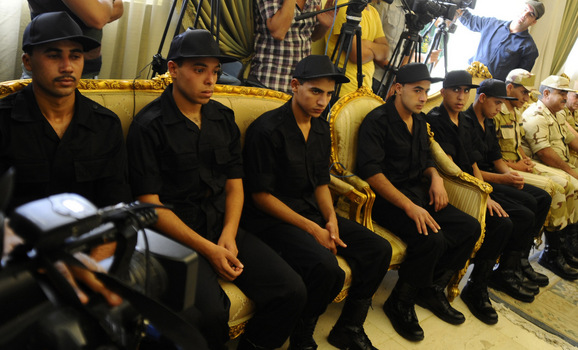
Soldiers who were kidnapped last week sit before a news conference by President Mohamed Mursi after their release

(Soldiers who were kidnapped last week sit before a news conference by President Mohammed Morsi after their release, photo by REUTERS)

I wrote this piece for  Al-Monitor. Look forward to your feedbacks and comments

Last week, Prime Minister Ismail Haniyeh of the Hamas government in Gaza called on Egypt to revise the Camp David Accords, which were signed with Israel. His speech came after the kidnapping and later release of Egyptian security personnel in Sinai by radical jihadist groups.

The debate about the peace treaty with Israel is not new. It is as old as the treaty itself. The recent deterioration of security in Sinai, however, particularly after the ouster of the Mubarak regime, has reinvigorated the debate about the Camp David Accords. This is especially the case regarding amendment of the security arrangement in Sinai.

It may look like an easy fix; let’s bring the Egyptian army in to combat terrorism in the increasingly lawless peninsula, but it’s not. When Sadat signed the Camp David Accords with Israel, he was a leader of the state of Egypt, forging a deal with the aim of ending the animosity with Israel and kick starting a wider peace process to solve the Arab-Israeli conflict. The military annex was negotiated within that context, preserving the peace between two nations. Thirty-four years later, Haniyeh’s speech reflects the new reality; there is neither a peace nor a two-nation deal. Security in the Sinai has become a dodgy threesome affair. To continue reading click here.

Posted in Egypt, Israel, Sinai | Tagged , , , , , | 1 Comment

Egyptian Aak: Week 21

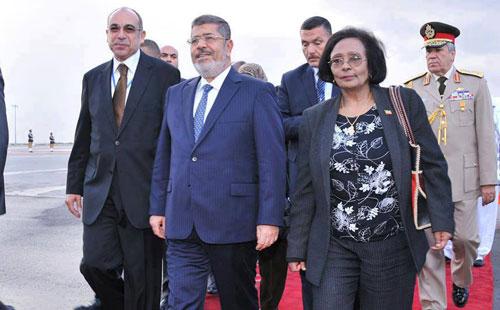
ethipia(President Morsi in Ethiopia was welcomed by the Mining Minister. Photo via Almogaz)

Main Headline

Monday

Tuesday

Wednesday

Thursday

Friday

 Saturday

 Sunday

A Few Thoughts

 Egypt’s water Crisis 

 The visit of president Morsi to Ethiopia has finally shifted the focus to the much-neglected topic of water resources in Egypt. Although many Egyptians have started to come to terms with the prospect that a water shortage could become a reality in the near future, the extent of the problem, and the impact of African projects, such as Ethiopia’s Renaissance Dam, has yet to sink-in.

1)   The issue is not just shortage; but water poverty. Each Egyptian citizen’s quota of water has fallen to 730 cubic liters per annum, far below the standard global quota of 1,000 cubic liters.

2)   Despite 95% of Egypt’s water supply coming from the Nile river, Egyptian abuse of the river on daily basis is astounding. For example, all sorts of garbage is dumped into the river, and Egyptians have a breathtaking lack of respect to their eternal river.

3)   Despite this poverty, water waste is a national life style. Most Egyptians take water for granted. Household and domestic leakage is very common, with little effort put into repair. In fact, leakage within public facilities is even worse.

4)   Previous Egyptian governments have consistently failed to invest in water conservation projects or in any reliable rationalization program for Nile water.

5)   The current government seems to have conflicting priorities. For example, there is a desire to expand agricultural land that directly conflicts with water rationing programs. This conflict will remain unless a complete strategy is formulated, but thus far, none has been articulated.

6)   The current relationship between Egypt and its African neighbors and in the past was notbuilt in a strategic way. Each subsequent Egyptian government failed to invest in building solid strategic alliances with countries of the Nile basin. Ironically, Egypt backed a butcher like Bashir, but not South Sudan or Ethiopia. This is precisely why the cold reception of president Morsi; welcomed by the mining minister instead of the president at the airport, and the turn of the microphone off during his speech in Addis Ababa should not come as any surprise.

7)   There are reports that Israel is encouraging Ethiopia to build the Renaissance Dam. Even if this is true, does it really matter? This is a geopolitical framework that strengthens Ethiopia’s position.

8)   A military solution is not an option. It would be counter-productive and would only drag the region into a deeper conflict

 It will take a lot more than just a visit to Ethiopia to fix this critical crisis. There are still no details about his agreement with the Ethiopian government, but any deal will not be enough to solve a very complex problem. Water poverty is a national security issue that Egypt’s Morsi cannot afford to ignore. Surely, ruling a thirsty, hungry Egypt is not the victory that Islamists have aspired to achieve.

 Power Outages

 Egypt’s increasing number of blackouts reminds me of my own childhood. Frankly, at the time they were fun; a good excuse to stop studying and listen to the radio. The current impact, however, is not good fun, as it now affects airports, hospitals, and factories.

 The attitude of the Egyptian government towards its electricity problem is again irresponsible. It is a silly mix of denial, blame the public, and accusations toward the opposition to spin the problem for political gain. Even when suggesting solutions, it comes up with some classic Islamist thinking, “the nation’s Imams and preachers need to help influence citizens to change their consumption patterns.” I doubt the government appreciates the depth of anger of the customers and how the campaign to stop paying electricity bills is gaining momentum. Well, good luck with preaching!

 Sinai

Sinai deserve a separate piece, but here another example of the preaching as the answer for all the problems: President Morsi sends religious leaders to Sinai to combat radicalism. again, good luck!

A Final Gem

 Talking about preachers, Dr. Abdel Rahman el-Ber, the Muslim Brotherhood’s Mufti has “allegedly” said that a Jewish psychic in the 60s has predicted that three presidents named Mohamed would rule Egypt, and the third Mohamed will liberate Jerusalem.  Translation: Nasser, Sadat, and Morsi, all share a first name of Mohamed, which mean that Morsi is the “third Mohamed.”

 The Mufti and his alleged Jewish psychic have failed, however, to count the first president of Egypt, Naguib. As the Egyptian writer Saad Hagras rightly noted, his first name was also Mohamed. Dr. el-Ber needs to re-study history before he preaches to Egypt’s biggest Islamist party. I’m quite sure a prompt denial will soon follow; “el-Bar never said any anything about Morsi III , and the Jewish psychic is a liar and a Zionist.” Meanwhile, here is an interesting Arabic piece about it by Abdelallah Kamal

Good Read

Interesting Reports

Finally, here are Jayson Casper’s prayers for Egypt

Posted in Diary of Aak, Egypt | Tagged , , , , , | 3 Comments

The Abuse of “Takbir” from Ballot Boxes To Woolwich

For many non-Muslims, “Allahu Akbar,” or God is Great has become synonymous with radicalism, brutal murders, rape, and even cannibalism committed in the name of Islam. It is hardly surprising, as the Islamic slogan has been repeatedly used and abused by anyone who wants to justify his or her crimes by adding the wrap of Islamic religiosity. A recent example of such glaring abuse in the name of God was the appalling crime in Woolwich, in which two criminals brutally attacked a soldier, beheading him and mutilating his body. Eyewitnesses reported how the perpetrators chanted, “Allahu Akbar” while committing their sick murder.

The crime in Woolwich, like many previous terrorist acts, ignited debate about Islam and extremism. Of particular interest has been whether radicalism is linked to the exploitation of Muslims’ grievances or ideological and theological interpretations of Islam. In fact, it has nothing to do with either. As Jamie Bartlett explains, many young al-Qaeda terrorists are not attracted by religion or ideology alone, but also by the glorification of violence, precisely why more attention should be paid to the concept of Takbir.

Historically and over the last few decades in contemporary usage, there has been a slow and subtle evolution in the use of “Allahu Akbar.” This shift sheds some light on the current “free for all” use of this slogan.

Allah for beauty

It may be a revelation for some, but until the 1970s, “Allahu Akbar” was used within the Muslim society mainly in the call for prayers and religious ceremonies. The wider public in the Muslim world used the word Allah to praise natural beauty. The term “Allah Akbar” was a step further and used during special occasions such as weddings, graduations, and birth. It was used as an expression of awe, reverence, or deep appreciation of God’s creation, and to invoke God’s blessing for these special events. Old black and white Egyptian movies are full of endless examples of such behaviors that reflect the depth of religiously and appreciation of the Almighty in Islamic tradition.

The rise of Takbir

The social, economic, and political changes in various Arab and Muslim societies, particularly with the rise of political Islam, have taken the use of “Allah Akbar” to a different and new meaning. Now, the word “Takbir” is a prompt used to trigger Muslims to chant “Allah Akbar,” and has become a routine at Islamist gatherings. This is the case for benign charity events to more sinister radical group meetings. For each, a man usually stands in the crowd with a special designated job to prompt others to chant “Allah Akbar.” Prompting the crowd to chant Islamic slogans has become a deliberate and devious policy by Islamist groups and parties to fog the relationship between Islam and politics, and to cast an air of legitimacy to their goals.

Takbir as a distress call

The Arab awakening has added a new shade to the politics of Takbir. On the one hand, it pushed various Islamist parties into the public arena. They all use Takbir and other religious slogans, yet they vary politically and religiously (e.g., Muslim Brotherhood and various Salafi parties). On the other hand, the ruthlessness of the fight in countries such as Syria has been reflected in an endless scream for God’s help. There are few videos emerging from Syria without the word Takbir in its content. Takbir has become a sign of distress and despair, rather than a sign of religious or political affiliation. The stunning destruction of cities, town, and villages has made Takbir a desperate call for help.

Takbir and wartime

In addition to its use in peacetime within the Muslim society, it is important to acknowledge that “Allah Akbar” was used in both medieval and contemporary battlefields, when Muslims were fighting foreign armies, mainly to create a sense of belonging, unity, and to evoke morals. It is also important, however, to understand that even in medieval times, these chants were organized, rationed by leaders, and were not allowed to overwhelm the scene or to exploit enemies. The manners and conducts of Saladin in fighting the crusaders was just one example.

This attitude has changed recently, particularly after the rise of none-state players, and radical groups. Radicalism, which is by definition an extremist act, has indulged in abusing the words “Allah Akbar” to justify murderous criminal acts. By creating a state of war as a permanent mindset and continuously feeding this mindset thru endless chants of God is Great, radicals exploit weak and insecure youth for criminal purposes within civilian communities. Invoking God has become the heroin of radical Islamists, numbing their moral codes and allowing them to authorize and legalize all forms of atrocities.

The shift in the use of Takbir from the vocabulary of beauty to the vocabulary of blood has, unfortunately, linked Muslims to gory crimes, as the one in Woolwich. For decades, many Muslims have failed to calibrate their religious barometer, and tolerated the hijacking of God’s name under various pretexts. While any anti-Islamic gestures have prompted overly irrational reactions, many Muslims have failed to see that the use of Takbir in election campaigns or civil war is far more blasphemous than a cheap video or cartoon that insults the prophet Mohamed.  Surely, God is not just “Great” because X has won a parliamentary or presidential seat, or because Y has donated some money to an Islamic charity, or even because a rival in a civil war has lost a tank or an aircraft. Such cheap and cheesy uses of God’s name—despite their good intentions—has led to a cumulative heritage that is eventually abused by radicals to glorify despicable crimes. In other words, political Islam did not invent criminality, but it initiated a slippery slope that eventually led to criminality.

Not much good comes out of horrific crimes such as the one in Woolwich, yet the graphic video that later emerged serves as another reminder to many devout Muslims of the glaring abuse of their religion, and has led the Muslim community in Britain to stand firmly against this abhorrent act. Meanwhile, in the Arab world, many Muslims continue to fight hard against radical Islamism to reclaim Islam from hijackers who use and abuse their religion for a wide range of purposes, ranging from winning elections to violent crimes.


This piece also published in  Daily News Egypt, and also translated to French

Posted in Britain, Islam, Politics | Tagged , , , , , | 14 Comments