Year one of the Syrian Revolution- A Timeline

This is a timeline of year one of the Syrian revolution. Many thanks to Iyad el-Baghdadi and Syria Deeply

Feb 2, 2011: Twenty Syrians hold a candlelight vigil for Egypt’s revolution. They’re attacked & beaten up by thugs.

Feb 15, 2011: Teen blogger Tal al Mallouhi sentenced to 5 years in prison for “espionage” in closed hearing.

Feb 17, 2011: Small protest in Syria shows people are fed up and ripe for revolution. 

Feb 20, 2011: Blogger Ahmad Abulkheir arrested for praising Tunisian revolution and posting anti-censorship information.

Feb 23, 2011: Rally in solidarity with Libya is violently dispersed.

Mar 6, 2011: Libyan rebels shoot down two Gaddafi fighter jets. Pilots had Syrian passports.

Mar 15, 2011: Having designated this day as a day of protests, many rallies across Syria: Damascus, Aleppo, Daraa, Homs, Banyas.

Mar 18, 2011: Violent clamp down leads protests to spread & escalate across the country. This is now a revolution.

Mar 20, 2011: Baath party headquarters in Daraa torched.

Mar 22, 2011: Stand off at Omari mosque in Daraa. Eventually 12 die and 200 are injured.

Mar 23, 2011: Regime already describes protests as a foreign powers plot carried out by Alqaeda.

Mar 25, 2011: One of the first “Friday demonstrations”. Daraa, Damascus, Douma, Homs, Hama, Latakia, Jableh. Deaths, injuries.

Mar 30, 2011: Bashar gives a speech to “his” parliament. Talks about emergency law and allowing multiple parties. Clamp down continues.

Mar 31, 2011: Assad forms a committee to study lifting emergency law, which was in effect since 1962.

April 8, 2011: Protests in Qamishlo (Kurdish majority town) despite offer of citizenship by Assad.

April 8, 2011: Protests in Daraa reach the 100,000 figure. Met with live gunfire. 23 reported dead in Daraa only on this day.

April 12, 2011: Regime starts a midnight military operation to clamp down on the city of Banias.

April 22, 2011: Protests reach Midan in the heart of Damascus. Clamp down continue. Overall death toll on this day 80+.

April 25, 2011: Full scale military operation by Assad’s army in Daraa. Rumors of defections. City is blockaded.

April 29, 2011: Protests get angrier across Syria, clamp down continues. More rumors about defections from Assad’s army in Daraa.

May & June 2011: Daily unarmed protests, especially on Fridays, across Syria. Clamp down continues. Demonstrators not backing down.

9 June 2011: Lt. Col. Hussein Harmoush among the first confirmed defections. Posts video and says him & other defectors will “protect the peaceful protests”.

Mid June 2011: Syrian army in full scale military operation in the north after defections. Revolution begins to adopt the pre-Baath flag.

16 June 2011: Billionnare tycoon, and Assad’s cousin Rami Makhlouf has publicly resigned

20 June 2011: Assad gives his third major speech since the uprising began.

July 8, 2011: Ibrahim Qashoush, who wrote & sang chants for unarmed protests, found dead. Larynx ripped out, dumped in river.

July 10 2011: Syrian officials announce a “National Dialogue” to advance political reform

July 19, 2011: Tanks deployed against protesters in Homs.

July 29, 2011: The Free Syrian Army (FSA) is declared.

July 31 2011:  Activists groups say 136 are killed in Hama, Dier ez-Zor, Harak, and Abu Kamal.

August 8 2011: Saudi Arabia, Kuwait, and Bahrain recall their ambassadors to Syria.

August 18 2011: Leaders in the US, France, Germany, and Britain call for Assad to resign.

August 23 2011: Syrian dissidents in Turkey announce the formation of the Syrian National Council.

August 25 2011: Ali Ferzat, a famed political cartoonist, is beaten up by pro-regime assailants.

September 2 2011: The European Union bans imports of Syrian oil.

September 21 2011: Turkey’s prime minister, Recap Tayyip Erdogan, says he has cut off all contacts with Syria.

October 4 2011: China and Russia use their veto power at the UN to block potential sanctions on Syria.

October 29 2011: As part of the ‘Siege of Homs,’ Baba Amr is pummeled by tanks and artillery.

November 12 2011: Syria is suspended from the Arab League.

December 13 2011: U.N. says more than 5,000 people were killed in Syria’s conflict.

December 22 2011: Arab League monitors arrive in Syria.

December 30 2011: An estimated 500,000 people participate in protests around the country.
Posted in Syria | Tagged , , , | 3 Comments

Week 34. A Few Thoughts

This piece was initially published in the premium edition of The Globe and Mail

October 6, 1981_____ the distance between my home and the bakery was no more than a few hundred meters, yet it felt like an endless journey. The vibrant streets of Cairo were reduced to a deafening silence, as if everyone has disappeared. My mother and I were totally unaware that president Sadat had been assassinated. In the eerily empty street, I met my first Army officer. He was bemused by my childish determination when I said, “I left home to get bread, I will not go back without it.” Miraculously, I got the bread and went back home with a new word added to my vocabulary, “curfew.” It was a word that I did not fully understand, as the deeper meaning and implications were lost to my childhood mind. I did know, however, that this word made Cairo a spooky place.

Since the forced ending of the Pro-Morsi sit-ins, the terrifying moments of 1981 have come back to haunt me. The current events continue to unfold in Egypt with a tragic loss of life, rage and violence, and the declaration of a state-of-emergency. In addition, the Egyptian government hints that it may declare the Muslim Brotherhood as a terrorist organization. Egypt’s new constitution (still in deliberations phase) may also outlaw religious political parties.

 The ongoing crisis has a different context and narrative, it nonetheless poses the same questions that many Egyptians were asking in 1981, “How will Egypt’s Islamists deal with the leadership’s brutal crackdown?”

 In theory, there are two main options being put forth by various observers. These are referred to as the Algerian and the Turkish scenarios. In the Algerian scenario, the forced ending of the sit-ins, the calls for disbandment of the Muslim Brotherhood and the arrest of many Islamist cadres, may tempt the Brotherhood and other groups to revise their stance on violence and revert from low-simmer aggression to a full-fledged violent campaign like their Algerian’ Brothers, which occurred following the cancellation of the 1991/1992 election in Algeria. The hypothesis that violence breeds violence is not just plausible, it also fits in with the Islamist’s defiant ideology.

 However, the history of the Islamists in Egypt dismisses the Algerian scenario. Despite Nasser brutal oppression, and banning of the Muslim Brotherhood, Islamism had slowly emerged after years of dormancy. Some groups, mainly the Muslim Brotherhood, had opted to reinforce their social basis, rather than taking arms and focused on gaining popularity in target areas like student unions and syndicates. This was seen as a preparatory phase for full–scale political participation. Meanwhile, some other radical groups opted for violent confrontations with the government, but only in late 70s after Sadat’s peace treaty with Israel. In hindsight, the 1981 emergency law and the assassination of Sadat was a blessing in disguise for the Muslim Brotherhood.

Despite maintaining warm relationship with other radical groups, the Brothers were generally perceived as non-violent victims, oppressed by the regime. Mubarak (who succeeded Sadat) has turned a blind eye to the Brotherhood’s widespread social activities.

 In contrast, 2013 has brought completely different challenges to the Brotherhood, as the group has now lost the trust of a wide section of Egyptian society. Now they is relying on other partners in an “ anti-coup coalition” in order to provide a good cover for the embattled, severely weakened Muslim Brotherhood. If the current ruthless crackdown continue, this coalition may decide to engage in a long standoff with the army that makes the violent confrontations of the 80s and 90s look like an elegant tea party, while allowing the Brotherhood as a group to mask itself and claim a “peaceful” stance. Political assassinations should not be dismissed as a possibility in the near future.

 The other alternative for the Brotherhood is the Turkish model. Some have drawn comparisons between Turkey’s ex-leader Erbakan and deposed Egyptian president Morsi, while others like to compare General Sisi and General Kenan Evren. Regardless of these mostly hollow comparisons, Turkey is living proof that Islamists can survive military coups and even win post-coup elections. Can Egyptian Islamists emulate the Turkish experience? Can they sideline their old guard and reform the party from within?

 It is a possibility that should not be dismissed, but it is still unlikely in the near future. There are two reasons for this. First, the current Turkish’s AKP leadership are openly adopting Brotherhood narratives and refusing to accept that their “Egyptian Brothers” have committed grave errors in judgment. Such a myopic Turkish stance, which contradict their own past non-defiance policy against Turkey’s military coup, does not encourage the Brotherhood to adopt more pragmatic, liberal reforms. Second, and more importantly, the skeleton of the group is inherently authoritarian, and it regards its authoritarianism as an appealing card that wins hearts and mind among their core conservative supporters.

 Perhaps, there are other tactics that the Brotherhood may try. There is a possibility that they may try to divide the Egyptian army, and recruit junior cadres to create an Egyptian version of the Free Syrian army. Some Islamists even openly admitted this intention during the sit-ins. This approach may not be successful initially, but a long standoff with the army may challenge the loyalties of middle-ranking officer corps and conscripts. The Egyptian army is stretched and has already called on reserve ranks. I doubt they will succeed; the army chief, General Sisi is still very popular within the army, he is also a very conservative Muslim that has succeeded to a large extent in forging a new national identity that counters the Islamist ideology.

 Another important factor that may decide the future of the Muslim Brotherhood is their financial funding. Thus far, the group has had no problems with financing, however, the group’s funds have been frozen inside of Egypt and the rising hostility against the group in many Arab countries may create enough of a financial crisis to severely curtail its activities. Nonetheless, the international wings of the Muslim Brotherhood will not leave the parent group in Egypt to suffocate financially and will make every effort to help them to survive.

 Thus, after looking at these two scenarios, it is difficult to predict how the current standoff will end between Egypt’s two major illiberal forces, the Muslim Brotherhood and the military. Regardless, Egyptians should not be distracted by those who are trying to pull the country back to the old days of authoritarianism. We should instead focus instead on the goals of our revolution: bread, freedom, and social justice. These demands will not happen without an inclusive constitution that doesn’t exclude any section of the Egyptian society, but prevent the abuse of religion in politics. This delicate balance is crucial for the salvation of Egypt. Since my childhood, our democratic aspirations have proven to be elusive to achieve; we cannot afford to waste another opportunity to grasp at these goals. History will not forgive us if we waste this chance.

Posted in Diary of Aak, Egypt | Tagged , , , , , , , , | 3 Comments

Egyptian Aak. Week 34

Main Headlines

Monday

Tuesday

Wednesday

 Thursday

  • Mubarak flown from prison to hospital-sources –
  • NSF rejects drafted amended parliamentary articles in Constitution
  • Rebel campaign blames Morsi for Mubarak’s release order
  • Egyptians rally at White House denouncing Brotherhood, and Obama
  • Anti-coup alliance calls for mass protests on Friday
  • Police arrest Muslim Brotherhood’s Hassan al-Brens

Friday

 Saturday

Sunday

Two recent interesting polls:

Baseera poll and Pew Research Center

Great Read

 Three interesting pieces about Egypt’s proposed constitution:

Plus:

Finally here are Jayson Casper’s prayers for Egypt

Posted in Diary of Aak, Egypt | Tagged , , , , , , | 2 Comments

Here are my thought that was published today in Fikra Forum about the forced end of the sit-in and the crisis in Egypt:

I wrote on Sunday, August 11 that the sit-ins should be left alone and not dispersed by force; it seems that the government lost patience, and viewed the Muslim Brotherhood (MB) and its supporters as an increasingly provocative group looking to defy the state. Sadly, the government’s tactics were brutal and deplorable, and there were other non-lethal measures that they could have tried before using force.

After the sit-ins were forcibly dispersed, emergency law became inevitable. Pro-Morsi protestors had been indoctrinated for 7 weeks during the sit-ins that Copts and regime thugs were behind the coup, so the military’s action against the protestors unleashed their raw, pent up anger.

I doubt both sides will reconcile their differences, and it appears that there are dark days ahead for Egypt. The leadership is currently engaged in a termination game with the Muslim Brotherhood, and thus far, the military seems to have the upper hand. The future of democracy in Egypt will depend on the outcome of this battle. If the violence continues, Egypt could be doomed for years of autocracy, but if the military succeeds in controlling the violence, it is possible that steps toward democracy can be taken. How this will happen and to what extent remains to be seen. One thing, however, is clear: Egypt’s leadership and the broader public do not care about the U.S. or its calls for democracy.

Among those who are neither pro-Morsi nor pro-military, the mood is somber, and there is a sense of helplessness. In Egypt, those who are genuine are not powerful, and those who are powerful (on both sides) may not necessarily be genuine.

Posted in Egypt | Tagged , , , , , | 1 Comment

Week 33: A Few Thoughts. Rabaa

rabaa photo 2

Raba’a el-Adawyia, an Arab girl born in Iraq in a humble background was the fourth born child in her family, so her dad named her Rabaa, or fourth in Arabic. Rabaa was known for her ascetic life and for her Sufi poems.

 In Egypt, there is a mosque named after Raba’a al-Adawyia that is situated in a square in Nasr city, a suburb of Cairo. On June 28, the pro-Morsi supporters picked this square for their sit-in; an encampment that continued for 7 weeks until the Egyptian police ruthlessly end it on Black Wednesday.  The crackdown, understandably, has created a shock wave around the globe. The images of the dead victims (more than 600) have rightly trigged a sense of disgust and outrage.  August 14 will be marked forever as a black, shameful day in the history of Egypt.

 As I wrote last Sunday, the best way to deal with the Islamists’ sit-ins is to ignore them, until the numbers gradually fade. Unfortunately, the current Egyptian leadership has opted for the exact opposite; a bullish response that was not gradual. There were various non-lethal methods that could be tried first; however, all were ignored and ruthlessness was the police and army’s choice. Their ruthless actions (as Iyad El-Baghdadi aptly describe it) effectively whitewashed the Muslim Brotherhood’s obscene, dystopian atmosphere they created inside the sit-ins in which there was a consistent twist of the Islamic faith to serve their political goals, and intensive sectarian rhetoric against the Copts for the “supporting the coup.”

 One the best analyses I read after the carnage was by Brain Whitaker: “Two-and-a-half years after the uprising against the Mubarak regime so many people still hanker after authoritarian solutions.”  He rightly pointed out that the Muslim Brotherhood is playing the same cynical game as the military: “They have reverted to playing the role of aggrieved victim—a role in which the military have assisted by providing them with martyrs.” I am glad that these words were written by a Guardian journalist__. If any Egyptian had written something similar, he or she would be accused of siding by the Junta and dehumanizing the Islamists.

 In a piece published in the New York Times, Rick Gladstone gathered the opinions of analysts and experts who have suggested “the ferocity of the attack…had been a deliberate calculation of the military-appointed government to provoke violence from the Muslim Brotherhood and its allies.”

 This theory could indeed be true; however, it has two main flaws. First, it postulates that the police’s brutal methods are almost exclusively reserved to be used against Islamists. This theory ignores the long history of murder and torture that the Junta has committed since Nasser. The angry mobs that defied the central authorities in 1972, 1977, and 1986 were not from the Islamists, yet they all were ruthlessly killed or tortured. The difference today, is the higher numbers and the existence of social media that has spread the gory images of the victims.

 Authoritarianism is an endemic virus that chronically occupies the Egyptian psyche regardless of political or ideological affiliation. There is a question that an apolitical friend from Cairo asked me, and I resisted answering: If Morsi is still in power with a loyal army, and the Tamarod rebels were the occupier of Rabaa, would he leave them alone? Or would he ruthlessly crush them?  I honestly do not want to speculate, but the answer to this question could define the crisis in Egypt. Many in Egypt now have stopped believing that Ballot boxes are a cure for tyranny because, in their eyes, it legalizes authoritarianism, and they prefer an overt autocracy than a covert one.

 There is another problem with the Galdstone piece; it somehow infantilizes Islamists as if they are easily tricked. I find this difficult to believe, especially in view of their 80-year history in politics and more than 60 years of turbulent confrontations with the Junta.  Since late June, the Islamists have refused to take the army’s threats seriously, they dismissed Sissi’s ultimatum, and looked surprised by the coup; later in Rabaa, they dismissed the threat of ending the sit-in and claimed that it was just psychological warfare. There is no explanation to this absurd behavior except an utter underestimation of their enemy that has led to tragic miscalculations.

 The stakes for Egypt are high; many are rightly predicting the return of a dark tyrannical era that will make Mubarak rule look soft and mild.

 I humbly appeal to the Muslim Brotherhood to listen to the voice of reason; defiance and marches may attract the world’s sympathy, but it will neither stop the bloodshed in Egypt nor revert the country back to the democratic path. Syria is a living example of the failure of the international community to stop the on-going bloodshed. Iran is another example of the failure of boycott as a method to stop tyranny.  The United States and the EU could withdraw their aid if they want; however, they must understand that their actions will have minimum impact on the ground, particularly after the Gulf pledged aid. The lack of western leverage in Egypt will only force the country to bed other autocratic regimes.

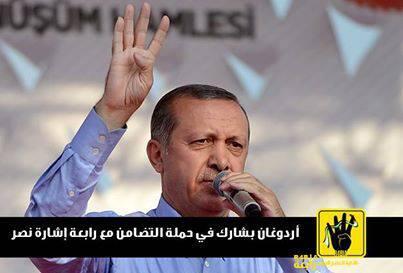
 The only way to defeat the Junta is to stop playing into their hands; by taking a step back to lick the bleeding wounds, withdraw from the streets, and focus on winning back their other partners in the January 2011 revolution. This may take time; serious reflection on last year’s tragic mistakes is needed and major reforms inside the Brotherhood’s autocratic system is the only way to restore democracy in Egypt. If Rabaa is a symbol, it is certainly not a symbol of defiance or victory as Mr. Erdogan likes to promote, but a symbol of devotion and divine love, two qualities that are truly lacking at the moment. The Islamists are now the underdogs and they need, more than anyone else, to play a smarter game that will restore their credibility in the Egyptian streets.

 Egypt is now bitterly divided; those who are genuine are no longer powerful; however, decision makers, on both sides, may not necessarily be genuine. It is time to remember our revolution and our struggle for freedom, justice, and equality. That is our only salvation. Nonetheless, the burden is not just on the Islamists’ shoulders, non-Islamists must stop cheering the Junta. Demonizing the Islamists will neither uproot them from Egypt nor it will make the conservative public cheer for liberalism. Both sides must grow–up and “wake-up.”  Until this happen, please stop playing the “four” symbol because it is frankly meaningless.

Posted in Diary of Aak, Egypt, June30 | Tagged , , , , | 7 Comments

Egyptian Aak. Week 33

Main Headlines

Monday

Tuesday

Wednesday

Thursday

Friday

Saturday

 Sunday

Good Read

Finally here are Jayson Casper’s prayers for Egypt

I will write my thoughts about Egypt in a separate post.

Posted in Diary of Aak, Egypt | Tagged , , , , , , , , , | Leave a comment

Egyptian Aak- Week 32. The Dystopian Camps

 Main Headlines

 Monday

Tuesday

Wednesday

 Thursday

  • EU envoy is latest diplomat to leave Egypt after negotiations declared a ‘failure’
  • Morsi’s wife: President is definitely coming back
  • Hamas PM denies group’s interference in Egyptian affairs
  • Rights groups call for end to incitement against Christians
  • Obama and Erdogan discuss Egypt

Friday

 Saturday

  • Army ‘dealt’ with culprits behind the killing of 16 soldiers in Sinai 2012
  • Israeli Minsiter of Defence Ya’alon: Israel respects Egypt‘s sovereignty
  • No Egyptian-Israeli coordination on Sinai operations against jihadists
  • Muslim Brotherhood rejects al-Azhar reconciliation plans
  • 10 Brotherhood detained for inciting violence in Fayoum
  • Victim of harassment killed in Tanta

Sunday

A Few Thoughts

One of the unintended consequences of the crisis in Egypt is that it gave many of its subjects the opportunity to have a taste of extraordinary low-budget camping, right in the heart of the capital, Cairo. For many ordinary Egyptians, camping is a novel concept that they have only watched on TV. Egyptian films and soap operas are also full of stories about cool, spoiled rich youth, camping near the Red Sea or along the northern Mediterranean coast. Unlike Europe and the U.S. where camping is available for everyone, in Egypt, it is usually the kind of exclusive adventure left for the elite who are looking for “a different vacation.”  Perhaps that is why some describe the crisis in Egypt as a “class divide,” however, there is more to the conflict than a class war, many working class Egyptians are strong supporters of the army chief, general el-Sissi. The division in Egypt has more subtle sides; including, chemistry, affiliations, links, and yes, attraction to this kind of summer camps.

 Following June30, the Rabaa and Nahda sit-in has slowly evolved into proper camps. With the Brotherhood’s organizational skills, and the Egyptians amazing improvisation, the Islamists have managed to turn Rabaa and Nahda into well-functioning shantytowns. Life has started to evolve to fit the daily needs of the supporters. Pragmatism has become a necessity; pirating electricity from road lamps became halal and music and dance is allowed (usually strictly prohibited). In fact, this has become acceptable entertainment to celebrate “the Eid of victory,” and even looking for “observant women” as possible brides is allowed.

 The sit-in camps have offered a glimpse of the Islamists’ version of “a utopian society,” a society that is made up of loyal subjects, embracing an Islamist leader without questioning his abilities; a society that is equipped to encourage unquestioned loyalty. This is a society where non-Islamists and minorities do not exist. Here, dissent is an alien concept. Historically, the Muslim Brotherhood and other Islamists groups has excelled in maintaining the loyalties of their supporters, but failed miserably in dealing with their opponents. This is precisely why they survive well while underground, but then fail when they emerged into the light.

 The Brotherhood’s so-called renaissance project has based its future success on embracing three virtues: listen, agree, and follow; and on rejecting three vices: thinking, reflecting and disagreeing. The conundrum for the Brotherhood has always been on how to deal with dissent and those who reject their doctrine. This is a tricky challenge in true democracies. Islamists scholars have failed to provide a workable formula that could prevent a contemporary version of the assassination of Caliph Osman or Caliph Ali. Even when they adopted democracy, they still failed to provide an answer, and in fact wrote an Egyptian constitution that make impeachment almost impossible.

 Sunni Islamists thought that they were smarter than their Shia “Brothers” in Iran, who function in a fully pledged theocracy. Instead, the Sunnis thought they could bring the best of both worlds and have a public mandate through the ballot box and illiberal governance through Sharia. This did not work and many who stood against Mubarak and Ben-Ali strongly disagreed with this forced deal. They demanded a proper democracy, and not a ballotocracy. This is precisely why they revolted on June30. The millions who poured into the streets had legitimate reasons to revolt against Morsi’s Islamist regime, regardless of the eventual coup and whether it was plotted in advance or not.

 It is hard to judge events in hindsight, but the army’s hasty decision to join the revolt in its early days has undoubtedly overshadowed the civilian uprising. Morsi was not in a stronger position than Mubarak in 2011, and he would have probably been forced to resign, particularly if the police and the army refused to obey his orders. The bloodshed would probably be more than what Egypt witnessed after July 3, but it would expose the Brotherhood’s ruthless face. Unfortunately, the “coup” has given the Brotherhood an excuse to launch its “anti-coup campaign.”  As a result, the army versus the Islamists stand-off has masked a bigger and more important debate, how to counter the Islamists’ dystopian project?

 As I tweeted on several occasions, a forced ending of the sit-ins is myopic, counter-productive, and only a short-term solution to a bigger and deeper problem. These sit-ins have survived partly because of the tenacity of the participants, but also because of the huge worldwide attention by the media. The weddings, kid zones, flowers, and media statements are all designed to please foreign observers, more so than the loyal followers. In reality, Rabaa and Nahda are nothing more than political summer camps that will end once the participants have had a large enough dose of adventure, and when sponsors realize that maintenance costs are more than the political rewards.

 That is why Bassem Sabry is right, Egypt should not break up the sit-ins, and rather should just leave it to dissolve organically. That is also why the alleged plan to end the sit-ins as published in the Arabic newspaper Al-Sharq Al-Awsat is dangerous and reckless to say the least. The geography of the Nahda sit-in may facilitate a forced break-up, but Rabaa’s site is trickier with a higher risk for bloodshed, even if the casualties are in tens and not the hundreds as some have predicted. A containment policy may be more realistic in the form of clearing all the roads clearing to the sit-in, and removing road blacks, securing all the side roads, preventing further sit-ins in other squares, and securing military building and headquarters.

 The solution for Egypt’s political deadlock may be tricky, however, there is a golden opportunity to challenge this Islamic project. Rabaa and Nahda are no more than distorting mirrors that deflect the unsustainability of the broader, mythical Islamist project. The crowds inside both camps are happy with the fraternity and sense of unity, but also because the camps have sheltered them from other challenges that they face in their daily lives. It is better to leave the jubilant crowd alone, until they realize that sheltering reality is not the solution. Sooner or later the sponsored “camp holiday.” The Brotherhood tycoons cannot sponsor their loyal Egyptians permanently; their ideological project is more bankrupt than their dodgy finance, and the crowd will slowly realize that the organizers are running out of ideas. Chanting Takbeer will not make Egypt an Islamic state, nor it will bring back a deposed failed leader.

 If Egyptian politicians are really keen on the future of Egypt, they should focus on fixing Egypt’s dysfunctional political system, and strike the right balance between the demands of the ordinary Islamist crowd, and the wider non-Islamist Muslims, Copts and other minorities. This needs to be done in a more robust constitution, together with a serious of social reforms at basic level of service, particularly in rural regions so as to counter the poisonous indoctrination by zealous Islamist preachers.

 All the above may take a long time to fulfill, with many possible painful short-term problems, but it is Egypt’s only path to salvation. Meanwhile, ignore the “Republic of Rabaa, the Emirate of Nahda.” Egypt is bigger than them. Bloodshed will only inject life into a dystopian project that has repeatedly failed to face reality. I hope the decision to end the sit-ins (allegedly on Monday) to be reversed.

Good Reports

Good Read

Finally, here are Jayson Casper’s prayers for Egypt

Posted in Diary of Aak, Egypt, June30 | Tagged , , , , , , | 1 Comment

Egyptian Aak- Week 31. The Anatomy of Defiance

Main Headlines

 Monday

Tuesday

Wednesday

Thursday

Friday

Saturday

Sunday

  • Trial of Egypt‘s Muslim Brotherhood leaders on charges of killing protesters to open Aug 25
  • Head of Morsi’s office arrested for presidential palace violence
  • Egyptian authorities say clock is ticking on talks to find peaceful end to pro-Morsi sit-ins:
  • 15 injured in Minya sectarian clashes

A Few Thoughts

 Amidst the 2006 war in Lebanon, and while hiding in his bunker, Hezbollah leader Hassan Nasrallah was once asked: What is victory?  He calmly replied, “Defiance.” This redefinition of victory makes sense, especially if defeating the enemy is difficult to achieve. In such a situation, bold resistance is the next best course. Hamas has also adopted the same mentality in two consecutive Gaza wars (2009 and 2012), allowing the group to declare victory in both.

 Popular defiance is an integral part of the anatomy of Islamism. It is usually triggered by Islamists are faced by overwhelming developments that transcend their abilities and maneuvering skills. Interestingly, the supporters of ousted Egyptian president Mohamed Morsi have decided to copycat parts of the resistance manual, and apply the same tactics, outside war-zones, against the military coup in Egypt.

 Defiance has two main goals: First, it sheds the sense of defeat, sidelines the reasons for failures, and transforms the feeling of being the underdog with its sense of victimhood and emotional irrationality into something positive, and even productive. Second, it creates favorable conditions that pressure their opponents to accept concessions.

 Arguably, it has worked. The sit-ins at Rabaa and Nahda have continued for days, despite July 26 demonstrations in support of Sissi’s mandate against “terror,” and the repeated calls by the Interior Minster to end the sit-ins. There have been a consistent number of jubilant participants (men, women and children), thanks to an embodiment of total demonization, which has been an effective tool in maintaining the determination and tenacity of the crowd. Now, the pro-Morsi supporters consider Sissi as an extreme version of Sharon, Saddam, Assad, and Ghaddafi. Such hyperbolic labeling has compelled some protestors to pray for his paralysis, even comparing him to the devil that dared to disobey the Almighty.

 The psychology of this crowd should not be overlooked. Although there are some non-Islamists in the sit-in who are simply against the coup, the majorities are Islamists, and according to many observers, most are from rural areas that have come especially to join in. Such gatherings provide a huge sense of empowerment to many previously marginalized communities and give them a sense of belonging and self-importance.

 There is endless debate about how to end the sit-ins, however in reality, the options are limited:

 1-    A full-scale security operation:

A mini-Tiananmen, as I have written before. Ex-Brotherhood, Kamal al-Helbawy in a TV interview has reminded the audience of September 1970, whenKing Hussein ordered a full-scale attack on Palestinian “freedom fighters” in Jordan. Of course the parallel is not exactly right, as there are many differences between the two scenarios, particularly as the Islamists in Egypt are mostly peaceful. However, it is an example of a brutal crackdown that worked effectively against a defiant underdog.

 2-    The Taksim Model

 Many have suggested more gentle methods to disperse the sit-ins, mainly a collection of actions using water-canons and tear gas. This worked in Turkey and the Turkish police have managed to successfully end the sit-in in Gezi Park with a minimum loss of life. The pro-Morsi crowds in Egypt, however, are more defiant and openly seeking martyrdom. Water and tear gas may not be enough to disperse them.

 3-    A political deal

This is precisely what the Brotherhood is after, a deal that they can sell to their supporters as victory and reward for their defiance. The ceasefire deals in Gaza and in South Lebanon were always marketed as a proof of “victory.”  Morsi’s supporters have three main demands: the return of Morsi as president, the 2012 Constitution, and the reinstatement of a Shura Council. Any deal that may include any of this, even temporarily, will be considered as a huge achievement. Again, despite El Baradei enthusiasm and local and international efforts, it is unlikely that such a compromise deal will be achieved.

4- Indifference:

 There is a possible fourth way that the Egyptian authorities may try: Simply ignore Rabaa and Nahda as if they do not exist.  No official statements, no media comments, and no threats. Ignoring you opponents can be a good anger draining exercise, which may render their defiance as meaningless. The hope is, sooner or later, the Brotherhood and other Islamists may learn the hard lesson that many non-Islamists have learned after Mohamed Mahmoud, and Occupying the cabinet that protests and sit-ins are effective in the short term, but the longer they continue, the more ineffective they become.

 The tragedy of the Muslim Brotherhood is not the July 3 coup, but their inability to behave as politicians. The Rabaa and Nahda sit-ins are a reflection of a feckless resistance movement that has dramatically failed to play politics.

Interestingly, three prominent, pro-Morsi, ultra conservative Sheiks, including Sheik Mohamed Hassan has met General Sissi on Friday. According to Sheik Hassan:  “[Al Sissi] called for the sit-ins to be peaceful and promised not to clear them by force.”  There is a big debate about Sissi’s religious and political affiliation (if any). This debate is linked to a broader discussion about the difference between conservatism and Islamism in the Muslim world. In general, Most of the Egyptian army cadres are pious, conservative, and may find Salafi literalism appealing. Many of them may revere ultra conservative leaders like Sheik Hassan, however, they may view organized groups like the Muslim Brotherhood with unease. 

 It is also worth mentioning that there is a subtle difference between the Rabaa and the Nahada camps, as Khlail al-Anani rightly hinted: “The difference between Rabaa and Nahda is exactly the difference between the Muslim Brotherhood and other Islamists.” It is pointless to predict what option the military and the Egyptians authorities will finally choose to end the sit-in, however, by choosing to meet Sheik Hassan, Sissi may want to exploit the ideological differences between the two camps, as a key strategy to end the sit-ins.

Good Read 

Plus:

  • General Sissi’s interview with the Washington Post
  • Video of Mohammed El Baradei‘s interview on Al-Hayat TV (Arabic)

Finally, here are Jayson Casper‘s prayers for Egypt

Posted in Diary of Aak, Egypt, June30 | Tagged , , , , , , , , , | 1 Comment

Egypt’s Nexus of Power

NexusOfPowerEgypt photo

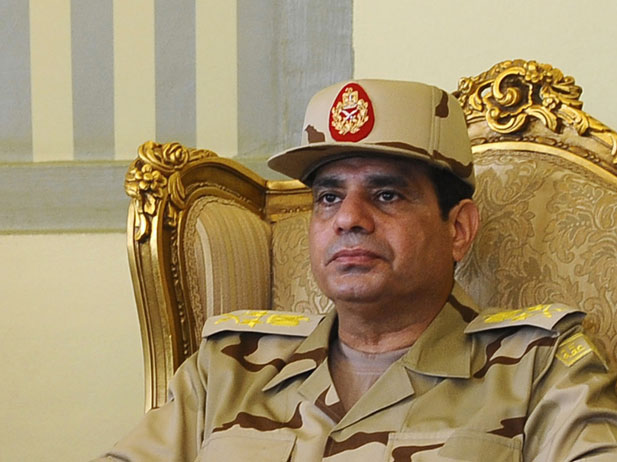
Egypt’s Defense Minister Abdel Fattah al Sisi is seen during a news conference in Cairo (Stringer/Courtesy Reuters).

I wrote this piece as a guest post for Steven Cook, Council on Foreign Relations

Who will be Egypt’s next president? Egypt has a notorious record of being ruled by the most unexpected candidate. In 1952, Maj. Gen. Mohammed Naguib was the most senior of the Free Officers, but he didn’t survive for long. Anwar Sadat was the least prominent of Gamal Abdel Nasser’s vice presidents, yet he managed to outmaneuver the others and rule. Hosni Mubarak was uncharismatic, but he survived for thirty years. Mohammed Morsi was his group’s second choice. He won in a free and fair election, only to lose his popularity after one year in power. Even the current interim president, Adly Mansour, was relatively unknown before the coup. If we are serious about planning for the future, it’s about time we take a closer look at the dynamics of Egyptian leadership.

For decades, Egypt has been a consented autocracy, in which leaders have managed to extract some sort of agreement from the public in order to continue to rule the country.

Initially, two rival forces have always competed to win the public: the leader and his loyalists, and the agents of political Islam (mainly the Muslim Brotherhood). As a basic rule, one of them must align with the public in order to alienate its rival. In 1954, Nasser managed to achieve this critical alignment, alienating the Muslim Brotherhood. The dynamics have slowly changed in favor of the Islamists following the January 2011 revolution, but only just so. The leaderless revolution has failed to sideline the old guards; instead, it has shifted the balance ever so slightly in favor of the Islamists. The last presidential election reflected this reality. Despite the availability of good and passable contenders, the winners of the first phase (Morsi and Ahmed Shafiq) were from the old groups: the former, a member of the Muslim Brotherhood, and the latter being a Mubarak loyalist. Their ability to advance to the run-off phase was due to the powerful election machines behind each of them. In the second round, many Egyptians reluctantly aligned themselves with the Islamists, and voted for Morsi in order to defeat the ex-regime camp.

There is another dimension to Egypt’s complex political dynamics: the military forces. During the Nasser and Sadat years, the Egyptian armed forces were a clear part of the ruling establishment, but its role began to shift during Mubarak’s tenure, when it became distinguishable from Mubarak’s civilian elite: the two had closely interwoven interests, but occasionally had a very tense relationship.

The Supreme Council of Armed Forces (SCAF) is an enigmatic group that is often misread by many observers. Its leaders can be pious, but are not necessarily Islamists. They can be populists, but are not exactly secular. They can be non-democrats, but aren’t manic tyrants. In short, they change ideology, outlook, and vocabulary to serve their own interests.

The Egyptian public is the only group that the military’s generals always care to win over in terms of loyalty. Throughout its history, the military has not been able to afford a hostile public. They fought in 1973 to win the public back after the defeat at the hands of Israeli forces in the Six-Day War. In 2012 they handed power to Morsi to improve their plummeting popularity during the post-Mubarak transition; however, the Muslim Brotherhood was always under the surveillance of the generals, who allowed the Brothers to rule, but only gave them enough rope to hang themselves.

Later, the SCAF successfully reinvented itself, thanks to Morsi’s failed leadership, and to the rise of the army’s “new star,” General Abdel Fattah al Sisi.

How will these complex dynamics among Egypt’s principal political actors impact the next presidential election?

Interestingly, hours after al Sisi called for a mandate from the Egyptian public to fight “terrorism,” ex-presidential candidate Ahmed Shafiq appeared in a video, appealing to Egyptians to take notice of al Sisi’s message. His intriguing video appearance has reignited the debate about his future, and whether or not he will run in the next election. An unexpected comeback is not far-fetched for Shafiq. He definitely knows how to reinvent himself. In the last election, he presented himself as an experienced man who could provide stability. The same logic can successfully be applied again, as Egyptians become more and more weary of chaos and uncertainty.

However, for Shafiq to win he must not only be acquitted of the many legal cases that have piled up against him, but he must also have weaker and unpopular opponents. Those who voted for him in 2012 did so because they either supported the ex-regime, or felt a deep mistrust for the Brotherhood candidate Mohammed Morsi, or both. Therefore, the political future of Shafiq will depend on many factors – the presence of an Islamist candidate, a strong showing from Mubarak-regime supporters, and also a possible nod from General al Sisi.

While a candidate like Shafiq might very well benefit from having a member of the Muslim Brotherhood on the ballot, other Islamists like Abdel Moneim Aboul Fetouh, himself a former member of the Brotherhood, will stand a better chance at electoral victory if the legal witch-hunt against the Muslim Brotherhood continues and ruins their chances in the next election. Aboul Fetouh’s semi-neutral stance, which swings between the army and the Brotherhood, coupled with the absence of another Muslim Brotherhood candidate, could make his victory a real possibility, as the Islamist crowd may rally behind him. However, he is often criticized for being indecisive and weak, accusations that could cost him dearly.

Perhaps the remnants of the Mubarak regime, or “felool,” may seek a better candidate than Shafiq this time to try and secure a decisive victory, and who would be better to rule the country than the “sexy guy” in black sunglasses?  Despite a firm denial, there are no legal obstacles that would prevent General al Sisi from retiring from the army and running for election. Already, his supporters are painting him as “a nice mix of Nasser and Sadat,” and they are also citing other examples of successful military servicemen who turned to politics like U.S. Senator John McCain.

It is rather ironic that after two recent uprisings, the future of Egypt could be determined by one man, General al Sisi; everyone wonders if he is secular or Islamist; democrat or autocrat. He is now holding many keys, and he may decide to run the show openly, or subcontract it to a loyal civilian like Shafiq, or another new name that may crawl out from the woodwork in the next few months or so.

However, it does not have to be this way. The future of an entire country should not depend on one man, regardless of how good he is; the general public is the true holder of power in Egypt, and all parties need its support for their political survival.

In the end, it doesn’t matter who will be Egypt’s next president, but rather who will back him and at what cost. The future of Egypt involves more than just the actual voting process – it depends on if the public will continue to be satisfied with being swayed and seduced by the old guards, or will instead put serious effort into breaking the nexus of power that has persisted for decades. The next few months will be decisive, and can shape the country for years to come, and the new boss could be a surprising name that no one possibly could have predicted.

Posted in Egypt | Tagged , , , , , | 2 Comments

Egyptian’s Aak- Week 30. On Mandate and Massacres

July 26

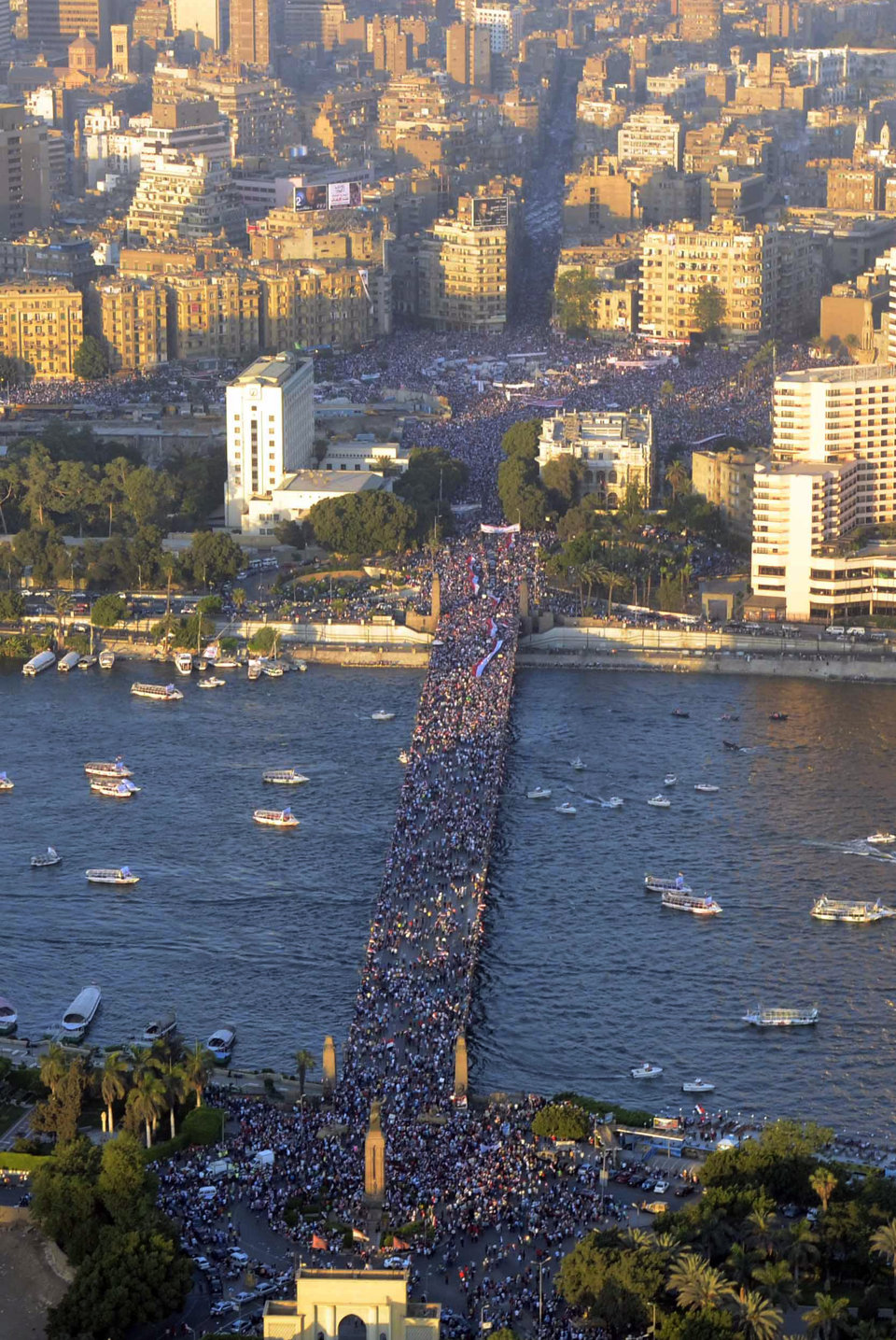
 (Pro-Military July 26 demonstrations, via Egypt independent)

Main Headlines

 Monday

Tuesday

Wednesday

 Thursday

Friday

 Saturday

Sunday

A Few Thoughts

Thirty weeks have passed since I started this diary on current events in Egypt, and it is messy politics or “ the Aak.” However, I have to admit that this week was by far the worst. Surely, Egypt has witnessed many tragic events in the past—blood, violence, and turmoil—but, I personally have never witnessed such disintegration of social cohesion as I did this week, even within groups of close friends and family members.

To explain this week’s events without being dragged into the battle of conflicting narratives and disinformation, let me first introduce two psychological tools commonly used by Egyptians: balloon tests and religious occasions.

Last week, the Muslim Brotherhood organized massive marches to celebrate the 10th of Ramadan, the anniversary of the October War on the Islamic calendar. Their plan was to march again on the 17th of Ramadan (Friday), which commemorates the battle of Badr, the first battle in Islam. On that same day, General Sissi, former Director of Military Intelligence, before being promoted (by Morsi) to Army Chief, decided to counter their move by calling for a massive protests for the “great Egyptian people to give him a mandate to fight terror.”

Does Sissi honestly need a mandate? Certainly not, it is his job to defend the country, so why has he called for this protest?

Simply put, there are two reasons. First, the protest is a form of visual psychological warfare against the Muslim Brotherhood to expose their relatively small number of supporters.  News coverage of a packed Tahrir Square and other squares will definitely minimize the visual impact of the pro-Morsi sit-in in Rabaa. Second, the protest will serve as a balloon test of the mood of the general public; a large turnout will confirm his popularity and silence foreign critiques.

There is no doubt that Sissi perfectly understands the strengths and weaknesses of the Muslim Brotherhood, including their great ability to rally and protest and their inept performance in negotiations and inability to compromise. The mother of all resistance movements in the Middle East has failed to transform into a crafty, skilled political party. Ironically, the Muslim Brotherhood’s performance in conducting the Rabaa sit-in has proven that Morsi’s return will not solve the country’s crisis; defiance alone does not solve any crisis or prove effective leadership.

Now, there are talks about a “legal” end to the sit-in. How would this happen?  We can only assume that a court order to end the sit-in will be delivered soon and be based on complaints filed by local residents who have had enough after a month of disturbance in their lives. However, the implementation of the court order could be a disaster. Having already witnessed two major bloodsheds, a third could be massive and, frankly, disastrous; I cannot even contemplate it. Unfortunately, the Brotherhood has failed to comprehend that even a massive round of international condemnation and the repeated Turkish rage of PM Erdogan will not put a dent in the army’s determination. I doubt that Sissi will end the sit-in now despite threats and ultimatums. Like many army generals, he prefers the pliers to the knife. In other words, he seems to prefer the slow torture of his enemy rather than a sharp decisive death—cruel, but effective.  The atmosphere is already bleak in Rabaa, and the longer it endures, the bleaker it gets. In addition, the public has already become sensitive to the news of death, and are readily buying the war on terror narrative.

What is sad is that it didn’t have to be this way. I am a supporter of June 30, but I am certainly not an advocate for a return to military rule. If Morsi was smart enough to listen to the people, none of this would have happened. The perfect scenario, for me, would be that Morsi step down without an army ultimatum. Now, we are all snookered; every time I see a poster of Sissi, my heart sinks.

That is, why I am pleading for the Muslim Brotherhood to see sense and end the Rabaa sit-in? They must stop playing to the army’s hand. It is not all or nothing, this is a defeat, but not the end of political Islam; they can reflect, learn, and reform.

Here are a few points that I hope both sides consider:

  • Both sides must stop the disinformation war. Hyperbole, parading dead, and demonization are tools of hate that will bread further divisions.
  • Egypt’s civilian leadership should either take ownership or resign. If Sissi wants to role Egypt, then at least he should be open about it.
  • Enough with the protests. This tool has been used and abused several times and both sides have made their points clear.  The country must now get back to normal
  •  The Muslim brotherhood must understand that a tough formal stance and a soft back-room stance is risky policy. They also must openly admit that a return of Morsi will not solve the crisis in Egypt.
  • A negotiated deal must be based on: Amnesty for every one, including Morsi and Mubarak. We must start with a new blank sheet, especially with the current polarised judiciary. A guarantee for future political participation for all parties (including the Muslim Brotherhood), a staged release of all Islamists prisoners in return for an end to the Rabaa sit-in, and financial monitoring of the Brotherhood’s activities.

I doubt that the main players will take any notice of the above suggestions. This was the worst Ramadan ever in my lifetime, and I have nothing else to do but pray.

Good Read

Posted in Diary of Aak, Egypt, June30 | Tagged , , , , , , | 1 Comment