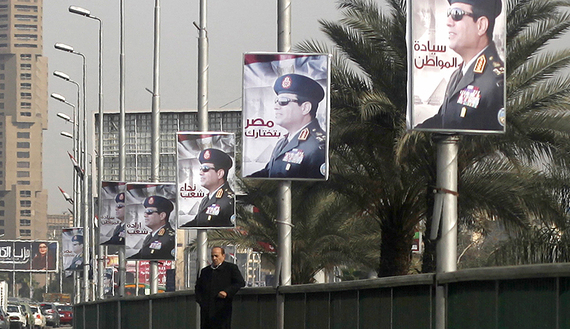
What to watch in Sisi’s run for president of Egypt

A man stands on a bridge where huge posters of Egypt's army chief Field Marshal Abdel Fattah al-Sisi are hanged in center Cairo

A man stands on a bridge holding huge posters of Egypt’s army chief Field Marshal Abdel Fattah al-Sisi, central Cairo, Feb. 3, 2014. (photo by REUTERS/Asmaa Waguih)


This piece is published in Al-Monitor

It’s official. Egyptian Minister of Defense Abdel Fattah al-Sisi is now Field Marshal Sisi. He is only the ninth Egyptian army commander to be bestowed this highest of military titles. On Jan. 27, the Supreme Council of the Armed Forces had announced Sisi’s promotion, which was made official Feb. 1, and on the same day “empowered” the defense minister to run for president.

Undoubtedly, the transition of Field Marshal Sisi from military man to statesman is a risky gamble that will shape the future of Egypt for years to come. Thus, it is no wonder that Sisi is taking his time preparing for his next move. There are five aspects of Sisi’s expected presidential campaign that he has to carefully deal with to make a smooth transition to the world of open politics.

Continue reading here

Posted in Diary of Aak, Egypt | Tagged , , , , | 1 Comment

Egyptian Aak. Week 5 ( Jan27-Feb 2)

Main Headlines

Monday

Tuesday

Wednesday

Thursday

 Friday

 Saturday

 Sunday

 Photo Gallery

 Video

  • Egypt’s Uprising: The Impact of Three Years on a photojournalist. Mohamed Abdelfattah

Good Reports 

Good read

Plus 

Finally here are Jayson Casper’s prayers for Egypt

 My thoughts this week will be published tomorrow. Stay tuned. 

Posted in Diary of Aak, Egypt | Tagged , , , , | 2 Comments

Egyptian Aak 2014. Week 4 (Jan 20-26)

Main Headlines

Monday

  • EU approves ‘largely orderly’ vote on constitution –
  • April 6 vows to escalate protests if activists are not freed
  • Foreign Ministry says communication over frozen membership of African Union is ongoing
  • Strong Egypt party: The revolution’s constitution has yet to be written
  • Education minister: Mubarak, Morsy’s tenures to be written in textbooks objectively
  • Pirateskidnap Egyptian sailors in Red Sea
  • Abu Ismail gets year in prison for insulting judge
  • Prosecutor charged liberal Amr Hamzawy with insulting the judiciary because of a Twitter post
  • Cairo Universityagrees to allow police until end of exam period

Tuesday

 Wednesday

Thursday

Friday

Saturday

Sunday

 Good Reports

Photo gallery

 Video

Profile

 Good read

 Finally here are Jayson Casper’s prayers for Egypt.

Posted in Diary of Aak, Egypt | Tagged , , , , , , , , , , | 1 Comment

Egyptian Aak. Week 3 ( Jan 13 -19)


EGYPT-POLITICS-UNREST-VOTE

(Photo from Egypt’s referendum via  Daily News Egypt)

 Main Headlines

 Monday

Tuesday

Wednesday

  • Egypt is calmer on second day of poll
  • Polls closeafter final day of voting
  • 20 Egyptians slapped with travel ban for accusations of insulting judges
  • Activist and Social Democratic Party member is released
  • Hamas denounces ‘threats’ of potential Egyptian attack on Gaza
  • Mubarak needs to go to polling station if he wants to vote: Official

Thursday

Friday

 Saturday

 Sunday

Photo gallery

 Poll:

 Good report

 Good read

And

More on Egypt ‘s constitution

Finally, here are Jayson Casper’s prayers for Egypt.

Posted in Diary of Aak, Egypt | Tagged , , , , | 4 Comments

The Impact of Egypt’s Referendum on General Sisi

The Supreme Election Committee has finally announced the results of Egypt’s constitution referendum that stated a turnout was 38.6% of the 53 million eligible voters, 98.1% of whom approved the draft constitution. This result can seem perplexing to many outsiders, but it should not; it is an accurate reflection of the current trajectory in Egypt, following a painful three years of instability, polarization and the collapse of law and order. The outcome of the referendum should give all parties some food for thought, particularly, the army chief Abdel Fatah al-Sisi.  The result of the referendum indicates that his problem is not just the Muslim Brotherhood but also his weak, unsustainable coalition, particularly in the country’s much-neglected south and western regions.

The Turnout

Even the most optimistic of Sisi’s supporters admit that the turnout was less than ideal. Despite aggressive campaigning by state and private media as well as top religious figures and political parties, including Salafi Nour, the overall turnout failed to reach the desired target of 40% or above. The low turnout was particularly obvious in the Southern regions (Qena, Sohag, Assiut 23-24%), Fayoum 23.7%, and even more alarmingly, Marsa Matrouh (near the Libyan border), which had the lowest turnout of 16.2%. The reasons for this lack of numbers in those regions are twofold; first, they are regions that have many Brotherhood strongholds and a record of strong backing for Morsi in the second round of presidential elections. There is no doubt that the call for boycotting was welcomed by many in those peripheral, deprived regions. Secondly, there is turbulent record of violence and sectarian tension in the south of Egypt, as well as arms smuggling and tribal links with Libya in Matrouh. Many voters may have simply avoided the polls for fear of revenge attacks from Islamists, or the ongoing violence between the Islamists and the police.

The Anti-coup Coalition

The Muslim Brotherhood and their supporters have continued with their dualism; on one hand, they claim that the higher than 98% yes vote indicates that the referendum results are rigged, while on the other hand they are gloating about the less-than-expected turnout. This is simply ridiculous; they can’t pick and choose the results that suit their views, and reject the rest.

It is true that the referendum was conducted in a very oppressive environment, with an aggressive campaign for the “yes” vote being conducted by the state and private media, top religious figures, and political parties. It also true that many campaigners for a “no” vote were arrested by security forces. Nonetheless, there is no reason to assume that the actual vote was rigged – the 19 million Egyptians who voted for the new charter have done it while fully aware of the implications of their vote, and that should be more alarming to the Brotherhood. Out of three referendums that Egypt has witnessed since January 2011, their own constitution referendum has scored the least popular with a 32.9% “yes” vote.

There are many studies that indicate how boycott is a bad idea. It is worth remembering that their political arm the FJP party is still not banned. Participation would have made them viable in the political arena and paved the way for their open participation in the next parliamentary election. Furthermore, violent intimidation of “no” voters on the days of the referendum would have had a detrimental effect on the military-led government’s image more than suppressing violent clashes with protestors elsewhere. The Brotherhood made the army‘s claims of securing a landside “Yes” vote easier.

The Brotherhood opted to label their opponents as corrupt fools or Copts. Such patronizing views provoked hostility against them from a wide cross-section of Egyptian society. The social rejection of the Muslim Brotherhood, particularly in urban areas and in the various syndicates, is far more dangerous for the future of the group than regime oppression. Now, the group’s core supporters are on the periphery and not in the heart of Egypt.

The Youth Conundrum

The other remarkable result of the referendum was the low turnout among youth. The unofficial reports indicate that only 19% of Egyptian youth between the ages of 19 and 30 participated in the referendum. This dismal rate should give general Sisi more sleepless nights than the overall turnout rate. There is a big generation gap in Egypt. Many seniors and middle-aged Egyptians are promoting stability and realpolitik, and are willing to accept the repressive measures of the authority in return for having a functional state, in comparison to a substantial portion of the younger generation who are still in the mood for revolution.

There are two reasons behind the current disenchantment among some Egyptian youth:

First is the ongoing violence and bloodshed in several Egyptian universities. There is a very emotionally charged environment, and even a sense of isolation, among many university students; many are not Brotherhood supporters and watch their colleagues lose their lives on a daily basis. The anger of the youth is being exploited by the anti-coup coalition to stir up more instability in Egypt’s universities.

Second is the re-emergence of the political and economic class aligned with the regime of former strongman Hosni Mubarak. It is worth remembering that the new constitution scrapped Article 37 for the “political isolation” of former members of the Mubarak regime. Many members of the old guard have openly expressed their disdain towards youth protests; some have even engaged in a smear campaign against revolutionary youths. Regardless of the truth behind the activities of some of these activists, these attacks are enough to make many Egyptian youths feel disenchanted with the entire political sphere.

Moreover, the referendum results reflect the weak nature of the coalition that rallied behind general Sisi after June 30. About 33 million eligible voters stayed at home during the referendum; some were boycotters, but others were passively unhappy with the political dynamics in general. Now, General Sisi has to solve a very complex conundrum – how to win back the alienated youth without losing the support of the hawks in the security apparatus? How can he build a new order without losing the financial backing from various members of Mubarak’s old guard? How can he regain popularity and reestablish law and order in various regions on Egypt’s periphery?

There are no easy answers to these questions, although it seems that General Sisi is aware of the challenge. According to a report in Al-Masry al-Youm newspaper, he asserted that there will be no return to pre-revolution state, but how serious can this assertion be?

Egypt needs a leader that can successfully implement Bismarck’s vision that: “Politics is the art of the possible, the attainable — the art of the next best.” Thus, the real question is, how creative is Egypt’s army chief?

Posted in Diary of Aak, Egypt | Tagged , , , , , | 6 Comments

On Egypt’s General Sisi

As the news has come in of Egypt’s military chief, General Sisi, looking for a strong turnout in next week’s constitutional referendum as a mandate to run for president, a mixture of near hysterical praise and hostile cursing of him has intensified on social media.  Sisi’s supporters are jubilant that he his still alive and that the rumors of his death spread by the Brotherhood’s supporters turned out to be fabricated, while his opponents are fuming that his candidacy has become a high probability.  The mixture of fascination and resent of strong men run deep in the Egyptian society; it is a symptom of a deeper, chronic struggle with Western modernity, which was manifested recently in the poor management, and even exploitation __ by all parties __ of both the January 2011 and June 2013 uprisings.

 “ Sisi ___ may you end as Kim Jong-un’s uncle.”  This was a curse that I read on Facebook. I heard similar curses in the Rabaa sit in, where many pro-Morsi supporters were praying in Ramadan (the Muslim holy month) for Sisi to be paralyzed, or for his legs and arms to be amputated. Such a savage curse reflects the depth of hatred for the man who dared to depose Morsi.

 In cursing Sisi, Islamists are cursing their inabilities to produce a solid, comprehensive project that can address the questions of institutions, freedom and democracy in a modern Islamic state. The Brotherhood’s inept approach to governance was mainly in the form of implanting loyal men in sensitive administrative positions, and introducing Islamic Sikuk as an answer to economic downfall. It was a shallow, insincere plan that was not even enough to consolidate their power or crush their enemies. Their failure has nothing to do with General Sisi; the military chief has exploited their clumsiness rather than causing it—a simple fact that is conveniently ignored by some observers.

Moreover, non-Egyptians’ strong men like Erdogan of Turkey, and even-ironically, Sharon of Israel, fascinate Islamists. They see them, these strong men, as the solution “for the victory of Islam.”  “I wish we had a leader like Sharon” is a sentiment I have heard from many, particularly from followers of political Islam. The sad reality is, if General Sisi, with his ruthlessness and brutality, backed the Muslim Brotherhood, Islamists would worship him as their all-time hero.

On the other hand, the non-Islamists’ fascination with, and elevation of, General Sisi into a near mythical figure is a reflection of their own failure to handle the challenges of modernity in a traditional Muslim society. They are neither secular nor liberals; their semi-adoption of the Western model has brought the pitfalls of many Western ideas without the goodness of its core values—a lose-lose situation that rendered Egypt’s postcolonial era into a trail of failures.  At the heart of the non-Islamists’ failure is the belief of a one-man approach to governance. With a quick glance at the constitution draft, one can notice the fascination with names from Mostafa Kamel and Saad Zaglool to Gamal Abdel Nasser. Although they were great figures in Egypt’s national struggle, none of them has actually succeeded in providing a solid, sustainable model of governance. In a way, Egypt is now paying the price of their failures, not their success. Moreover, there is something deeply unsettling to see potential presidential candidates like Sabbahi and Ahmed Shafiq praising their possible rival, General Sisi, instead of providing a clear manifesto for governing Egypt. Such a self-defeated approach only reflects their bankrupted credentials and subordinate characters. Both Sabbahi and Shafiq are the non-Islamist version of Morsi. The ousted president was his party’s second choice, now Sabbahi and Shafiq are happy to play the same role for General Sisi.

If the predictions are right and General Sisi becomes president, he will set a new chapter in Egyptian history: a new military rule that Egypt has never experienced before. Unlike the popular belief that the 1952 coup d’état has entrenched army rule in politics, the opposite is true; it actually turned some young officers to politicians who control both military and civil sides of the Egyptian state.  However, 2014’s instability could force “President Sisi” to submit Egypt to full, direct, ruthless military control.  “My men start work at 5:00 a.m., would you be happy to do the same?” General Sisi asked those who “pleaded” with him to run.  Many overlooked the statement but it is a perfect example of how the man thinks. Sisi will have no options other than trusting and empowering his men, and demanding tough working conditions from the others. Currently, the army is an empire within the state; later, the army may expand to control the state.

Revolution does not succeed by just removing bad leaders but by laying the foundations of a functioning state that can govern in a sound way. Egypt, sadly, has opted to reduce such a complicated matter into either electoral legitimacy, as with Morsi; or a mythical figure, such as Sisi.

Whether Sisi understands it or not, his candidacy is a huge gamble. The corrupt elite that is cheering for him now will be the first to turn against him if he fails to provide stability, tries to fight their corruption, or replaces their tycoons with his friends and colleagues. Moreover, the poor and the disfranchised Egyptians who are fanaticizing about his tenure can be the first causality of his failure if he failed to deliver welfare, security, and stability.

In a way, General Sisi is a man from Naguib Mahfooz’s novels; he is flattered by the praise and tempted by the adventure, but also fears its consequences. Egypt has not changed much from Mahfouz’s fictional novels; it has neither true democrats, nor smart autocrats, which is precisely why it was unrealistic to expect fast, substantive changes after its revolution. Egyptians have to learn the hard way from their mistakes—an organic process that may take time. Eventually, the fascination with General Sisi will end. President Sisi will not be as “sexy” as General Sisi, and the reality of governance will daunt him and his supporters.

Posted in Diary of Aak, Egypt | Tagged , , , | 9 Comments

Egyptian Aak 2014. Week 2 ( Jan 6- Jan 12)

Monday

Tuesday

Wednesday

Thursday

Friday

Saturday

Sunday

 Good reports

Poll:

  • Baseera Pollreveals over 70 percent will vote yes, but yet to read constitution

 A closer look at Egypt’s draft constitution

Freedoms

  • Sharia
  • Governement
  • Social justice
  • Military
  • 2013 vs. 2012: A comparison

 Good read:

Coptic Christmas

Finally, here Jayson Casper’s prayers for Egypt

Posted in Diary of Aak, Egypt | Tagged , , , , , | 2 Comments

In Egypt, watch the Nour Party

This piece is published in Al-Monitor

It’s hard to see any winner in Egypt’s messy political arena — one that is dominated by near-daily deadly confrontations between the Muslim Brotherhood and the military-backed interim leadership. However, there’s one political party steadily reinforcing its place in Egypt’s political scene: the Salafist Nour.

Since its establishment in 2011, the Nour Party has raised many eyebrows among pundits and observers. Many did not take the ultra-conservative party seriously, despite its substantive gains in the first post-revolution parliament (111 out of 498 seats). The Salafist party is considered an indirect beneficiary of the rising fortune of Islamism in post-Arab Spring Egypt.

Two years later, the underestimation of Nour has continued. Analysts have considered the party window dressing used by the army to legitimize the coup. Some went further and predicted that Nour’s support of the military-backed government following the ousting of former President Mohammed Morsi would finish its political career. But the political dynamics in Egypt refute this assessment. Backing June 30 did not damage the Nour Party; rather, it has enforced its stance as a player that should not be underestimated. Continue reading here

Posted in Diary of Aak, Egypt | Tagged , , , , , | 1 Comment

Egyptian Aak 2014 (Dec 30 – Jan 5)

Main headlines

 Monday

Tuesday

Wednesday

Thursday

Friday

Saturday

Sunday

Book Review

 Good reports

 Good read

Finally here are Jayson Casper’s prayers for Egypt.

My piece will be published later today. Stay tuned….

Happy New Year 2014

Posted in Diary of Aak, Egypt | Tagged , , , , , | 3 Comments

Middle East Digest. December 2013 Part II

Iran

Syria

Lebanon

Israel/Palestine

Gulf states/Yemen

Libya/ Tunisia

Jordan

Sudan

Iraq

Algeria

Good reports

Video

Poll:

 Plus:

Good Read

Happy New Year 2014. Wish the Middle East more wisdom and tolerance.

Posted in Iran, Israel, Jordan, Lebanon, Libya, Middle East, Palestine, Qatar, Saudi Arabia, Syria | Tagged , , , , , , , | 2 Comments