The king and Assad

Initially published in bikyamasr

bikyamasr.com/48410/the-king…

“If Bashar has the interest of his country, he would step down, but he would also create an ability to reach out and start a new phase of Syrian political life.”

What a statement from the Jordanian King Abdullah!

Before we get carried away, I think it is important to put The Jordanian Monarch’s remarks into perspective. They are several local factors that potentially prompted the king to speak out.

First, there are at least 40.000 Syrians live in Jordan. Many already hold Jordanian citizenship, a huge number in the relatively low populated country -just over 6 Millions- Surely, the leadership will carefully consider their voice and demands. Any instability can upset the delicate balance in a country like Jordan.

(Palestinians make up about half of the population).

Second, the Islamists, particularly the influential Muslim unions-who openly opposes the kingdom pro –Western policies- constitutes a tremendous political challenge. Recently, they change tune, and become more vocal against the king, and not just the government. Resent, and anger were not tampered by the recent changes in the government and the royal court.

On the other hand, they are passionately supporting the uprising in Syria (an uprising that the Islamic groups constitute a substantial portion of it). A quick look at the map, you can spot how close Deraa is to Zarqa (The birthplace of Zarqawi, if you still remember him!).

By standing by the Syrian uprising, the king may win hearts and minds of ordinary Jordanians and deny the Islamists a powerful card, reinforce his policy of containment of their influence in the kingdom.

Third, King Abdullah is probably aware of his father serious miscalculation by standing by Saddam in the first Gulf war, a mistake that cost him dearly. Again, the king is probably not keen to repeat past mistakes.

Fourth, The impact of the events in Syria on Hamas is probably on the back of the king’s mind. As the revolt intensify, their position in Syria become more and more unattainable, and they probably want to leave (if Assad let them!).

They are already many in Jordan (including the new PM Awn Khasawneh) who viewed the expulsion of Hamas 12 years ago as a big mistake. This view may not be to the king liking, he may not be eager to receive them back in Jordan. By taking a tough stance on Assad, any future rejection of Hamas may not look that controversial.

On the other hand, I find the king ‘s remarks a bit ironical. He was  never known for his bold remarks against any Arab leader. Even against Gaddafi, he was not that blunt. Plus, I am not sure he would say the same if a Monarch ruled Syria!

Nevertheless, we should welcome such stance from an Arab leader and encourage others to follow suit. The king’s wisdom may have some domestic reasons, but still a bold and desired step.

If Arab leaders are serious about reforms, they should go with the flow of the Arab uprising and not abide by their fellow friends and colleagues in the rotten club of dictators.

Posted in Jordan | 6 Comments

Roots of Egyptian Sectarianism through a 100 year old novel

 Orginally published in bikyamasr

@bikyamasr

is.gd/VnNTzC

I picked this novel from my Library in the early hours of Monday 10th of  October 2011. Plagued by insomnia, after what unfolded in Cairo and led to the  tragic death of many innocents (mainly Copts), I needed to remember better days. The days when Egypt was more tolerant with a normal social fabric.

Zaydan, a Lebanese scholar who moved to Egypt and opened a

publishing house Dar al-Hilal (The Crescent), was  knowledgable, passionate novelist. He was  a proud Christian and a proud Arab fascinated by the Islamic history.

His main objective since the publication of his first novel – The Fleeing Mamluk- was to provide Arabs with a sense of their own history in an accessible way.

I came across Zaydan in my childhood; sitting bored on a hot summer day, my grand mother offered me a novel from her vast library. It was “Armanosa Al Masryia” A story  of an Egyptian Coptic girl  who was  doomed to be the bride of the Nile (a custom of offering a virgin as a sacrifice to the river Nile) and was saved by the Arab conquerer of Egypt.

I loved the novel and the author. For me, Zaydan was a pearl hunter who dived in Islamic history looking for stories of harmony and tolerance, two values, which I grew to love and respect.

Zaydan success did not just reflect his work but the social cohesion during the nahda- renaissance-period (1860- 1935). Modernist Islamists and tolerant society created an environment that was ripe for the like of Zaydan to flourish. Reading was an integral part of the life of many Egyptians who were eager to know and understand their history. Neither the religion nor the ethnicity of the author was a precondition.

Later, Nasserrism prompted government sponsored education, literature and art.  However, there was a string attached, as censorship started to emerge. Only books and novels that provided a platform for the regime‘s ideology were allowed. Others, which did not fit in or were, considered anti- socialist would be denied publication. Luckily, social cohesion between Muslims and Christians maintained the popularity of Zaydan’s novels.

Sadat’s era was a turning point; Egypt witnessed a significant shift in emphasis to business. When money became a goddess and religion became a trade, reading was inevitably considered a futile activity. With the change of the political outlook toward political Islam, booksellers started to stock religious books, and demands for literature and history books were sharply dropped.

If Sadat’s era were the era of deterioration, Mubarak ‘s would be the era of total stagnation. Political decay and corruption led to a sharp decline in every aspect of life including Literature. The educational system did not provide sufficient space for students to read, discuss and reflect.

Reading and learning might prompt some awkward questions and the government had no appetite to handle such an ordeal.

Arab dependence on satellite TV for its news and entertainment compound the problem. Rather than learning their history from books, they depend on films and soap operas, which were mostly biased and full of historical inaccuracies.

The Project “reading for all” was a shallow attempt to rekindle the passion for reading. Its main aim was to glamorize Mubarak’s wife Suzan. A foolish ill- managed project with a selective biased toward certain books that lacked a genuine desire to educate young generations.

Also, social in-cohesion becomes the norm; Muslims and Christians stop reading each other history. Ignorance prevailed, and sectarianism started to rise sharply. Scoring point in the fierce battle motivated those who bothered to read, Muslims read the Bible to look for dispute between Mark, Mathew, Luke and John accounts. Christians read leaflets of Salafis and other Islamists, which asserted their feeling that Muslims hate them. Zaydan became a history that was either ignored or even mocked by some who considered him a romantic idealist.

It was a nice antidote to re-read my old novel and remember the good old days. However, I am not under any illusion that things was perfect even during  the renaissance era. In 1910, the newly opened Egyptian University offered Jurji Zaydan a professorship in Islamic History. Sadly, Zaydan was dismissed before he even begun his job.

Despite of his popularity, Zaydan was a hated figure among some conservative who opposed his appointment by the university. They objected to his Christian origins and secular leanings. The Tradionalist won the battle, and the Egyptian renassiance failed to eradicate the dogmatic barrier.

The tragedy at Maspero had many direct reasons, but the roots of the problem  started years ago. By abandoning  scholars like Zaydan and the cultural stagnation that subsequently followed (particularly in religious studies), Egypt embarked on a steady downhill path toward sectarianism and intellectual decline.

We should have the courage to face up to the problem and address its roots. Living in a denial would only compound an already challenging issue .

Posted in Uncategorized | 3 Comments

Enlightened Leaders or Zealous Moravids?

Seville Spain- In 1086, the last sovereign King of al-Andalusia “Al-Mu’tamid” made a call for help.  He needed support in his battle against the King of Leon and Castile “Alfonso VI.” The support came from Morocco by devotees of an Islamic fundamentalist sect known as the Almoravids (Al-Morabiton in Arabic), a Berber dynasty that emerged from the western Saharan desert.1

Devout and disciplined Muslims, the Almoravids were not just equipped with swords, but with zealous belief in Islamic orthodox doctrine. They successfully managed to conquer al-Andalus ending Al-Mu’tamid’s rule and later sent him to exile. 2

Their conquest signaled the end of Liberal Moorish Spain, an era of love, plots and betrayals and was replaced by a stricter, repressive rule.

Islamic history was always nonlinear; instead, it evolved in a series of incomplete circles. It invariably started with a period of enlightenment and liberalism, which descended into decadence and weakness, followed by an oppressive rule. Later, it would crumble under pressure from a newly emerging power that eventually interrupted the circle and started a new one.

Bullying in the name of Islam:

Almoravids recipe to salvage Moorish Spain from downfall was a rigid rigorous Islamic rule. They imposed their own version of Sharia (they were followers of the strict al-Maliki school of thought) on both Muslims and non-Muslims. Noticeably, they had no clear vision or strategy on how to run the country other than fighting the infidels. They despised the opulent culture of their predecessors; they smashed artifacts and sculptures, Jews and Christians were subjected to harsher tax and intolerant treatment. The church of Granada was destroyed in 10991.

True, they initially prevailed and united Andalucía. However, their policy earned them many enemies not just from outside but also from within. Their fall was almost inevitable

Modern equivalent:

Despite the different narrative, there are some remarkable similarities (at least in broad terms) between Almoravids and many of the current conservative Islamic groups who have emerged onto the political scene and inevitably will cash in on the emerging democracy in many Arab countries such as Tunisia, Libya, Egypt and potentially Syria.

1-both started as opposition movements who are very articulate about what they are against but not clear about what they stand for. Their unity was a sign of collective detest of what they perceived as dangerous innovation.

2-both had charismatic fiery leaders, preachers who knew how to win the hearts and minds of their audience. Yusuof ibn Tashfin the leader of Almoravids, currently, Ali Sallibi in Libya, Ghannouchi in Tunisia and Ali al-Bayanouni in Syria.

3-they shared a sheer antagonism to liberalism and a common belief that decadence and lack of implementation of Sharia‘s rule is the root of all problems.

4-they accused their predecessors of treason and submitting to Christian powers.

The battle for the Soul of Islam:

The recent Arab revolts reignited the old battle between two Islamic schools of thoughts. The traditional school, which is not monolithic – but divided into various shades of strict puritan beliefs – and a more liberal rational school. This war of ideas is as old as Islam itself, al-Andalus had its share when Caliph el-Mansour banned and burned the books of the rationalist thinker Averroes.

The torn between reason and dogma impeded linear Islamic progression and contributed to the failure of many Islamic dynasties including the Almoravids.

Most of the current Islamic movements have been insubstantial on the question of liberty, a core issue at the heart of the crisis within the Muslim world.

The basic Koranic rule “ there is no compulsion in religion” is a fundamental aspect of Liberal Islam.4 It was respected in the early Moorish rule and was eventually dismissed in later periods. Non-Muslims enjoyed relative freedom and were allowed to work as public servants and promoted according to their performances and expertise. Women enjoyed this freedom too; historians reported how the poet Wallada bint al-Mustakfi  opened a literary hall in Córdoba, mixed with men, and did not adhere to hijab  (head scarf) or the traditional Islamic dress code. In a twist of fate, Wallada died the same day the almoravids entered Cordoba. 3

In addition, there was clear distinction between the rights of the individuals and the rights of the society. In their quest to win loyalties of their new subjects, the early Moors had instinctively realized the difference between sins and crimes and that coercion would be counter-productive. Instead, they focused on creating a strong, advanced social and political system. They paid particular attention to the economy, science, agriculture and commerce.

Everyone in the Arab and Muslim world pines for the glorious al-Andalus, from Fairuz the legendary Lebanese diva to Osama bin Laden the leader of al-Qaeda, they all yearned for the good old days. However, their perception of what was good is far from identical.

 When it comes to what went wrong, many opt for a superficial, oversimplified explanation, “ The decadent, corrupted leaders and the evil infidels.” This is far from being accurate.

If it was that simple, then why did the Moorish fail to recreate the glory of the empire in Morocco, following their expulsion from Spain?

The fall of al-Andalus was far more complex and multifactorial. The final chapter might be by Fernando and Isabella but the turning point was the invitation of the fundamentalists. Radical Islam may win wars but always fails to achieve peace.

Religious groups are fond of Islamic history and always look back to the past for inspiration. Therefore, it is crucial for them to draw the right historical lessons.  Following years of oppression and tyranny, facts and fictions may not be easy to separate, but it is essential in order to plan a better future in which, Islam, modernity and freedom can co-exists in harmony.

Currently, Islamic parties are learning fast; they soften their tune, changed their vocabulary and start using terms like human rights, democracy and civil state. However, in the absence of any recent precedent, the performance of any democratically elected Islamic party will only be judged in retrospect. Words before the ballot box may differ than actions following elections. Only then, we can judge wither they are enlightened leaders or zealous Moravids.

Further reading:

1-  Moorish Spain, Richard Fletcher, November 2001.

2-  The Almoravids and the meaning of Jihad, Ronald A Messier, August 2010.

3-  Le retour de Wallada, Maram Al-masri and Jean- Pierre faye, March 2010.

4-  Islam without Extremes, Mustafa Akyol September 2011

Posted in Islam | Tagged | 8 Comments

The Palestinian UN bid: Abbas and the Domestic Front

Yesterday, President Mahmoud Abbas formally declared his intention to seek full membership for the Palestinian state in the United Nation. His decision raised more than a few eyebrows, as many did not expect him to defy the Obama administration who have  repeatedly warned against such a move. So does Abbas know what he is doing?

The bid for statehood has some diplomatic benefits, and it is a moral boost for the oppressed Palestinians who had to watch the failed Oslo peace process for 18 years. However, many analysts have rightly pointed out the risks of taking such a path, which can potentially undermine the prospect of reaching a genuine and lasting solution for the Palestinian-Israeli conflict.

Behind the scene, there is a domestic political imperative behind Abbas decision. Yes, he wants to seek a statehood, but he is also planning his own political survival.

For many years, Abbas watched his popularity plummet among the Palestinian public. Many viewed him as a collaborator who only maintain Israel security. Netanyahu made things even harder, his refusal to renew the moratorium on settlement building in the West Bank has led to the final breakdown of the direct negotiations.

By opting to go outside the framework of the Oslo accord, Abbas would probably be able to regain his popularity among the Palestinians, snooker the Israelis and US and most importantly score a few points against Hamas.

1- Winning hearts and minds

Abbas may not be charismatic or indeed wise; however, he is not dumb, and he knows a thing or two about the Palestinian domestic politics. He fully understands that a state resulting from negotiation is by far better than a symbolic one achieved unilaterally, and the reality on the ground may not change much for the ordinary Palestinians and may even get worse. However, he also understands the Palestinian psyche who will probably appreciate the small gains from the UN more than any achievement from any negotiated settlement.

When it comes to handshakes with the Israelis, Arabs always remember the compromises, not the achievements. Ironically, little gains without a handshake could be a popularity boost among the hostile  public.

By seeking the UN bid, Abbas would enhance the image of a  leader who want to create a state for his own people and is willing to defy the USA”the world superpower”to achieve his goal.

2- The US Aid

As the United States is the largest provider for the Palestinian Authority (PA), it appears a reckless decision from Abbas to rebuff the Obama administration, despite his full awareness of the latest congressional threats to cut off all US aid to the PA.

I think Abbas is banking on two factors; the Arab uprising and the risk of Hamas take over the West bank.

a- The Arab uprising:

The Arab uprising has provided Abbas with a perfect backdrop for his statehood  conquest. The current fluid and tense situation in the Middle East (Egypt, Libya, Syria and to mention the recent Turkish–Israeli confrontation) is enough to give the United States reasons for concerns. Would Obama risk stopping the Palestinian aids among all this evolving dramas? There are already many organization such as J street (the pro-Israel, pro peace movement) have called for the US not to cut its aid for the Palestinians, and probably many more will follow.

b-    The West bank:

Many analysts are predicting that Israel would take harsher countermeasures on the ground in retaliation of Abbas move, such as withholding tax remittances, restricting Palestinian movement, and possibly annexing some West Bank territory. Can Israel afford such aggressive moves?

Israel already has enough on its plate and is facing enormous challenges; terrorist threats from Gaza, deterioration in the relationship with Egypt, increasing hostility from Turkey.

Currently, the West Bank is the quietist of all fronts. Threats are perfect for the haggling in the UN, but at the end of the day, Netanyahu would probably settle for a Palestinian “non-state member” in order to avoid a third intifada.

3- Hamas

In recent years, the relationship between the two main Palestinian factions (Fatah and Hamas) has been extremely poisonous.  The recent unity deal had failed to restore confidence or resolve the bitter conflict between the two parties.  Even the thought of Abbas visit to Gaza was too much for Zahar (Hamas co-founder).

Ironically, the failed unity deal gave Abbas some popularity among many Palestinians who favorably viewed his efforts to seek a united front with Hamas before the UN bid. Many in Gaza are excited about the prospect of statehood, despite Hamas refusal to allow popular protests in support of the UN proposal. There are reports that shop owners are preparing for the UN bid  by making souvenirs imprinted with the ‘Palestine 194’ logo.

So what’s next?

Option one (escalation):  The US and Israel retaliate and a third intifada erupts including the possibility of violent confrontations. In that case, the Palestinians will blame “the Zionists” and not Abbas.

Option two (status quo):  The haggling in the UN will lead to a deal acceptable to Israel and the Obama administration. The US might reduce the aid (as a compromise to the Republicans in the Congress) without compromising the survival of the PA. In that case, Abbas can also claim some victory.

So in a nutshell, The UN bid is ideal for Abbas domestic needs.  The UN may not offer the Palestinians full statehood, but would give Abbas a reasonable chance for political survival in the possible next year election and that is what probably matters most to him. As for a permanent solution of the Arab-Israeli conflict, there appears to be no strategy except prayers!

Nervana

PostScript:

Even if Abbas is planing to retire,  he is probably looking for a symbolic win by the end of  his career.

Nervana

Posted in Israel, Palestine | Tagged , , | 7 Comments

My comments on Mustafa Akyol book “Islam without Extremes.”

It is challenging to write a book based on religion and history with a convincing case relevant to modern time. I think the Turkish Journalist Mustafa Akyol has successfully met this challenge and present an exceedingly compelling and convincing case for Liberal Islam.

I loved the way he described Abu Hanifa the pioneer of the juristic side of the rationalist school, the Mutazilite philosophy and the war of ideas between the Traditionalists and Rationalists throughout the history of Islam.

Akyol highlighted the link between economic prosperity and freedom of religious ideas, illustrating how the school of Tradition cut off the young Islamic community from the economic mainstream. By isolating Muslims from doing trade with nonbelievers, it severly affects every aspect of life from economy to art, language, science and many resources.

He also addresses a particularly tricky issue; “the rise of hadith” and the theory of abrogation in what is described as the “Post Quar’anic ideology”. In fact, if anyone wants a medical diagnosis of what went wrong in Islam, then look within some aspects of this ideology, for example, the distaste of some toward “innovation”.

Throughout the book, Akyol incorporates lessons from Turkey (Both Ottomans & kemalist). Akyol described the Ottoman Empire as a pluralist state (a description that I struggle to agree with). Yes, the state was tolerant to non-Muslims, but reforms and modernization only took place in the later period of the Ottoman rule. During the early period, the empire was strong and powerful but many of its subject particularly non-Turks were oppressed and lost their national identity without gaining equal rights. Sadly, the process of modernization came a bit late; the seeds of hatred and separatism were already planted in the heart and mind of many Ottomans subjects.

Akyol rightly rejects authoritarian regimes, even in its mild form. The attempt to push religion out of Muslim minds was proven counterproductive, and it failed drastically both in Turkey and Iran. However, Akyol clearly illustrate how the various rulers throughout Islamic history (as early as Umayyads & Abbasids) manipulated religion for their political needs. This basic historical fact should justify a degree of secularism provide it “allows freedom of religion not freedom from religion”.

The book also illustrates how kemalism nationalism has helped to destroy the religious identity in Turkey. However, a complete lack of national identity can also be counter-productive. Arab states lost their national identity under Ottomans rule, and they paid a hefty price following the collapse of the empire. The Arabs painfully had to watch colonial powers carving their lands to create new nations (even artificial ones), which had an immense knock on effect that still valid in modern days. It opened the door for nationalist, socialist dictatorship and religious extremism to fell the gap. Nationalism, as well as, secularism (in small doses) are not incompatible with Islam and can be accepted within a free liberal Islamic democratic society.

The last two chapters “freedom to sin” and “freedom from Islam” are simply delightful. Akyol clearly highlighted the clear distinction in Sharia between the rights of God and the right of people. Also, how the earthly punishment for apostasy is not Qur’anic but post Qur’anic.

His statement “ Replacing the fear of God with the fear of state or community could only be an obstacle to heart felt piety” reflect the style and the message of the whole book.

I guess the question is, how to convinces the masses to embrace liberal Islam? How to protect the rationalist school of thoughts from the overzealous of some? How to prevent past mistakes and secure a better future for Muslims?   Muslims need to reflect on their past and present and come with answers to these questions.  The Arab-spring provides a golden opportunity for Muslims to move on from the shadow of extremism and embark  on the road of rationalism as the way for a better future.

Posted in Book review | Tagged , | 9 Comments

Iran, Syria, Interests Vs Liabilities

How far is Iran willing to go in order to save the Assad regime from crumbling?

No one can truly answer this question; in fact, I think even Assad may not know the answer for sure. it is certainly true that Syria is Iran’s strategic gateway  to the Arab world  and it’s link with other proxy groups in Lebanon and Gaza. However,The recent events in Syria pose a serious challenge to the complicated relationship between the two countries and will probably expose its strengths and weakness.

Looking back at the past few years may give us some clues about the mindset of both regimes and how united they are at crisis time. While the world was watching closely for a possible Israeli air strike on Iran nuclear facilities, an interesting debate (particularly in Israel) surfaced about the nature of the relationship between Assad ‘s regime and Iran.

In December 2009, the Jerusalem Post published details of a cable written by the United States Embassy in Damascus, dated Dec. 20, 2009, summing up the visits earlier of the Iranian National Security Advisor Saeed Jalili, Vice President and Head of the Environmental Department Mahammed-Javad Mahamadzideh and Defense Minister Ahmad Ali Vahidi to Damascus. The cable cited an unnamed Syrian official who claimed that in the talks, the Syrians told the Iranians that they would not participate in an Iranian retaliation to a potential Israeli strike.

If true, and Assad was unwilling to stand by his closest allies, then what would make us assume that the Iranians would not do the same? This view is echoed by Meir Javedanfar ( Iranian-Israeli Analyst) who argued that Khamenei won’t support Assad to the end in his recent article in the Guardian (August 2011).

However, the British writer Patrick Seale (biographer of Hafiz al-Assad) always argued passionately about the strong ties between Damascus and Tehran.  In an interview to Ynet Israel  (December 2010), he warned Israel to stop deluding itself. Later, He labeled Syria as “a time bomb, which could truly set the Middle East alight” in another article in Foreign Policy in March 2011.

Rather than being dragged into endless debate about the Iranian mindset, it is probably easier to discuss the Mullah’s potential options (which are not many). They only have two; either to stick with Assad till the end regardless of the outcome or abandoning him when his regime becomes a liability to the Iranian national interests.

Which option would the Iranian choose?   It would  depend on the Syrian people.

There is no doubt that the smart tenacious and incredibly resilient Syrians are the driving force and the key to the success of their revolution. They fully understand that they have to earn their freedom, as no one will hand it to them. The longer the protests continues peacefully with huge participation, the more the Iranians will be forced to rethink their ties with Assad.

Despite the fact that it is harder and more taxing to undertake, nonviolent resistance is an extremely powerful tool that can successfully dismantle even the most vicious of regimes, as it invokes public scrutiny of the oppressor, something  dictators always fear.

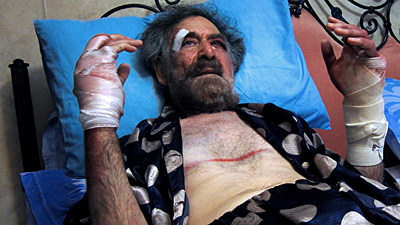
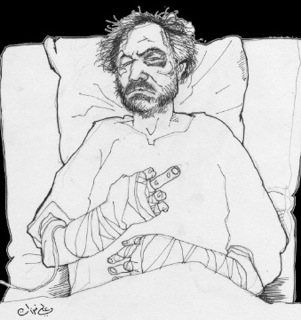
There is something about image of victims that profoundly affect minds and emotions (like the image of Syria cartoonist Ali- Ferzat’s hands broken).  The more the public opinion is engaged, the more countries like Russia and China would be forced to rethink their position. It may also encourage more defection from high ranked army officers who may be uncomfortable  committing such violent oppression on regular basis.

Many reports indicate that Tehran is sparing no efforts to help  Assad by supplying him with weapons, surveillance tools and expertise in order to help in crushing the popular protests. Although, history teach us that these methods are no match against the will of people.

However, any attempt to arm the protestors (either from outside Syria or through army defection) against the regime would be counter productive and might play into the hands of the Iranians who thrive on instability and civil war. It would also provide Assad with a pretext to justify more oppression and convert the discrete Iranian support to a potential public and formal one. The Mullah will cherish the opportunity, as they are the masters of instability.

In a country run by a regime that rely heavily on the loyalties of various minority groups, civil war is a huge risk and should be avoided at all costs. If Lebanon teaches us anything, it is how the eruption of the civil war can lead to the creation of groups like Hezbollah ( regardless of their sects).

It is crucial for the Syrians to stay focused, resist the temptation to despair and keep the momentum of  their peaceful movement going in order to avoid a similar fate to the Iran’s green revolution. That is what is the embattled  Syrian president ultimate goal, he is desperate to show his Iranian allies images like that of  Ferzat’s broken hand as a proof of his success in crushing the protests. Hopefully, Firzat self-portrait  (even it was fake) would give the Iranians a completely different impression.

Posted in Iran, Politics, Syria | 2 Comments

The Mullahs will pick up the pieces

It is almost impossible to predict how Syria might emerge after Assad. Many hope for a stable, democratic state. Though, instability, civil war and an Islamic state are also real possibilities. Regardless of the outcome, the collapse of the Assad regime in Syria will have an enormous impact on the wider Middle East particularly on Iran.

The heat of the Syrian volcano will be felt in Tehran far more than in Beirut, Amman and Istanbul. The Mullahs who stood by Assad for decades already faces daunting challenges today, and those challenges will multiply and grow in the near future and on several fronts.

The Domestic Front:

Perhaps the worst nightmare for the Mullahs is the implications on the domestic front. The psychological impact of the fall of Assad may inspire many in Iran to reignite a second green revolution. This is a red line for the Mullahs that must be avoided at all costs, and they would not hesitate to ruthlessly crush any rebellion. The Green movement is also watching the Arab spring, and they may learn a thing or two from their neighbors, the huge decline in the economy recently can also help their cause. However, it is essential to remember that the power base of the Mullahs and their revolutionary guards is probably still strong with no indication of any erosion, yet!

The Syrian Front:

With the potential loss of the massive Iranian investments in Syria, the economic impact of the fall of Assad could be enormous. However, the political impact would be devastating. By losing Syria, Iran would lose its strategic depth and gateway to the Arab world. How the Mullahs will respond to this serious blow? That remains to be seen.

Judging by their past responses, the Mullahs would probably resort to a quick policy of damage limitation and exploitation of any instability. The details will depend on events on the ground in Syria. Chaos, civil war, even a military quo is the Iranians’ best outcomes, as it this would give them more scope to maneuver in exploiting the situation to their advantage and allow them rebuild their links with the newly emerging power groups within Syria and to continue smuggling weapons to Hezbollah. Ironically, a stable, democratic Syria would be Iran’s worst nightmare and a Sunni Islamic regime would not be good either.

The Lebanese Front:

By throwing in its lot with Assad, the Iranian proxy group Hezbollah stands to lose a lot following the departure of its ally. Whilst it is certainly true that Hezbollah’s center of gravity is within Lebanon, and it is independent of Assad’s regime, however, the destruction of their main bridge with Tehran will have massive implications for Hezbollah’s policies over years to come. In fact, it is no exaggeration to suggest that Hezbollah views the collapse of the Baath regime in Syria as an existential threat.

How Nasrallah will respond? Can he succeed in maintaining his power?

No one can predict the future but at least we can discuss his options, Nasrallah will have a potentially three options:

a-    Do nothing:  It is probably wise for Nasrallah not rush to respond to any events in Syria and play for time until a clearer picture emerges, however, there is a risk that a lack of response may be perceived as weakness by his political opponents.  It is highly unlikely that the likes of Jumblatt would continue his support for the current government one more day after the departure of Assad!  Will Nasrallah sit & watch March 14th regain power and send his  “Brave Fighters” to the STL?

b-    War: Five years since 2006 war are enough for Hezbollah to reinforce its military capabilities. Nasrallah will not hesitate to spark a fight whenever convenient. However, this option is not without its risks particularly without the support of Syrians, his ability to engage in hostilities will be severely hampered. Any failure will totally eradicate his gains from the 2006 war and can permanently weaken his political stance in Lebanon.

c-     Emerge from the shadows: Nasrallah may decide to use his weapons in order to enforce a loyal government. Being the only armed faction, Hezbollah will not hesitate to use force in order to maintain their strategic interests.  If war with Israel can weaken Nasrallah stance, openly turning against his fellow Lebanese would be a political suicide and may even drag Lebanon down into another round of civil war.

Will the events in Syria trigger an all out war between Iran and Israel?   The answer depends on Israel as well as Iran. Can Israel resists the temptation or will be dragged into unpredictable war with Hezbollah or Iran? The Iranian may increase their rhetoric with Ahmadinejad ranting and raving in front of global media, but starting a risky war?  Dare I say “Unlikely”.

The Mullahs fully understand the challenges facing them in the new, evolving Middle East. They will continue to do whatever it takes to secure their own survival and maintain their tight grip on power. Despite their crazy rhetoric, they are certainly not suicidal and have no plan to gamble with their own future. They will pick their fights where and when they are ready for them.

Syria might trigger a grand game of snakes and ladders with numerous real life serpents that are far more deadly than those printed on the board.The US Ambassador Ford has correctly urged the US government to start planning for the day after Assad; the Iranian regime is probably busy formulating a plan too.

Nervana

Posted in Iran, Israel, Politics, Syria | Tagged , , | 6 Comments

Zionists

@shadihamid
Brotherhood’s website alleges spies & ‘Zionists’ infiltrating Tahrir protests: http://bit.ly/psAqi0 #Egypt

@AnMustafaWhen r our #Saudi bro/sis realize that their King is a pawn & slave of the #Zionists & the #US gov? German tank deal is just another proof!!

It seems increasingly clear that the recent wave of Arab revolts has helped the already ingrained conspiracy theories to become more elaborate, absurd and frankly ridiculous.  In one of the ironic twists, it appears that no one is immune from the accusation of Zionism.” Within the Arab world, it becomes an exotic alternative to “treason”.

So apparently, Gaddafi is a Zionist; did he not send a delegation to Israel recently to plot his own survival? , There are many examples of graffiti in Benghazi showing Gaddafi with the Star of David. The Libyan rebels and their LNC have had their fair share of these accusations too, after all the “Zionist” Bernard Henri Levi has supported them and brought in NATO to protect them.

Assad also is an alleged Zionist; he kept the Golan front quiet for years and he hinted (through his cousin Rami Maklouf) that the stability of Israel is linked to his regime’s survival. The same regime, which claims on a daily basis that there is a Zionist plot against Syria with many Zionist infiltrators attacking innocent Syrians everywhere from Deraa to Deir el Zour.

According to many, the king of all Arab Zionists is certainly Mubarak. For 30 years, he maintained a close relation with the “Zionist entity” and plotted against the Palestinian resistance in Gaza. As a reward, Israel has sent their agent, the 27 years old “ IIen Grapel “ to Tahrir Square in Cairo to stir up a revolution against him.  They were not even satisfied by his removal from power; their main aim is to destabilize Egypt who had peace treaty with them by sending more agents into Tahrir in order to orchestrate an opposition movement against the ruling military council!

In Lebanon, who killed Hariri? Search nowhere; apparently, the Zionists did it. Allegedly, Israel had penetrated the Lebanese cellphone system to coordinate his assassination.

The only possible conclusion from this absurd logic is, “ All Arab leaders are probably Zionist traitors and all their opponents are probably Zionist traitors too.”  Marvelous!! This is not even funny.

 Nor is this by any means a new phenomenon. Sadly it has been an integral part of the Arab daily political scene for a long time. Perhaps the first one to win the title was Sadat; he probably sealed his fate following his famous kiss to Golda Meir. It was distressing enough for some to see him pursue peace with Israel, but to kiss Golda was by far a crime that would never deserve to be forgiven (at least in their mind).

The Oslo accord was another turning point; it divided the Palestinians into two camps, a pro peace one who “foolishly fell” for the Zionist plot and a resistance camp that maintained their rejection of the “ Zionist entity “ and will keep fighting forever.

In fact, one of the few things the far right and the far left in the Arab world agree on is their rejection of the peace process with Israel. Both camps have done their best to discredit their opponents and label them as western imperialist Zionist traitors.

The explanation of this phenomenon is by no mean easy. It is emblematic of the whole Arab psyche and their perception of themselves and the outside world.

Roger Cohen has addressed the issue in his article in New York Times, (December 2010): “What we are dealing with here is the paltry harvest of captive minds. Such minds resort to conspiracy theory because it is the ultimate refuge of the powerless. If you cannot change your own life, it must be that some greater force controls the world”.

His statement is certainly true, however, if we want to dig deeper we can come up with some key contributing factors, which helped this phenomena to grow.

First: Media.

As a basic rule, Arabic media must avoid religion, sex and the current leader to be safe from censorship. Outside these areas, they are allowed to go wild with no limitation and no code of conduct. The Zionist plot and the Arab hero who fight it is an easy successful formula for a feel good factor.  You can guarantee one soap opera per season about a Zionist plot, and off course it usually breaches the fine line between Jewish and Israeli. The bottom-line message is that, they are all evil and they are continuously plotting against Arabs.

Second: Official History books:

The main aim of all official history books is to praise the current leader and discredit his predecessor. Modern history was usually addressed to fit the political outlook of the regime with a clear tendency to blame foreign plots rather than drew some balanced conclusions. In fact, both Arab and Israeli history books are biased against each other.

Third: Totalitarian regimes

There is no doubt that the first two factors stem from years of oppression and totalitarian rule. (One-man vision, one-man theory and one-man analogy). Arab leaders infantilize their people in order to rule them by creating a sense of victimization and helplessness, which were employed as a useful distraction tools to divert attention from the core problem “ Tyranny”. Accusation of treason and Zionism is easy way to discredit and oppress any opposition. It has worked time and time again; any western link will automatically put a political opponent under scrutiny.

Ironically, the longer a leader’s stay in power, the more his inconsistency becomes apparent.  The regime’s deals and link with western power become more exposed; people start to spot the hypocrisy. No wonder, some may label the likes of Gaddafi and Assad as traitors.

Fourth: Loose definitions.

The term Zionist becomes an umbrella to cover a wide variety of descriptions; western, liberal, pro- peace, etc.

They are usually four categories for these allegations:

Category A: an Arab with liberal western values, who consider the USA and Europe as useful allies. The accusation of Zionism may not be overt though hints and gestures may be deployed.

Category B:  an Arab with western affiliation who dare to criticize the resistance movements (Hamas, Hezballah) or possibly questions their plans or strategies. This is a red line, once crossed, a barrage of threats, abuse may follow, and certainly accusation of Zionism would be loud and clear.

Category C: an Arab who develops links with Israel either politically or economically.

Category D: an Arab who accepts Israel right to exist.

Many may argue that Category C and D deserve the accusation and they are indeed traitors (this is a topic for another post), however, to extend the accusation to the first two categories is not just absurd but also reflects a deeply troubling unidirectional vision which is incapable of considering any different point of view.

Fifth: Invasion, occupation, conquerors.

It is easy to forget that Arabs were colonial power too.  For example, Arabs hadve occupied Crete, Malta, Sicily and indeed Spain. Yes, they created a thriving multicultural society and were tolerant to non-Muslims. However, it was at the end of the day an occupation. However, somehow in the Arab psyche, they were benign conquerors and the others were oppressive occupiers and nobody dares to challenge that concept at all. It is certainly true that Arabs usually had a code of conduct far more advanced than their peers, and their actions should be put within the historical context; nonetheless, they were occupiers who fought those who resisted them. The sooner they admit it, the better the prospect of recovery from for this sense of being victims will be.  They need to understand that history comes in cycles with good eras and bad ones.

Throughout history, plots and treason have existed, and Israel is no exception. Their secret agents “ Mossad “ had a long record of assassinations targeted against Israel’s opponents.  However, it seems that their Arab neighbours want to give them credit for literally every event in the political arena far more than what they deserve.  This silly generosity needs to stop soon, enough is enough.

Many thought the Arab spring might put an end to this pathological problem; it was great to watch the January 25th revolution in Egypt without seeing any sign against Israel or America in the demonstrations. Finally, Egyptians were addressing their local issues without involving any outsiders.

The only way forward is for us Arabs to have the self-confidence to accept some measure of responsibility of our own mistakes. After all, to seek the truth is surely to affirm our finest values and not in any way to betray them. We also need to build a pluralistic society where all political parties are accepted, including those pro- peace with Israel. You may despise them, but you should let them express their point of view. Definitions need to be accurate, only those who have illegal contacts should be labeled as traitors.

Sadly, old habits die-hard, plots and conspiracy theories have already started to creep in again after only a few months, it will take many years of free open society and pluralism to wipe it out.

I decided to show the Roger Cohen article to someone who continuously use the term “Zionist plot”. His reply was “ A classic piece from a Zionist”.

I know nothing about Roger Cohen background or his political affiliation but I am sure that his article has nothing to do with either of them.

Nervana

Many thanks to Abu Hatem for the New York Times article
Posted in Uncategorized | 7 Comments

Ottomans Versus Mamluks: New Episode Same Playground

On 23rd of January 1517, the Ottomans defeated the Mamluks army, entered the city of Cairo and hanged their leader Tuman bey from its southern gate “ bab Zuwaila”.  This victory had a profound impact on the entire Middle East for decades that still resonates today.

The Mamluks period was indeed an intriguing era, with tales of plots, love & betrayals, not to mention brutal violence, but nonetheless, vibrant with a long period of prosperity. The ex-slaves determined warriors defended their adoptive country and offered patronage for artisans and intellectuals. Cities such as Cairo served as a center for learning with flourishing Madrassas, it even had a hospital for psychiatric illness where music played to create a soothing, healing atmosphere. (I usually take what was written in my old history books with a pinch of salts, but I believe this one). Women enjoyed some rights and were not segregated. The remaining Mamluks houses in old Cairo with its lofty windows (unlike the rather restrictive Mashrabia) reflect this relatively liberal atmosphere.

The killing of the young, devoted Toman bey signalled the end of national identity. The Turks divided the conquered empire into three sections, the northern region with Aleppo as the capital, central region (including Palestine) with Damascus as the capital, and Egypt with Cairo as the capital. Arabian countries were relegated to the status of mere provinces within a super empire. Ottomans strategy was clear; a strong, powerful wealthy center served by resources and skilled workers from peripheries. They just sucked blood out of the local economy and increased its vulnerability and dependence on the central government.

Rather than resisting their occupiers, Arabs went into full submission at least initially. Though there were sporadic revolts (which were promptly suppressed), the Arab provinces were relatively calm in comparison to those in Europe and Persia. After all the Ottomans were fellow Muslims, a crucial factor that helped Arabs to accept their fate despite simmering grievances.

A combination of inertia, religious dogma and a false sense of security lead to a gradual decline in virtually all aspects of life. Arabs became increasingly isolated, inward looking, completely unaware of the enormous progress and renaissance in Western Europe.  Women paid a hefty price; they became increasingly segregated, “Harim”, imprisoned within their homes and had to cover their faces if they had ventured out.

A modern Twist/ mediocre Mamluks

 500 years later it seems we are witnessing a new version of the Mamluks/ Ottomans confrontation with a modern twist. This time the Mamluks are a mediocre version of their predecessors with no charisma or insight and with sheer incompetency. Despite the fact that they are the native sons of the land; they certainly never cared about it or worked towards its development, but only cared about their own survival, Arabic countries descend to a new low with corruption, dictatorship and poverty. This decline affects every aspect of life from science to medicine and art. The new Mamluks are simply pathetic and slaves to their own greed.

Weak leadership created a power vacuum, which attracted the attention of many regional and world players, including the new charismatic Turkish leader “Recep Tayyip Erdoğan”. With his vast economic achievements, the ambitious Turk has just managed to secure a third term in office, after turning his country to the Chine of Europe. Now the new Ottoman started to focus his attention to his Arabs neighbours with a different grand strategy.

So far Erdogan has managed to win the hearts & minds of many Arabs. A magic formula of anti-Israeli rhetoric, flourishing economy and increased trade links seems to be working wonders, not to mention the popularity of the Turkish soap operas among Arabs audiences. He presented them with a magical formula, where Islam, democracy and secularism can coexist together. The devout Muslim who used to sell lemonade and sesame buns (simit) on the streets of Istanbul’s rougher districts has inspired many who share his humble background and indeed his ambitions, he has become the model they can follow and want to emulate.

The Arab world has had enough from their Mamluks & has started to embark on a long journey for self-salvation from dictatorship. Uprising has started to shake the palaces of dictators everywhere in the Middle East. Many believe that Turkey could be an inspiration in their struggle for freedom and democracy.

Is Turkey’s Erdogan the right example for the Arabs to follow? Can he be the father of the Arab spring?  I do not think so; there are several problems with the Erdogan model.

1- What kind of Islam?

Perhaps, the biggest failure of Erdogan is his inability to promote progressive Islamic thinking. Rather than addressing extreme religious school of thoughts particularly, in contentious topics such as woman rights, conversion out of Islam, freedom of speech, the AKP sticks to the old religious formula as a safe way to attract the heart & mind of devoted Turks. The recent protest ban in memory of the Sivas massacre is a classic example that freedom of speech is not Erdogan’s highest priority. The murder of Intellectuals for reading extract from Salman Rushdie’s Books can be conveniently ignored as a minor event.  Turkish newspapers are full of horror reports: for example, religious fanatics who sprayed acid on the exposed legs of schoolgirls in Mersin and the increase in the number of honor killings.

It is a myth that Turkey succeeds in marrying Islam with democracy; AKP used them separately in a mere cohabitation rather than a firm marriage.

2- Parallel life may end up in tears

 On the surface, the combination between secularism and Islamic foundation seems to be working perfectly. In reality, Islamists and liberals live a complete parallel life; they do not mix or interact.  Devout, pious, Muslims are highly unlikely to mix with those who drink alcohol and wear bikini. However, the rising economic standard will allow many conservative Muslims to move to fancy neighborhood and joins luxurious golf courses. Tension and clashes will be inevitable, not just with liberal locals, but also with western homeowners who took advantage of low-house prices in Turkey to buy a second home in the sun with potentially disastrous consequences. There are already several disturbing reports of bullying of artists and celebrities who do not share the Islamists worldviews.

3- Relations with Israel

There is no doubt that Erdogan ant-Israeli rhetoric is his biggest asset in the Arab world. However, this winning card may not be sustainable in the long term. He can have a public, heated debate with the Israeli President, support the Gaza flotilla, or even try his luck mediating between Fatah and Hamas, but the more he shifts away from Israel, the more he will lose his ability to play as a mediator who can be trusted by both sides. Needless to mention Turkish membership of NATO, which is extremely valuable for him, and it will indeed soften his anti-Israeli stance. Even if he ignores, NATO, the maximum he can do is to cut his diplomatic ties with Israel, but he will never send his army to liberate Al_ Quds.  Erdogan will soon learn the hard lesson many learned before him, “ it is too complicated”.

 4- Arab uprisings may not be good news:

Regardless of its future, Arab uprising may have a negative impact on Turkey. Though Turkey has shown a strong support to the Syrian and Libyan revolts (after early hiccups about Gaddafi) and shows considerable hospitality towards Syrians refugees, which help to cement its positive image among millions of Arabs, the actual events within the Arab world will cast its shadow over Turkey.

a-    If the Arab uprising succeed:

Egypt and Tunisia are the leading force behind the Arab uprising; their young, passionate youth are fighting to fulfill their dream of a vibrant, democratic, free society. If they succeed, the Arab world will eventually have a newly emerging power that will have its own plans and agenda, which may not fit in with the Turkish one.  No wonder Turkey is trying desperately to influence the Muslim Brotherhood in Egypt, but Egypt is not Turkey, Muslim Brotherhood blind copycat policy could be disastrous.

b-     If the Arab uprising results in stalemate or failed states

Chaos, anarchy is Turkey’s worst nightmare as instability, is bad for the economy. Turkish towns and cities near the Syrian border are already feeling the heat due to the halt of trade with the Assad regime, not to mention the flux of refugees. The deterioration of the situation particularly in Syria may force Turkey to interfere militarily, which again could be counterproductive. Turkey is not immune from the increasing regional, sectarian tensions; there is already tension within the local Kurdish areas, which can escalate if Kurdish refugees from Syria start to head toward the Turkish border.

c-     Pro status quo

There are still several forces in the regions that are desperate to maintain the status quo, the modern Mamluks and their allies will not go without a fight and they are not happy with Turkish meddling. They will do whatever they can in order to undermine the Turkish efforts.

The Ottoman Empire was a colonial power and never a union of nations or  a common wealth; any claim to the contrary is simply a twist of history for the sake of political gains. Modern Turkey can be a close friend and ally to its Arab neighbours; however, they have to address their own problems first. Erdogan need to reconcile with the 50% of Turks who did not vote for him before he builds bridges with others. As for the Arabs, they do not need a father-in-law; they will get rid of their Mamluks by their own efforts and should not allow their countries to be a mere playground for any outsider.

Nervana

Posted in Egypt, Turkey, Uncategorized | Tagged , , , | 7 Comments

A simple act of defiance

Many women have taken to the streets in Saudi Arabia defying the ban on driving. Their numbers may be small, and the results may not be imminent, but they simply made history and I am full of respect. Their hands who turned the steering wheel has just injected new blood into the Arab spring and sent a strong message to all the pro-status quo in the Arab world “ There is no going back “.

I am not the only one who support those brave women, they have million of supporters around the globe. I also have no doubt that their grand mother the charismatic Khadija Bint  Khuwaylid  is proudly watching them now. Lady Khadija had a brilliant insight, and her grand daughters certainly share her resolve and determination, and they will change the modern history of their country and steer it to the right direction.

I find the way of thinking of some men quiet amusing. They trust women with raising their children, but they can not  trust them with a simple piece of metal, which can be easily steered around.   Their excuse is protection, but they make a mockery of the word, which they do not even understand. For them, I have only one message “You can not protect what you do not respect”.

Ok, let me assure you, women have two eyes just like men and can clearly see the road. Their hands & legs are strong enough to steer the wheel and push the gas pedal, not to mention that they have a brain, and can make their own independent decisions. Women  certainly are exceedingly careful drivers simply because they like to look after themselves, and crazy driving is not necessarily their cup of tea, unlike some!

So stop patronising women and insulting their intelligence, women are not just dolls who want to paint their face with make up and spend money on shopping as some adverts on several Arab channels imply  (particularly the vimto one which drive me crazy). The brave women who responded to Bouazizi death in Tunisia, and demonstrated in Tahrir square, not to mention those who still protesting in Yemen and those who defied the driving ban in Saudi Arabia, are not that silly or superficial. They will not go away or give up demanding their rights, so I am afraid, it is  just about time to recondition your brain.

We all born free but only the lucky few who continue to enjoy it throughout their life. As for the majority, particularly women, life can be a miserable act of oppression, sadly many accept  their fate, but some brave one  challenge it and yearn for a better future. Their actions will always be inspiring for the rest of humanity particularly for those of us who have freedom  but do not appreciate it that much.

Nervana

Posted in Uncategorized | 2 Comments