Egyptian Aak: Week 3

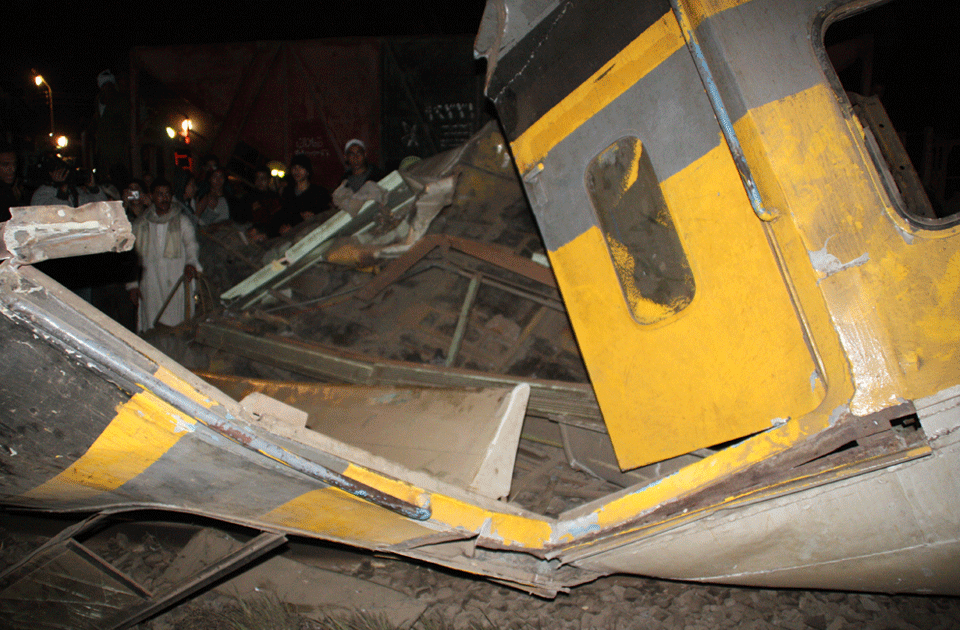
Train crash

(Photo, Al-ahram online)

Monday

 Tuesday

 Wednesday

 Thursday

 Friday

 Saturday

 A Few Thoughts

  • On the Domestic Front:  In 48 hours, two train crashes and three building collapses occurred. These tragic accidents have exposed the grim reality of the country’s public services and its climate of corruption. It also exposed the Islamist government’s abstract vision, with confused sense of priorties that doesn’t necessarily fit in with reality. The blame game, including blaming Christians for the train crash, reflects immaturity and inability to deal with Egypt’s chronic problems.
  • Political parties: Fragmentation seems to be the prevailing theme. The NSF’s cohesion has been faltering ever since amendments to the law organizing parliamentary elections were proposed. An interesting statement by Nour member predicts that FJP will only win about 35% of the seats in the next Parliament. I think the Muslim Brotherhood shares his assessment, which is why they opted to appease the Salafis who oppose the “quota” systems.
  • Economy: The hype about Islamic bonds is one example of how the word “Islamic,” is now used and abused to label superficial changes that is aimed to add a religious flavor to a politically motivated phenomenon (bonds, cafes). Here is another example of the government’s weird approach to the economy, which I will not even comment about. There were many resignations among big names, including Al Ahly (Egypt’s biggest bank) Chairman, Tarek Amer, and the Deputy Governor of the central bank. Many see that as part of planting pro-Morsi personnel in sensitive jobs that control the economy. In a nutshell, two words reflect the current state of the Egyptian economy—fear and greed.
  • Judiciary: Though the top court postponed a ruling on the legitimacy of the upper house of Parliament and avoided a potential political storm, there are remaining potential storms coming on Saturday, the 26th of January, with another verdict on the crucial cases of the Port Said massacre. Many Ultras (as demonstrated Friday in Tahrir) demand the death sentence to revenge the death of their loved ones at last year’s Port Said tragedy. I doubt they will get the verdict they expect; there are droughts of evidences in post-revolution Egypt that make the job of any Judge nearly impossible.
  • Sectarian approach and slurs: It is hard to ignore the trail of incidents for which Copts were blamed or attacked. The simmering tension between Islamists and Copts is not showing any sign of easing. Although Islamists always affirm their respect for their ”Coptic Brothers,” realities on the ground tell a different story of mistrust and a low threshold for justification of attacking Coptic local institutions once any accusation has surfaced. As for Morsi’s 2010 video, describing Jews as “pigs and bloodsuckers,” it is indicative of not just Morsi’s mindset, but also many more like-minded people in Egypt. Morsi will get away with his slurs, both the U.S. and Israel don’t want to escalate the matter; in other words, Morsi is just a lucky, hypocritical version of Ahmadinejad.
  • Revolution’s anniversary: The supposedly happy celebration could potentially turn to a sour occasion, which political parties abuse for political gains:-    With an eye on next parliamentary election, the Muslim Brotherhood seems to prefer to celebrate in the form of public campaign,” around the country. It seems that the ruling party still behaves as a non-government organization.  –      Opposition parties are planning a demonstration in Tahrir, where they are within their comfort zone and can rant happily without articulating a clear strategy for the future.-     Hazmoun are planning to “celebrate” at Media city, to protest what they perceive as the bias of the media against Islamists.
  • A magic solution for sexual harassment: Some cadres of Egypt’s Strong party, led by Aboul-Fetouh, proposed separate bus services for women and men and doesn’t just indicate a twisted understanding of the roots behind sexual harassment in Egypt, but also indicates a problem within the party’s conservative camp, as well as the more liberal one. This difference will ultimately shape the future and the performance of this party in the next election.

 Good Read


Posted in Diary of Aak, Egypt | Tagged , , , | 1 Comment

Egyptian Aak: Week 2

Imagge Pope

(Photo, arabianbusiness.com)  

Summery of the Week’s Main Headlines:

Monday

  • ElBaradei beefs up constitution party leadership in preparation for parliamentary elections.
  • Negotiations with US to drop Egypt’s debt.
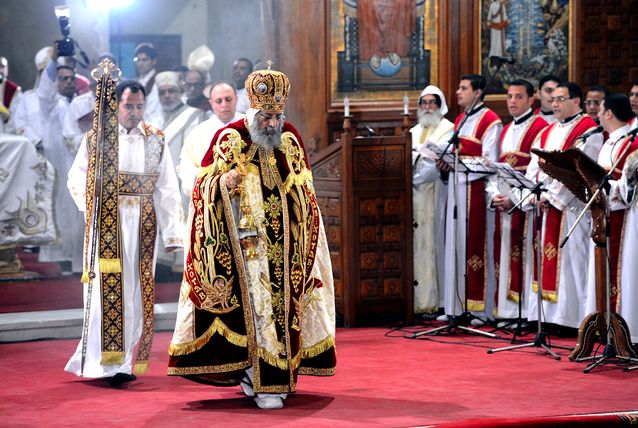
  • Tawadros II prays for Egypt and Morsi on Christmas
  • Egypt engages talks over $4.8 billion IMF loan
  • Egypt’s National Salvation Front parties bicker ahead of parliamentary election.

 Tuesday

  • National Salvation Front to run two separate lists in elections.
  • Egypt must endorse IMF loan deal as its own: Lagarde
  • Qatar lends Cairo further £1.25bn and donates extra £300m in effort to control Egypt‘s currency crisis.
  • Sovereign Sekuk draft (Islamic fund) law released by the government
  • Egypt’s Minister of education instructs all schools to learn from Sheik Al-Arifi’s speech(Arabic).

Wednesday

Thursday

Friday

Saturday

  • A group of teachers form a party to fight the Brotherhood’s control of education. (Arabic).
  • ‪#Egypt‘s Salvation Front demands11 guarantees for parliamentary polls.
  • Three members of 6th April movement in court accused of insulting the president.
  • Egypt’s slum crisis persists amidst housing abundance.
  • 14 injured in assault on protestors at Egypt’s presidential palace.
  • Court refers lawsuit demanding Islamic parties dissolution to state commissioners.

A Few Thoughts

The economy continued to be the dominant topic in week 2 of 2013. Morsi’s main survival tactic was in the form of an economic blood transfusion. Qatar was the main supplier, the terms and conditions of the deal is unclear, and the exact figure varies from one newspaper to another; BBC reported $1.25 bn and a donation of an extra £300m, while Daily Star reported $2.5 billion. The Qatari support helped, but only temporarily; by Thursday, the stock exchange dropped again. In addition, Qatar has proposed new investments in East Port Said and the North Coast that could be worth up to US$18 billion. It is still unclear whether Egypt will successfully get the required IMF loan. A team from IMF is expected in Cairo in a couple of weeks. Meanwhile, Morsi continues to appoint loyal people in sensitive positions − the new governor of central is one example. The controversy surrounding Islamic bonds continues among Egyptian economists. It was already rejected by al-Azhar once, but as it is one pillar of the brotherhood dream which I have heard about since the ’80s, I suspect they will persevere in this goal at any cost. Meanwhile, the question still remains: will Morsi be able to organize Egypt’s messy budget?

Foreign policy was another dominant topic; Morsi finally had a taste of the tricky nature of negotiations, disputes, and conflicting demands surrounding this element. Forging a Gaza ceasefire deal possibly felt like a walk in the park in comparison to mediation attempts between Hamas and Fatah. Reconciling the two Palestinian factions is by far a tougher task than achieving a ceasefire that everyone could use as proof of victory. Morsi even failed to persuade Meshaal and Abbas to join him in a trilateral meeting; this provided a sign of how wide the gap between the two rivals is and how great a task Morsi must achieve. The question remains: why must Morsi organize those meetings before getting positive signs that obstacles will not hamper his efforts?

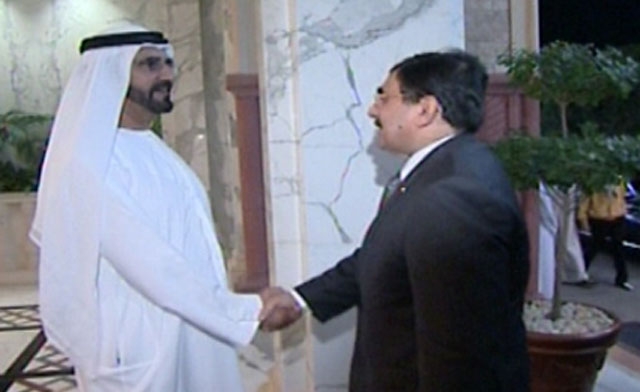
The turbulent relations between Egypt and the UAE are another tricky front for Morsi; his cozy relationship with Qatar is in stark contrast to his fragile relationship with the other important wing in the Gulf (Saudi Arabia and UAE). This wing was probably watching Morsi’s movements carefully, particularly on another front − Iran. The Iranian foreign Minister’s visit to Cairo and his charm offensive is not just about Syria, as it is officially announced − it is about both countries. Iran and Egypt are both trying to survive in a very tough neighborhood. It’s no wonder; Morsi rang the Saudi king on the same day he met with the Iranian envoy (al-Arabyia TV). Political talk shows in Egypt were also abuzz with the visit amid allegations of a meeting between Morsi’s advisor Haddad and leader of the Quds brigade that was vehemently denied by several brotherhood figures (but no legal case has been presented against the UK Time newspaper yet!).

 Political parties continue their preparation for the next parliamentary election, and no one knows when it will be held (rumors of next April were denied). On the Salafi Front, it has become clear that Nour party is drifting away from the brotherhood sphere of interest. They view the brotherhood as a body of more opportunists who are willing to build their values for political gains. The new leader of Nour is a straight talker and well respected among the Salafi general public; thus, I suspect that the party will continue to show solid performance in the next parliamentary election.

My guess for the fate of Watan and Hazmoon is that they will end up forging a deal with the Brotherhood; however, it is difficult to be sure how things will evolve in the current murky political atmosphere.  The non-Islamists are still bickering, though in a civilized way. Their decision to run in two separate directions was inevitable because of the fundamental differences between various parties within this fragile coalition. It seems to me that they are preoccupied by the anniversary of the January 25 revolution. But they are not the only ones − the Islamists are planning a strong show, too. Thus far, the anniversary, it seems, will reflect not only the goals of the revolution, but also the divisions of post-revolution Egypt.

Sewage

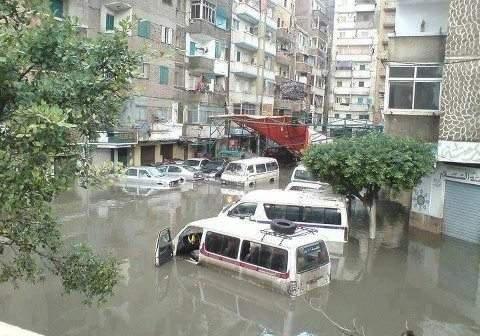
On the domestic front, bad weather conditions have led to flooding in several areas of Egypt, particularly in Alexandria, exposing Egypt’s neglected infrastructure. Egyptians joked that the country “drowned in a few inches of water.” Underneath the humor, there was a strong sense of resentment toward the Brotherhood, particularly the Alexandria governor (Brotherhood), who simply failed to rise to the occasion. True, he inherited a very bad situation, but he neither prepared for the storm (its annual timing is well known to locals) nor set an emergency task force to help the distressed public. Another unintended consequence was the destruction of many Gaza tunnels. The storm did in a few hours what Israel tried unsuccessfully to do for many years. Last night’s incident at the presidential palace is just another example of the deteriorated security situation in Cairo. It was not the first; we used to blame Mubarak’s thugs, now who should we blame?

Good Read:

 Egypt year 3 of democracy continues to be interesting. Next week, a new report! Meanwhile, I will leave you with this uplifting video. Egypt Still has many good people who believe in its revolution: 


Posted in Diary of Aak | 2 Comments

Morsi Manages Egypt’s Economic Decline

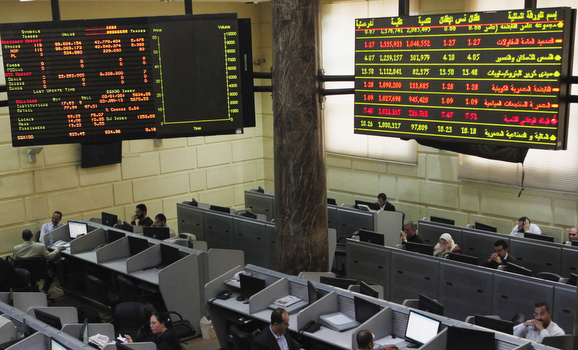
Traders work at the Egyptian stock exchange in Cairo

I wrote this piece for Al-Monitor. Hope you find it interesting!

In the midst of a regular monthly journey that I always dreaded, I stood in the long queue with my mother to collect our share of subsidized basic food items. All were of poor quality and badly packed, yet no complaints were accepted. Getting a pair of frozen chickens was more fortuitous; one needed to develop good contacts with workers in the government-owned, less-than-“super” market. If you were lucky, they would notify you once a new stock was available. Still, the queue was unavoidable, and the crowd was always tense, each person hoping to buy before everything was sold out. That was the reality for many Egyptians during the Sadat and early Mubarak eras.

As fear for the economy grows in Egypt, a comparison to the conditions faced in the ’70s and early ’80s becomes more plausible. How far will the economy deteriorate? Can Morsi’s team save it? Every household ponders these questions while watching a devalued Egyptian pound and witnessing the hike in food prices. Continue reading here

Posted in Egypt | Tagged , , , , , , | 2 Comments

Egyptian Aak: Episode One

Al-Hadad

Presidential adviser for foreign affairs, Essam el-Haddad (Egypt’s real FM)  in UAE after arrest of “Brotherhood cell.” courtesy AlArabyia


Here is the first episode of my diary. As I wrote last week‘Aak’ is an Egyptian term that describes a messy situation.

 Tuesday

  • The Muslim Brotherhood’s Saad el-Katatni: “God willing, the year 2013 will be the year of institution-building and establishment of the modern democratic State.”
  • A group of ultraconservative Islamists, under the leadership of Emad Abdel Ghafour, announced the formation of a new party, Al-Watan.

Wednesday

  • Egypt’s fact-finding commission says Mubarak watched the January 2011 uprising against him live. It also urges the investigation of the Muslim Brotherhood members accused of killing protesters.
  • Egypt’s satirist, Dr. Bassem Youssef, faces a probe for insulting the president. Another complaint was also filed, claiming that Bassem has mocked the Islamic prayer.
  • Opposition writer, Abdel Halim Qandil, is being investigated for “insulting” President Morsi (Arabic).
  • President Morsi’s administration has accused the al-Masry-Al-Youm, newspaper of “circulating false news likely to disturb public peace and security.”
  • Hisham al-Ashri, a brotherhood-member-turned- Salafi has proposed a new morality police (Arabic).

Thursday

  • Five non-Islamist political parties are discussing a possible merger with the Al-Dostour party.
  • According to Egypt’s Prime Minister Qandil, Egypt’s parliamentary elections law will be submitted to the constitutional court for review within 15 days of the endorsement of the new constitution (that’s January 9th).
  • Egypt’s main opposition announced it is willing to engage in a national dialogue with President Morsi if a number of conditions are met.

Friday

  • The Nour Party is getting ready for the upcoming parliamentary elections by selecting candidates and developing new methods of campaigning.
  • Radical Saudi cleric, Al-Qarnee delivered Friday sermons in Cairo (broadcasted by Al-Jazeera Mubasher). Arabic

Saturday

  • Opposition calls for 25 January protests
  • Cabinet reshuffle brings in 10 new ministers including new interior and finance ministers. ‪ 

Few thoughts:

  • The Muslim Brotherhood’s Chief Katatni ( apart from the cheesy clichés) did not articulate a clear plan ( apart from cheesy cliches) on how the ruling party will rebuild the country’s institution. I doubt the Muslim Brotherhood is willing to change the framework of governance in Egypt; they just want to mend it to their advantage.
  • The changes on the Salafis front are very interesting. Watan party officials claim that they are more moderate than Nour, while Shadi Hamid claims that Abu Ismail “offers a more revolutionary form of Salafism.”  Besides these fancy definitions, all Salafi parties claim their goal is the implementation of Sharia, but none of them has articulated how it will be translated into a political platform in a way that differs from other Salafi parties. The Strong Egypt party is another party to watch; whether it will run alone or make a possible alliance with other non-Islamist parties in the next parliamentary election.
  • What is disturbing about the Egypt fact-finding commission is the unprofessional early leakage of its findings. Announcements should be in a complete report with a formal reply from the Ministry of Defense and Ministry of Interior, who are both implicated in the events. That is the international standards, which are sadly ignored.
  • Probing Bassem Youssef and others raises many questions: Is democracy for the Brotherhood a strategic choice or is it a tool to reach power? Islamists in Egypt view satire as an act of disrespect; they fail to see it as part of the safeguards against dictatorship. It was great to watch him on Friday, unfazed, and continuing with his satirical criticism of Morsi.
  • Regarding the Al-Ashri proposal for a morality police, here are some of his views, which speak for themselves:

Once you left the house, you are not free. Sharia is about obedience.”

       “If the Coptic woman doesn’t want to convert, she still has to wear the hijab against    her will.”

Many Salafists share his views. The preaching of radicals Sheiks like Al-Qarnee will enforce these trends in the Egyptian society.

  • Election law presents a crucial battle; the gap remains wide between Islamists and opposition forces. The current law will serve the Islamists well, and modifying the law will be crucial if the opposition stands any chance of success in the next election. As for the news of a possible merger among opposition parties and the “national dialogue,” I will believe it when I see it. The call for protests on the 25Th January, highlights the opposition’s heavily reliance on street protests. Their performance is not convincing; it is even alarming.
  • The details of the proposed protest law are enough to cause anyone to lose faith in the Brotherhood’s intentions. I think Morsi’s administration will have to proceed with the proposed law to curb future protests that are expected due to economic hardship.
  • Despite the fact that Egyptian authorities did not confirm the smuggling reports, if true, it indicates that Egypt is a partner to the ceasefire between Israel and Hamas and is willing to take steps against smuggling. The question is: How does Hamas view the Egyptian policies?
  • Egypt‘s foreign policies are amateurish. The recent crisis with the United Arab Emirates reflects how Morsi still view his party, the Muslim Brotherhood, as his main priority, which is exactly why Gulf States are deeply worried. To send a president advisor who was later rebuffed by the authorities in UAE and the alleged Saudi rejection to mediate are slaps in the face to Morsi. The relationship with Iran is also intriguing− what exactly is Morsi after? Knowledge about their subsidy system or their Basij?
  • Finally, the cabinet reshuffle was expected. I doubt that this government will produce any remarkable changes. Morsi’s team is the one who calling the shots, not Prime minister Qandil.

Best Tweets:

‪@stevenacook Why can’t you insult the president? How about this? If you don’t like being insulted, don’t run for president.

@ElBaradei Egypt: Show me a faltering economy and I will show you a fractured society.

@monaeltahawy “People have only as much liberty as they have the intelligence to want and the courage to take.” ― Emma Goldman

@tomgara Egypt’s core skill has been managing a series of graceful declines for 1000s of years.

‏‪@hisham_melhem Egypt didn’t recover from the flight of Greeks, Italians & Jews; if flight of Coptic Christians continues the loss will be incalculable.

Good read:

Next week, a new episode.


Posted in Diary of Aak, Egypt | Tagged , , , , , | 4 Comments

Israel Already Deals With Hamas

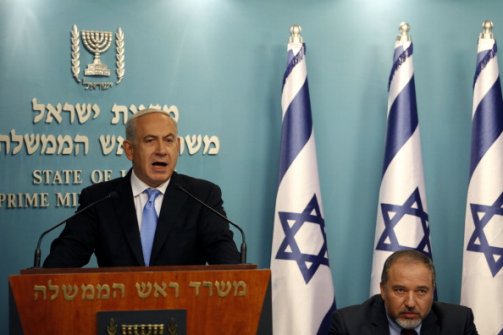
Bibi Lieberman

I wrote this piece for  The Daily Beast’s Open Zion Here is a copy, in case you missed it.

As the debate about the potential nomination of Chuck Hagel as the next U.S. Secretary of Defense becomes increasingly heated, many have expressed their opinions both for and against the nomination. Last week, the New York Times ran two op-ed articles two days in a row defending Hagel. In one piece, Thomas Freidman did not just defend the Hagel nomination—he also defended Hagel’s alleged willingness to engage Hamas. Freidman wrote: “I don’t think America or Israel have anything to lose by engaging Hamas to see if a different future is possible.”

Here is a surprise for Mr. Freidman: Israel is engaging with Hamas—not only recently, but it has been doing so for the past few years. The best example of this quiet engagement is the ceasefire agreement that ended Israel’s recent operation in Gaza (Pillar of Defense). Despite  initial skepticism, the deal seems to be holding, with more positive steps to ease the blockade (delivering building materials and allowing fishing at Gaza’s shore). In addition, Israel allowed Hamas leader Khaled Meshaal to visit Gaza after years in exile for Hamas’s anniversary celebration. The man that Netanyahu once tried to assassinate has enjoyed unprecedented freedom. Israel, it seems, rewarded Hamas for firing the rocket that reached Tel Aviv and Jerusalem by acceeding to a wide-reaching deal with the terrorist organization that is still committed to destroying the Jewish state.

What both Israel and Hamas has learned from the failed Oslo peace process is that direct engagement and shaking hands at the White House are bad ideas that bring scrutiny and earache. Therefore, both opted for quiet, indirect talks (the Gilad Shalit deal) that were necessarily based on shared interests. And believe it or not, there are many shared interests between those two archenemies: keeping quiet at the Gaza/south Israel front and undermining Abbas’s leadership are the best examples. Israel, for example, decided to punish President Abbas, who dared to go to the U.N. and achieve an observer status, if only a symbolic one, by blocking funds to the Palestinian Authority. Israel’s Foreign Minister Avigdor Lieberman went event further by claiming: “There are many alternatives to the Palestinian President.”

Israel’s ill-fated disengagement from Gaza  empowered Hamas and other radical Palestinians groups, who viewed it as a victory for the “resistance,” and helped them later to fully control the Gaza Strip. The same scenario could easily happen if the Palestinian Authority weakened more in the West Bank (despite Lieberman’s claims to the contrary). There are already reports—which may or may not be credible—of possible preparations by Hamas to take over the West Bank. Nonetheless, the ultimate aim of Hamas is to control the West Bank; whether they will achieve it by “reconciliation” or by takeover remains to be seen. It all depends on the evolving facts on the ground in 2013. A weak Abbas, a crumbling economy, troubles in Jordan and an Islamist regime in Syria, may all bring the West Bank to a tipping point, which Hamas is eagerly waiting.

Like two hostile neighbors living in a tense, crowded region, they continuously watch each other, looking for clues and hints. Netanyahu and the leadership of Hamas are enemies who at times share the same mindset: both want their cake and to eat it. Neither are willing to compromise, nor like to admit defeat, which is precisely why both are seeking to redefine victory and bend the definition of deterrence and balance of terror to their advantage.

Whether Obama appoints Hagel or not, Israel’s policy toward the Palestinians will continue to be dictated by the reckless underestimation of Hamas’s tenacity and ability to maneuver. Netanyahu might thinks he tolerate an emboldened Hamas until he finishes Abbas off, then later turn against Hamas if necessary—a risky game that will backfire. He shares the same mindset of Ariel Sharon, who assumed that disengagement from Gaza, without reaching a comprehensive deal with the Palestinians, was a good idea. It was not. Hamas’s rule over Gaza may not alone finish the prospect of a two-state solution, but could soon open the gate for Hamas to re-launch its influence in the West Bank as the only party that can “engage” with Israel and bring reliable political results on the ground.

Posted in Gaza, Hamas, Israel | Tagged , , , , | Leave a comment

Diary of Aak

‘Aak – عك’  is an Egyptian term that has always been used to describe a very messy situation when things become detangled and going the wrong way. I think it is the best way to describe Egypt’s current political scene. As the mess is Egyptian, let’s give it an Egyptian term: Aak.

Although the over-heated political scene seems to be cooling down following the approval of Egypt’s mediocre constitution, I doubt this calm will last for long.  Confusion, fogginess and political stubbornness are the current themes; political parties are simply not talking to each other and did not yet reach an agreement on election law.  This is in addition to the ongoing economic crisis that could easily inflame an already tense environment.

If 2011 was the year of the revolt—when Egyptians, regardless of their political affiliations, forced Mubarak to leave and fought against the Supreme Military Council that ruled Egypt afterward—then 2012 was the year of exposing many myths: the emerging power of Salafis, the Brotherhood majoritarian claim that was slowly eroded by the end of the yea, and the opposition division with its limited popularity. 2013 will likely be the year of confronting realities: the role of religion, the disfranchised rural regions and how the economy would be best managed.

It will be interesting to see if the ruling party, the Muslim Brotherhood, will do some soul searching and reflection on their behavior over the last two years, or if they will continue with their dogmatic approach to politics. Their relationship with various Salafi parties will also be crucial in the next few months, particularly in the next parliamentary election. Ironically, the bad economy will help Islamists, in general, to seduce many Egyptians into voting for them (the legacy of buying votes is still alive in Egypt).  The opposition must also reflect on their dismal performance and how they can bridge the gap and reach out to voters in the regions that voted against them in previous elections.

I will try to cover the most important weekly events in a diary, entitled the “Diary of Aak,” which I will publish each Sunday.

Some analysts have predicted an optimistic outlook for Egypt in 2013. I hope and pray that they are right in their predictions, and I promise to change the diary name to the “Diary of Brioche,” if they turn out to be correct. After all, that is what many ordinary Egyptians dream about: a decent piece of bread , not mixed wth tear gas or blood of victims.

Happy New Year 2013


Posted in Diary of Aak, Egypt | 3 Comments

Morsi’s Pyrrhic Victory

pyrrhic victory

I wrote this piece for Egypt Source, Atlantic Council. Here it is, in case you missed it.

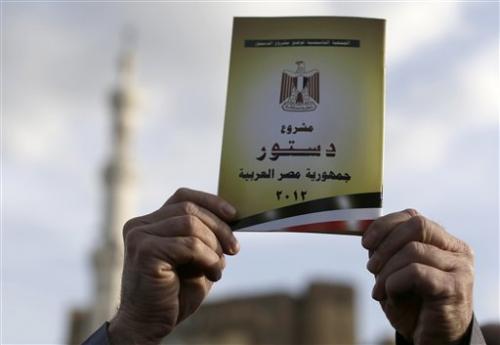
Following weeks of tension and violence over Egypt’s divisive draft constitution, the second round of voting in the referendum is complete. The unofficial results indicate a turnout of approximately 32% with 64 % approval of the draft constitution. The journey for Egypt from January 2011 to December 2012 has been chaotic, but in hindsight it has also served to expose many hidden facts and painful realities.

First, these results are the legacy of a disenfranchised Egypt. The overwhelming support of the referendum in the South Egypt, Fayoum, Red Sea, Sinai, New Valley and Matrouh governorates exposed how these regions were neglected during the Mubarak era. It also reveals how political Islam, particularly Salafism, was a slow growing phenomenon that has now flourished in marginalized communities throughout the country. In these areas ‘religion-as-a-solution’ became an appealing slogan. Appearing first during the previous parliamentary elections, this week’s referendum reflects a continued strength on the ground. Salafists–and not the Brotherhood–are the true victors emerging from this last round of political mayhem, a fact that Egyptians must accept and deal with accordingly.

Second, the voting exposes the real size of the Brotherhood’s influence in Egypt. The results contradict President Morsi’s claim that 80 % of Egyptians support his decisions. In fact, it indicates a drop in his popularity, as only 10 million endorsed the bill in comparison to the 13.2 million that voted for him in the presidential election.  Furthermore, an overall low turnout of 32%, in comparison to 49% in the presidential election, reflects the actual size of Islamist influence throughout Egypt. In actuality, 68% of Egyptians are either not interested or not impressed with the current political dynamics. The turnout may also reflect a return to a Mubarak-era sense of apathy among voters who don’t believe that their vote will make any difference, in the midst of rigging and fraud allegations. This is a bitter pill to swallow for the Brotherhood, who for the last few weeks indignantly told a foreign media that they represent the majority. In actuality, they failed to achieve their 70% target and were endorsed by only 10.5 million Egyptians out of nearly 51 million eligible voters.

Third is the myth of the pro-Shafiq constituency. Many compared the referendum results to the June presidential elections. The valid comparison is when one considers the performance of Islamists as organized political groups, with the referendum indicating a lack of consistency in their performance. The same, however, cannot be said of those who supported Mubarak and his last Prime Minister, Ahmed Shafiq. The pro-Shafiq constituency is not a fixed group with a clear ideology. It includes some loyal members that considered him the right man to lead Egypt. However, it also included many who voted not for a candidate, but for stability. It is likely that they voted ‘yes’ in the referendum for precisely the same reason; a yearning for a stable environment. The fluid dynamics in Egypt will always produce leaders, alliances and parties that may or may not sustain the test of time. Shafiq is just one example.

Fourth, the National Salvation Front’s performance must be considered. The coalition of opposition parties that was formed in haste as a response to President Morsi’s recent edict has proven to be weak, fractious and lacking a common vision for the future. They failed to capitalize on their modest achievement in the first round of the referendum (only 56% voted yes), failed to appreciate the degree of protest fatigue in Egypt, and could not come up with a cohesive plan to manage the ‘no’ campaign in the second round of voting. Their survival as a united front is also now in question, despite today’s announcement of plans to form a single political party. The next parliamentary election is crucial for non-Islamists, especially if they really want to survive in Egypt’s ruthless political environment. Their performance in the constitutional referendum is simply one misstep in a long trail of less than perfect decisions, and they are often reactive rather than proactive in their performance in post-revolution elections and referenda. This should serve as a wake–up call and highlight the importance of unity. The results also reflect their poor performance in rural areas, a far cry from their forefathers’ performance in the 1919 revolution, which enjoyed strong rural support. Galvanizing farmer and worker votes against the draft constitution could have, in fact, proved to be a more successful strategy for the opposition.

The Islamists “pyrrhic war” against their opposing camp may have resulted in a victory. However, this victory is hollow, and is tarnished by reports of many violations and voting irregularities. They turned a battle about the constitution into a confrontation of piety, using religiously charged slogans to gain support. However, with the voter turnout, it is possible that 68% of Egyptians eligible to vote, many likely conservative, did not buy into the religious rhetoric. In contrast, the loyal Islamist camp has voted for stability and out of an extreme desire to end their disfranchised status. This is a huge task for the Brotherhood to achieve, particularly, after alienating many middle-class Egyptians who would be instrumental in achieving that task.

President Morsi and the Brotherhood’s shock-and-awe approach to politics has divided Egypt and reinforced the right wing-puritan Salafis, a move that the Brotherhood may come to regret in the next parliamentary election. It also exposed their true influence within society, and the real map of political forces that was pushed underground during the Mubarak era.

Going forward, Egypt’s political path should be based on facts and not myths. This would be a positive outcome, particularly after a hefty price paid in a chaotic environment. This environment will not be quickly healed and the violence and polarization will not fade in the near future, but at least this referendum has purged many underground myths, a vital step for the evolving democratic process in Egypt.

Posted in Egypt, Politics | Tagged , , , , | 1 Comment

Egypt’s Public Prosecutor

Tonight resignation of Talaat Ibrahim as Egypt’s public prosecutor is part of long and complicated dynamic that Egypt is currently witnessing. Here is an explanatory timeline. I hope it can help in understanding the background:

October 11: Egyptian President Mohammed Morsi sacked Mubarak-era public prosecutor Abdul Meguid Mahmoud a day after a court acquitted stalwarts of the old regime of organizing an attack on protesters during last year’s uprising.  However, Morsi’s order to dismiss Mahmoud exceeded his mandate. The law protects the prosecutor general from being fired by the president.

October13: Judge Abdul Meguid Mahmoud returned to his office in a symbolic display of independence and defiance of the president. Later, on the same day, President Morsi has agreed to allow prosecutor general to keep his job after an embarrassing public row.

 November 22:  Morsi issued an edict granting himself unprecedented power and remove the public prosecutor Abdul Meguid Mahmoud; in his place, he appointed Judge Talaat Ibrahim.  It is worth mentioning that there were conflicting narratives about him, some suggesting that he had previously handed some politically motivated verdicts

December 11: Many judges, including the judges club, rejected Morsi‘s edict. A court in Cairo (the Azbakiya Misdemeanor Court) declined a case because it was referred to the court by the new public prosecutor, saying that he does not legally hold that position.

December12:  Public prosecutor Talaat Abdallah has transferred the attorney general Mostafa Khater for East Cairo Prosecution to Beni Suef. The attorney general said the decision was based on work needs. However, the transfer followed Khater’s order to release 137 suspects detained during the recent clashes around the presidential palace, citing a lack of evidence.

December13:  After outcry, Morsi-appointed public prosecutor reversed his decision to transfer attorney general who released all presidential palace detainees.

December17: Morsi-appointed public prosecutor Talaat Abdullah  Steps down following protests by judges; Hundreds of judges and prosecutors had staged a protest at his office earlier in the day after marching from the Judges’ Club building. Supreme Judiciary Council has yet to accept resignation.

So in a nutshell, Morsi replaced Mubarak’s man with his own; Judges stood firm, rejected a prosecutor who was directly appointed by Morsi, and defended their independence, forcing the public prosecutor to submit his resignation. What’s next? Who knows?

Posted in Egypt | 6 Comments

Egypt’s Constitutional Referendum

Ref photo 2

( photo: Ahram online)

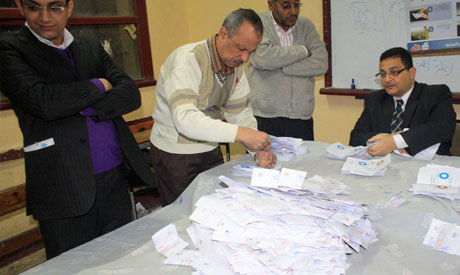
Following weeks of violence, casualties, allegations, and counter-allegations, Egyptians voted in the first leg of a referendum on an Islamist-backed draft constitution.  Here are my thoughts on yesterday’s events:

This is not just about a draft constitution; in a way it is a mandate about President Morsi and his party, the Muslim Brotherhood, and their respective popularity or lack of it on Egyptian streets. If the final result of the first leg of the referendum is that only 56.5% have voted yes, despite Islamists previous predictions of at least 70%  of Egyptians support them, then the Brotherhood, according to its own statistics, cannot claim to be the majority ( at least in 10 major governorates), and should stop labelling the opposition as “undemocratic minority” that “deterring” democracy. Not to mention the fact that the Salafis backed them by mostly voting yes, a voting alliance that will turn into a competition in the next parliamentary election.

According to most updated figures,  it seems that three big governorates  (Cairo, Alexandria, and Gharbia) were deeply divided between the Islamists, who support the new draft constitution, and non-Islamists, who reject it.  All media outlets, including the Brotherhood Web site, confirmed that Cairo clearly voted NO to the constitution, which, in my opinion, is a huge blow to President Morsi. The president, who recently changed his home address from Sharqyia to Heliopolis in Cairo, has to live in a constituency that rejects his vision for the country. Graffiti over the presidential palace walls tells  the story more bluntly than any in-depth analysis.

The images of long queues in front of polling stations did not in fact reflect the turnout, but point rather to the shortage and likely inefficiency of the judges in running the polling stations. Some voters went even further, accusing the election committee of deliberately delaying voting in disputed areas in the hope of putting people off and persuading them to leave without casting their votes.

The results from the South of Egypt (Aswan, Assut, and Sohag) are very alarming as they highlight Egypt’s  sectarian divide. It seems that many Muslims voted yes, not to support the constitution, but to oppose the Christian vote ( mostly voted no). If Egypt is still in a two-year democracy, many are not willing to let it progress further and want it rather to be plunged into a tribal, sectarian divide. What is even more alarming is how the Brotherhood’s own media indirectly incited feelings against the Copts and supplied inaccurate information.

Although stage two would be in many rural regions of Egypt, I do not think it is a done deal for the yes camp as many predict. Despite a healthy turnout, it seems that 68% of eligible voters have decided to boycott the whole process. The opposition has a week to focus and spread awareness among the boycotters. If some refuse to cast their votes out of disaffection (towards both Morsi and the opposition) or simply because they think their vote would not matter, the opposition should work to change this mindset. Fact: Islamists have already reached their maximum support, but the opposition has not reached its full potential.

Despite the Brotherhood’s claims of a perfect referendum process, there have been countless reports of irregularities throughout the country, including 26 polling stations in 4 governorates that lacked judicial supervision.  The hasty rush to proceed with the  referendum despite many judges boycotting it, has cast a huge shadow on the whole process. More importantly, it will make it more difficult for the president and the referendum committee to refute the claims of fraud. Already Monitoring and human rights groups demand first round referendum re-run because of rampant irregularities. I doubt the government and election committee will agree, but these statements would put the second stage of the referendum under more scrutiny.

Last night’s attack on Wafd Party headquarter and previous attacks on many Muslim Brotherhood offices in addition to Friday violence in Alexandria should all be viewed as part of the slow disintegration of law and order in Egypt. Rather than working on restoring law and order, the Brotherhood has been busy pointing fingers and blaming a “third party.”  The road toward a failed state starts with citizens losing respect for government institutions.

Regardless of the final outcome of the referendum, this is not the result President Morsi and the Brotherhood should celebrate. This referendum has done the opposition a great service by highlighting its strongholds around the country, and its potential in the next parliamentary election. On the other hand, it has exposed the myth of the Brotherhood’s high popularity, particularly in urban areas, and its dependency on Salafi support in rural areas. A sad state of affairs for Egypt as a country, but it could be the beginning of a much-needed political awakening for many ordinary Egyptians. Morsi should wake up from his delusions and start to seek much-needed consensus to prevent Egypt from spiraling down the path of a failed state.

Posted in Egypt | 2 Comments

Bahrain: The intriguing Kingdom

” Ladies and gentlemen, I am not a prince of Sunni Bahrain, I am not a prince of Shia Bahrain. I am a prince of the Kingdom of Bahrain and  all mean a great deal to me personally. I soon hope to see a meeting between all sides – and I call for a meeting between all sides – as I believe that only through face – to – face contact will any real progress be made.”                                                                                        

HRH Crown Prince Salman

Manama Dialogue 2012

IMG_3018

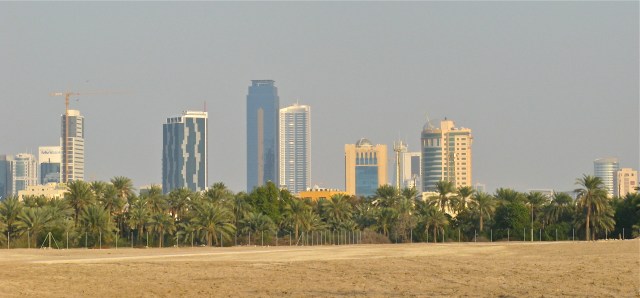
Manama is a modern, cosmopolitan city with skyscrapers sitting right in the heart of a desert island. The giant Christmas tree in the posh Bahraini hotel (where I stayed) reflects one face of Bahrain – the tourist-friendly, tolerant country that is known for its relative liberalism in comparison to other Arab Gulf countries, particularly Saudi Arabia. For example, it is well- known that Saudi women often go to Bahrain to get a driver’s license, an act that is prohibited in their own strict Islamic country.

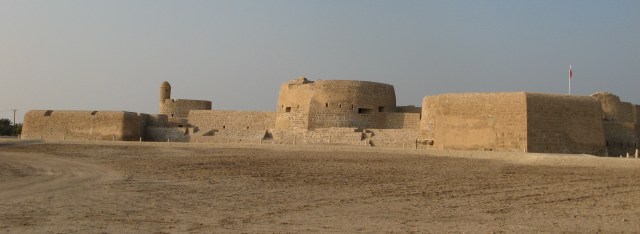
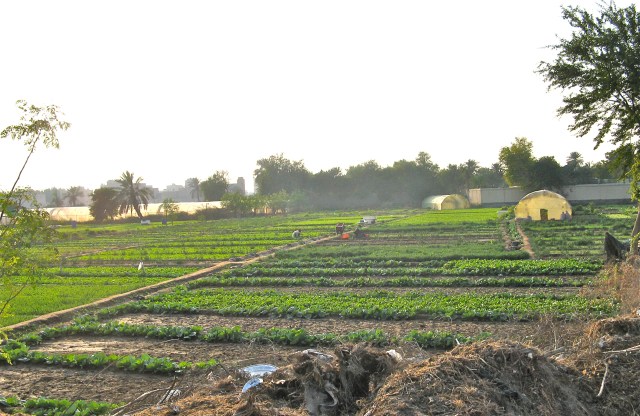
The Kingdom may be modern, but it has a long history due to its strategic location in the Arabian (Persian) Gulf. Ancient Sumerians described it as an island paradise to which the wise and the brave were taken to enjoy eternal life. Excavations in the Qal’at al-Bahrain (Bahrain Fort, a world heritage site since 2005) have unearthed antiquities created by various occupants dating from 2300 B.C. Although most of the island is a low-lying, barren desert, there is a fertile strip that is five kilometres wide along the northern coast where date, almond, fig and pomegranate trees grow.

The aforementioned modern face is just one of many on this intriguing Island; there are  several others projected by its three main communities: The Sunni, the Shia and the ex-pats, which are multinational communities mainly from the Asian subcontinent. Sadly, the current political climate is tense and occasionally violent. There are long-running tensions between Bahrain’s Sunnis and the Shia Muslim majority. In early 2011, the government called in the Saudi military to crush protests by demonstrators who were demanding a greater say in government and an end to what Shias say is systematic discrimination against them in jobs and services. Despite the crackdown, Shia resentment has continued to simmer, sporadically erupting in anti-government protests.

IMG_3015

Bahrain Fort

IMG_3021

The fertile land of the Island

During my brief visit, I was a bit surprised by how they were willing to talk politics (even with a complete stranger like me), and how each has a very firm, fixed opinion about the situation in Bahrain.  Some views of Asian ex-pats were particularly alarming. Here are some examples:

The Indian community has been here for more than a hundred years.  If those Shia get into government, they will kick us out.” An Indian worker.

The Shia are victim of oppression, but I worry if they take over, they will mistreat us.” Another Filipino worker.

The Shia must understand that this country is not as rich as other Gulf states and the king cannot provide everything they want.” A Bangladeshi taxi driver.

But perhaps the most interesting comment was from an Egyptian man:

Everyone here, including me, is biased one way or another; take what they say with a pinch of salt.”

Finally, a Bangladeshi taxi driver agreed to take me to the Shia neighbourhood of  Sanabis, – only after he rang two of his friends who reassured him that it was safe to visit. He later confessed that he had never ventured inside Shia areas in his 18 years inside the Kingdom; “only main streets; still it may not be safe,” he said. He looked tense as we started to walk the narrow alleys. “No police here; if anything happened to us, no one would know,” he said. It was so odd, that I – the foreigner – had to reassure a local that it would be fine and that the area looked safe.

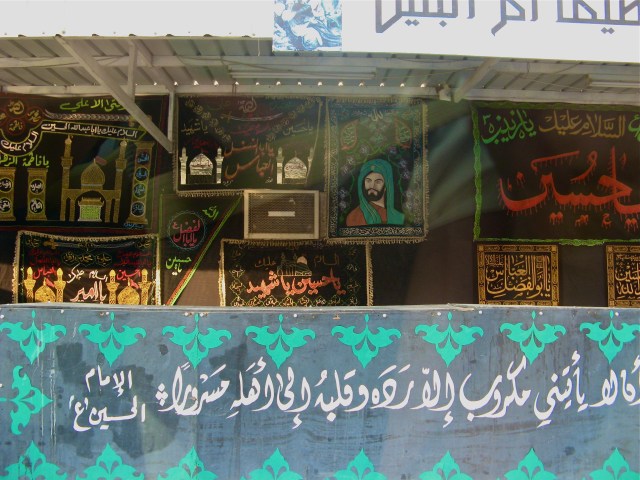
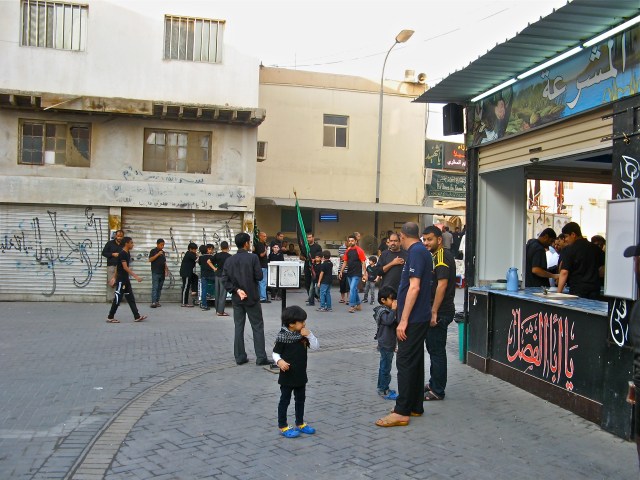
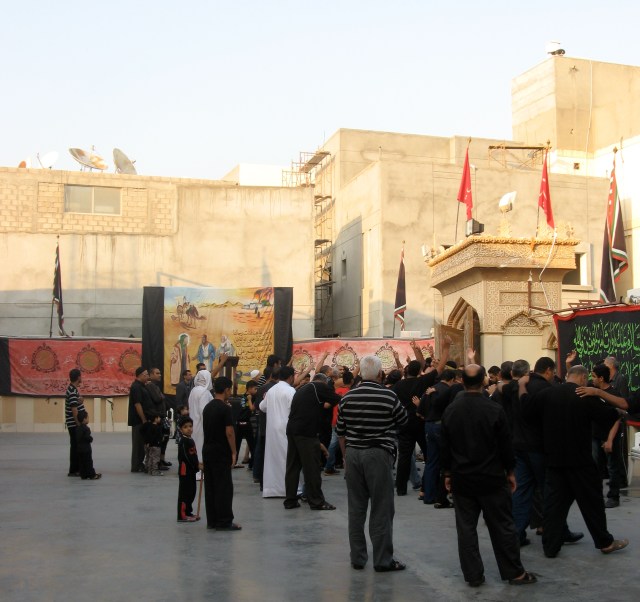
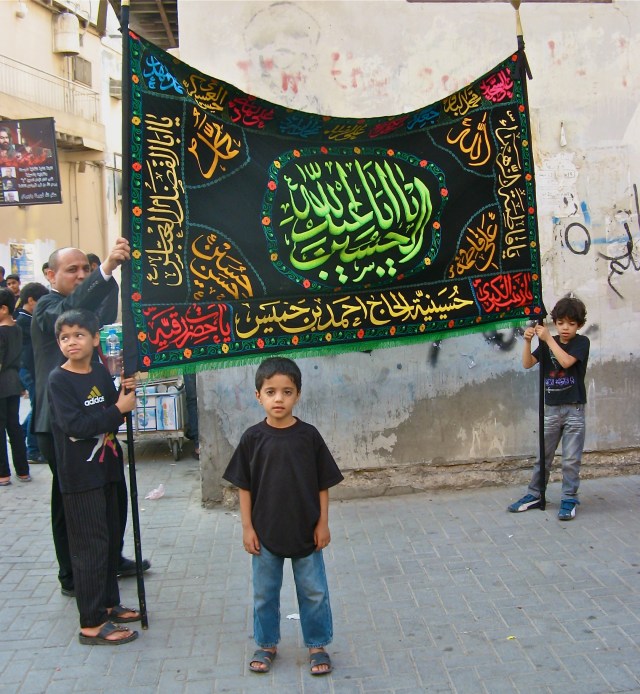
A local man offered to guide us around; he even let us park the car in his private garage, while we went to the Matem (a mourning remembrance for Imam Husain). It was amazing, and the photos do not do it justice; the music, the chanting and the lyrics were simply beautiful.

IMG_3027

A Shiite Matem

IMG_3035

Every one dressed in black

IMG_3042

A congregation Chanting in love of Hussain

IMG_3050

Kids are part of the carnival

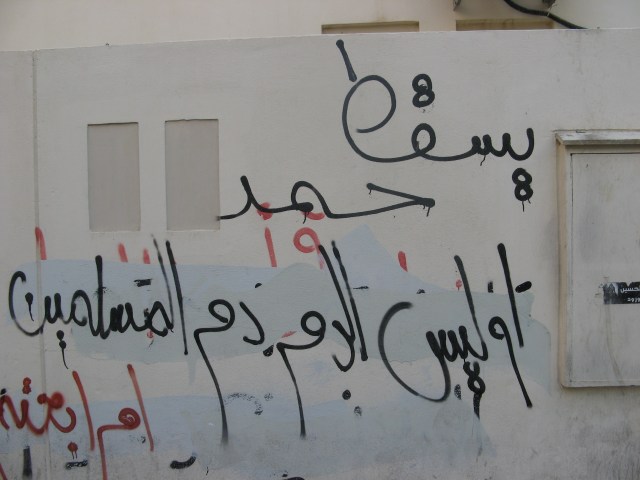
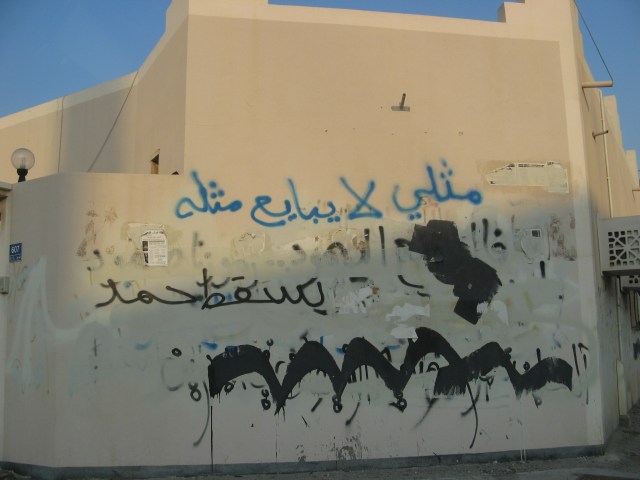
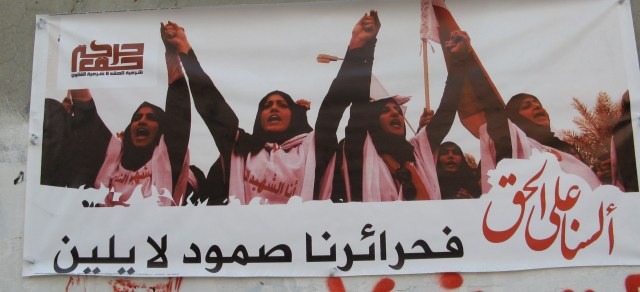
It was a men-only celebration; in such a conservative environment, women hardly ever mix with men. All of the women were reluctant to speak to me and definitely avoided my camera.  Men were polite and let me wander around freely but many were not keen to talk. However, the graffiti on the walls was more telling; literally every house has one and they all share  a common theme: “Down with Hamad.”

IMG_3055

IMG_3061

Here are some quotes from Bahraini Shia (not just from Sanabis):

“ We don’t hate Sunni, we just want equality and justice.” A Shia man speaking n Arabic.

“The King can do more for Shia. I work daily for long hours, still earn peanuts and it is very expensive here.” A Shia young lady who works in a shopping Centre.

“ Wefaq is not a violent party.  We renounce violence and we welcome the Crown Prince’s invitation.” A Shia member of Wefaq. (indeed, Wefaq issued a statement, which you can read here.)

IMG_3054

 A sign say: the resilience of our free women would never resolve

Despite the call for dialogue, it seems that there is ongoing tension, also there was news that the Bahraini court reduced (rather than annulled) rights activist Nabil Rajab’s sentence from three to two years.

I left Bahrain with the Crown Prince’s words still resonating in my mind: “Without justice, there can be no freedom, and without freedom, there can be no true security.” It was well-crafted and worthy of his first public speech since April 2011. I hope his wise words prevail; otherwise, it could be déjà vu reminiscent of 2011.

Nothing grows without seeds, and reconciliation and reforms are no exception.

All photos are mine. Copyright protected.

Posted in Bahrain | Tagged , | 4 Comments