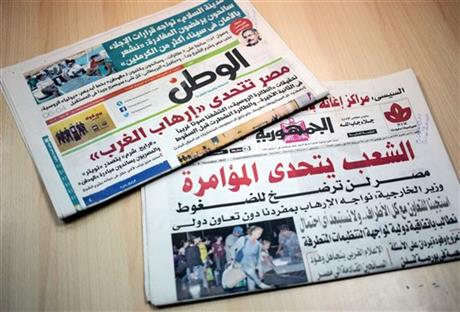
Egyptian Aak 2015 – Week 47 (Nov 16 -22)

Top Headlines

Two Egyptians confirmed dead in the Paris terrorist attacks. (Monday)
• Russia confirmed that a bomb brought down Russian jet in Egypt. (Tuesday)
• Second phase of parliamentary elections launched in Egypt. (Sunday)
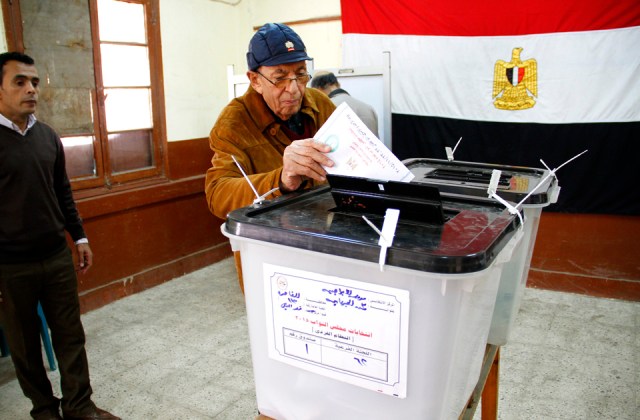
Week 47 C

Egyptians vote in the second-round pf parliamentary elections-

 via Ahram

Main Headlines

Monday

Tuesday

Wednesday

Thursday

Friday

 Saturday

 Sunday 

Good Reports

Good Read


From Twitter


https://twitter.com/basildabh/status/667664625421459456


Plus

• Tourism in Khan el-Khalili drops to 20% after Russian plane crash
• Egypt among 10 worst countries for gender equality
• Portuguese coach Ferreira leaves Egypt’s Zamalek in shock move

Photo Gallery

• Complete demolition of Egypt’s former ruling NDP headquarters in Cairo
• Cairo’s streets turn orange as hundreds join Dutch embassy’s bike day

Finally here are Jayson Casper’s prayers for Egypt.
Posted in Diary of Aak, Egypt, Uncategorized | 2 Comments

Katibat al-Battar and the Belgian Fighters in Syria

This piece is an interesting read on Katibat al-Battar is the elite militia within the Islamic state that probably coordinates all its attacks in the West

Posted in Uncategorized | Leave a comment

Short Comments: Egypt’s muted crisis management

Less than 24 hours after Russia’s security chief announced that traces of foreign explosives were found in the debris from the Airbus plan that crashed in Egypt’s Sinai, the terror group Islamic State released a photo of a Schweppes drink that was allegedly used to make an improvised bomb, which the group claims brought down the plane.

Where is Egypt in all the news?

Well, the Egyptian Prime Minister Sherif Ismail is currently discussing Tuesday’s announcement by Russia. Later, Egyptian President Abdel-Fattah El-Sisi spoke with Russia’s President Vladimir Putin on a telephone call, where both leaders discussed cooperation in fighting terrorism.

Meetings, and phone calls, but still no formal address from the president to the public about what exactly is going on. Egypt opted for a muted crisis management that keeps the public in the dark, leaving plenty of room for rumors, speculations, and conspiracy theories. Meanwhile, a meeting was scheduled for Wednesday afternoon between the UK’s National Security Advisor John Jenkins and Egypt’s Foreign Minister Sameh Shoukry was cancelled.This means that British tourists might not return to Sharm El-Sheikh any time soon, and Egypt’s tourist industry continues to pay the price for an indefinite future.

Historically, Egypt has a very long record of poor crisis management. When Sadat was assassinated in 1981, the Egyptian public was the last to know the details of what happened. Worldwide, the last images of Sadat life were broadcast with the only exception, of course, being Egypt’s State Television. In 1986, around 25,000 Egyptian conscripts of the Central Security Forces (CSF) and Egyptian Paramilitary Force staged violent protests in and around Cairo. Still, most Egyptians did not know exactly what was happening. I remember how I was forced to walk for miles, among thousands of other Cairo residents, as all public transports suddenly stopped working without warning. We all understood that there were some “troubles,” but no details. Some speculated a coup; others claimed that Mubarak was attacked. We later heard “rumors” of the CSF revolts.

Those flashbacks were from the pre-Internet era. Now, Egyptians have satellites, social media, and full access to foreign reports about their country. Still though, the leadership suffers from the hangover of the bygone era of information control.

Some Egyptians argue that silence is a good policy. They believe that the waves of terror attacks in Beirut and Paris, which followed the Russian plane crash, have distracted attention from Egypt and highlighted a global vulnerability—not just Egypt. Others resorted to more conspiracy theories, blaming Russian President Putin for exploiting the crisis to legitimize his intervention in Syria.

Indeed, Russia is trying to capitalize on the tragedy. On one hand, President Putin wants to look as though he is taking maximal security measures to protect Russian citizens, even if that means taking unnecessary steps like banning Egypt Air from landing in Moscow. On the other hand, he wants to garner more international support for his intervention in Syria and strengthen his position that backs the Assad regime in Syria.

The problem for Egypt is the alarming inability of the Egyptian leadership to understand that silence also loses any international credibility. Now the Islamic State, the world’s most barbaric terror group, has gained more credibility than the State of Egypt. If that’s not bad enough, Egypt seems incapable of understanding that its tourist industry and economy in general rely on global trust, and without transparency, there will be no trust, even if all Egyptian airports were to become the most secure airports on earth.

It’s about time for the Egyptian leadership to cut its losses, address the public, share all the facts and provide some answers about the Russian plane crash. A muted crisis management is a failed crisis management.Egypt cannot afford further failures.

Posted in Diary of Aak, Egypt, Short Comments | Tagged , , , , , , | 1 Comment

Egyptian Aak 2015 – Week 46 (Nov 9- 15)

Top Headlines 

  • Egypt military frees prominent activist reporter Hossam Bahgat. Tuesday
  • Moscow bans flights by Egypt Air lines to Friday

week 46 photo

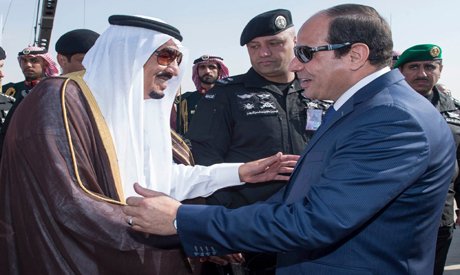
 Al-Sisi with Saudi King Salman during Arab- South America Summit Via Ahram

Main Headlines

 Monday

Tuesday

Wednesday

Thursday

Friday

Saturday

 Sunday

Good Reports

Good Read

Plus:

From Twitter

Photo Gallery

Finally, here are Jayson Casper’s prayers for Egypt

Posted in Diary of Aak, Egypt | Tagged , , , , , , | 2 Comments

Is Egypt ready for the next terrorist attack?

Conspiracy

Local Egyptian outlets: Egypt is facing a Western conspiracy- via AP

Investigators of the Russian plane crash in Egypt are now “90 percent sure” the noise heard in the final seconds of a cockpit recording was an explosion caused by a bomb. The bomb “theory” has now become almost a scary reality. Russia’s Prime Minister, Dmitry Medvedev, admitted on Monday that a plane crash in Egypt’s Sinai could be a terrorist attack, a possibility the Egyptian authorities will have to accept. Bomb or not, Egypt has to face the risk in a way that convinces the outside world the country is a safe tourist destination. The complex challenge for Egypt is not only to uncover the depth of the Islamic State’s infiltration into Sharm el-Sheikh Airport, but also to prevent the group from executing more terror in both Sinai and mainland Egypt.

Many reports about a lack of security and loopholes inside Egyptian airports have emerged in several quarters. Even Al-Arabiya, supposedly friendly to Egypt, has published a report on how paying $30 is enough to “bypass” Egyptian airport security. Furthermore, according to ABC News, new evidence uncovered during the investigation of the Russian airliner that crashed in Egypt indicates that an inside man may have helped to plant an explosive device on board. Those reports, if true, are simply devastating. Not just because the reality could ruin Sharm El-Sheik as a tourist hotspot for many years, but it also cast doubts on Egypt’s remaining airports, including the main airport in Cairo.

Egyptians may still remember the bygone era of “innocent security breaches.” During the late President Sadat’s rule and the early years of Mubarak’s tenure, many luxury goods were not available on the Egyptian market. Some opportunists developed a trading career by illegally importing those good and smuggling them through Egyptian airports. A mixture of bribery or clever hidden pockets in hold luggage used to work wonders. That was, of course, before the current era of screening. Successful smuggling of electronic juice blenders or posh watches was an exotic goal for some. Airport security was later tightened during Mubarak’s last years in power, as his police state expanded extensively in Egypt.

As the Islamic State excels at recovering medieval religious doctrine, it also excels at digging deep in past memories looking for sick, “innovative” ideas to terrorize the public and weaken the Egyptian state. Some have suggested that tightening surveillance of passengers, hold luggage, and catering is the answer to the Sharm El-Sheikh Airport disaster. However, like any advanced technology, that alone cannot prevent problems as long as human factors exist.

By resorting to bribes or acting under the influence of ideological indoctrination, any airport worker can plant a bomb or turn a blind eye to a planted bomb. Is Egypt ready to handle those scenarios? Some patriotic Egyptians have rightly pointed out that IS has tried to breach other international airports in the past. That is, however, not the point. It is not about the Islamic State’s desire to breach airport safety measures. It is about the vulnerability of our airports to security breaches. Head of Cairo airport announced that new x-ray security scanners have been installed in the departure hall of the airport. Good decision, but more still needs to be done, and in all Egyptian airports. There also reports that bomb detectors being used by some hotel staff in Sharm El-Sheikh have been exposed as fake. Such reports should be taken seriously and investigated properly.

Many local media outlets are indulging in conspiracy theories about what happened to the Russian plane and blame the Western media for their ruthless criticism of Egypt. Others are confused, and not sure what is going on. Egyptians, however, deserve to know the truth about what happened in Sharm El-Sheikh on October 31; establishing the truth is also essential for Egypt’s counter-insurgency strategy. Facing the public with facts undercuts the militants’ chances of abusing safety measures and will help restore global confidence in Egypt’s airports.

It is also important to think a few steps ahead of the militants. By attacking south Sinai, the Islamic State is trying to escape from the army’s increasingly tight grip in the northern part of the Peninsula. Such a successful attack may entice the group to target other destinations, particularly ones that are considered safe and remote, such as those in the Red Sea resort of Hurghada. After any major attack, terrorists usually look for the authorities’ response and adapt or modify their responses accordingly. Raising the alarm level in other destinations, again, is not a sign of panic, but an indication of a proactive counter-terrorism policy.

All eyes, from friends and foes, are on Egypt, and how it will handle this crisis. The Russian plane crash is not just Egypt’s version of 9/11; its impact could be as devastating as the loss of Sinai in the 1967 war. Yes the IS affiliate has failed to carve a state in Sinai, but if the group manages to deter the outside world from visiting the Peninsula or starts to attack other parts of Egypt, then it can quickly plunge the country into unchartered territory of economic and political uncertainty. Behaving like a blindfold person, trussed up in the wilderness, is not the way forward; Egypt needs to get a grip, recompose, and move fast to face its ruthless enemies.

Posted in Egypt, Middle East, Sinai | Tagged , , , , | 1 Comment

Egyptian Aak 2015 – Week 45 ( Nov 2- 8)

This was the hardest week this year to collect and summarize Egypt’s news. It is hard to compile conflicting and often confusing news. I hope you find it useful. 

Top Headlines

  • UK holidaymakers stranded in Egypt as Downing Street cancels flight amid terror fears. Wednesday
  • Bomb may have caused the Russian plane crash in Egypt. Thursday/ Friday
  • Tension in Sharm El-Sheikh as tourists stranded amid flight cancellation. Saturday
  • 11,000 Russian tourists have flown home from Egypt. Sunday
  • Egypt arrests rights activist over report of military trial. Sunday

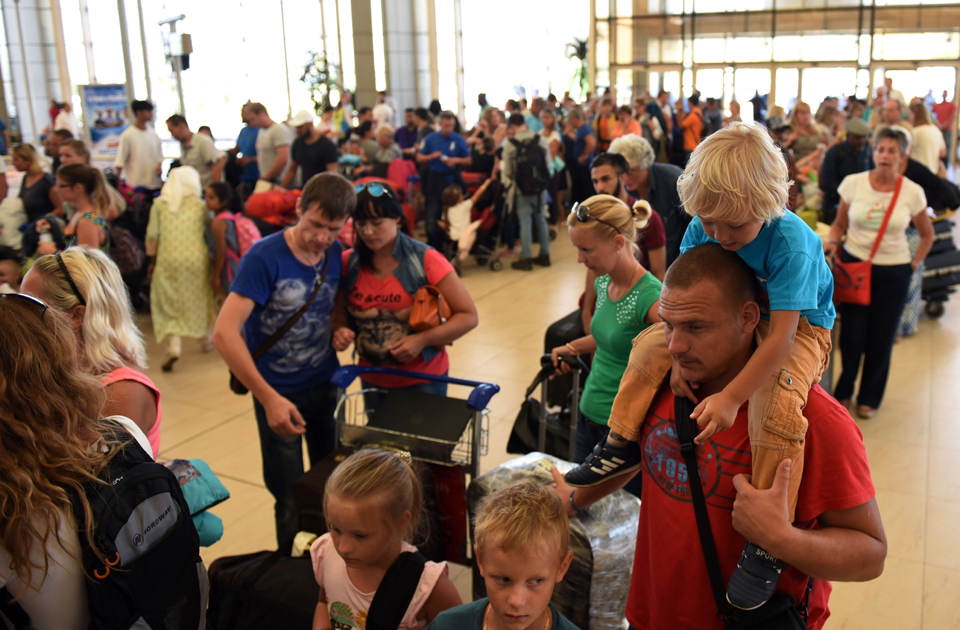
Stranded passengers

Tourists stranded at Sharm el-Sheikh airport – via Ahram

Main Headlines

 Monday

Tuesday

Wednesday

 Thursday

 Friday

 Saturday

 Sunday

 Good Report

Good Read

From Twitter


https://twitter.com/minafayek/status/663082479969005569


Interview

Video

  • Death toll rises to 12 as rain storms in Egypt cause havoc

 Photo Gallery

Plus

Finally, here are Jayson Casper’s prayers for Egypt

Posted in Diary of Aak, Egypt | Tagged , , , , , , | 2 Comments

ISIS, Russia, and Egypt

What really happened to Russian Metrojet Flight 9268 over Sinai a few days ago? Forget it. The fatal crash does not matter any more. Regardless of what truly did or did not happen to the Russian plane, the prevailing theory is that ISIS planted a bomb that led to the plane crash, and this has entered and stuck in the global mindset.

Communications and “chatter,” allegedly uncovered by British intelligence, followed by Britain suspending all flights to and from Sharm el-Sheikh has been enough to cement this possibility within the global consciousness. Britain and the United States have offered no evidence, however, as it is too late for a drawn out inquiry. Perception has won the day and Islamic State (IS) has secured a major psychological victory.

The Islamic State affiliate in Egypt has gained a prestigious reputation. It is now portrayed in global media as an upgraded, sophisticated terror group that has extended its sphere of influence beyond its initial bases in North Sinai, capable of recruiting Egyptians in sensitive positions, and maintaining their names and details in secret. Egypt will now live under the shadow of this monstrous perception with a tremendous impact on its security and economy.

Since the rise of the Islamic State, counter-terrorism experts have explained the main difference between this group and others like Al-Qaeda by the far enemy/near-enemy theory. As such, Al-Qaeda focuses on far enemies like the United States and Israel, launching attacks like 9/11. Meanwhile, the Islamic state has had different priorities, mainly establishing a “state” for itself and for its affiliates in countries around the region. This is precisely why, when Egypt’s Al-Qaeda affiliated terror group Ansar Beit Al-Magdis (ABM) swore loyalty to the Islamic State in November 2014, it shifted its focus from targeting the Israeli border to more local targets against the Egyptian Army in North Sinai and other areas, with fewer attacks in the rest of Egypt.

What has made the IS shift in style and copycat old techniques from its rival Al-Qaeda? The easiest answer is to respond to the Russians who are officially fighting IS in Syria. However, this answer ignores how the Russians focused on moderate rebels in Syria and not ISIS. In contrast, other countries, mainly America and France have been targeting IS for month, but none of their planes were attacked. If IS has managed to recruit conspirators at Sharm El-Sheikh airport, why it did not do the same in other failed states in the region, such as Libya, Syria or Iraq?

The assumption that Sharm El-Sheikh is more vulnerable than other Middle Eastern airports is false, and there have never been major security incidences in any other airport. In Egypt, however, since the collapse of Mubarak regime, there have been far more episodes of instability with deteriorating security, chaos, prison breaks, and street fights. If the group has agents in the airport, why they did not try to bring down more planes? Domestic Egyptian planes are arguably more vulnerable and easier to attack. Why didn’t IS release any details? The bomb’s theory is very plausible, but plausibility and some intelligence leaks are not enough to make it a fact.

Regardless of all this speculation, in fact, whether or not the Russian plane crash was indeed caused by a terror attack, it is more paramount for Egypt to turn this tragic event to its advantage. The Islamic State should not be allowed to establish its dream state by targeting domestic planes. If the terror group resorted already to such tactics, then is a potential sign of weakness hiding under the evil glamour of terror. The group has failed to clinch a state in Egypt, and it may have resorted to bombing planes just to maintain a deceptive perception of existence.

Therefore, the Egyptian authority must work harder to project this weak side of IS, and enhance its counter-terrorism abilities. Airport security may need substantial updates, but other aspects of fighting IS must also be considered.

This Russian tragedy might have been Egypt’s version of 9/11. Egypt should project itself as a responsible country that need support, not a reckless state that is hiding its own wrongdoing. Bomb or not, Egypt must prevail against terrorism in these circumstances.

Posted in Best Read, Diary of Aak, Egypt, Short Comments | Tagged , , , , , , , , , | 16 Comments

Short Comments: Esraa El-Taweel must be released

Esraa

(Esraa El-Taweel, photo via Mada Masr)
The photos of imprisoned Egyptian activist Esraa El-Taweel walking with crutches, sobbing, and begging for medical care as a judge extends her detention by 45 days, have gone viral, triggering a mix of responses among Egyptians. Some have labeled her as a symbol of regime oppression; others show no mercy for her. Moreover, these photos of Taweel in tears have come at the right time for opponents of President Sisi’s visit to the United Kingdom.

Those who support Taweel highlight how the 23 year old has been held at Qanater Women’s Prison for 155 days on charges of belonging to a terrorist organization, disseminating false information, and disturbing the peace. Taweel was shot when security forces dispersed a protest during the anniversary of the revolution in 2014. The bullet inflicted a debilitating spinal injury and confined Taweel to a wheelchair for several weeks. President Sisi, who is heading to the UK soon, has raised serious concerns in that country about Egypt’s human rights record.

Taweel’s opponents, on the other hand, have published some of her older tweets. I was struck by two recent tweets in 2015, in which she  incited the murder of police officers. Agaib, her friends denies the authenticities of those tweets. As her account is now susoended, there is no way to prove or disprove them.

Others claim, without providing evidence, that she actually joined a violent youth group and spread false information about Egypt to foreign media.

However, I believe the question we should ask ourselves is not what Taweel did or did not do. As Egyptians, we should ask how we propose to deal with our vulnerable,angry youth? How do we reintegrate them into society? How do we prevent them from radicalization?

Whatever the answers to the above questions are, imprisoning a young vulnerable and disabled girl is not one of them. Egypt has to find a formula to rehabilitate its disfranchised youth.

For 30 years, the Mubarak regime offered nothing to Egypt’s youth. As a result, many of them found their refuge in virtual reality on social media, in which they have fantasized about violence and anarchy. The January 2011 revolution and the political chaos that followed gave this section of Egyptian youth an opportunity to vent their anger and try to implement what they think is right. It was a mix of idealism and frustration. The ousting of President Morsi has made it even worse for those youth. They feel betrayed and now view violence as a solution.

By detaining Taweel, the Egyptian authorities have inadvertently turned a girl with Twitter’s diarrhea, a confused political view, and possible violent fantasy into a hero for political Islam. Her photos will be in the history books and on social media pages for decades as evidence of the ruthlessness of the Egyptian regime. That is definitely not a wise move for Egypt.

I do not have to be supporter of political Islam or a revolutionary activist to support Taweel’s release. Even regime supporters such as TV anchor Amr Adeeb have expressed similar sentiments.

Taweel should be released, at least on bail, until her trial. If Egypt does not want to show mercy, it should at least stop behaving as a vulnerable country scared of a disabled young girl. It does not bode well for the future of Egypt.

Posted in Diary of Aak, Egypt, Short Comments | Tagged , , , | 4 Comments

Egyptian Aak 2015 – Week 44 ( Oct 26 -Nov 1)

Top Headlines

  • Egypt extends state of emergency in North Sinai by three months. Wednesday
  • Egypt’s parliamentary elections produce 21.7% turnout in first round run-off. Friday 
  • Russian plane crashed over Sinai. Saturday

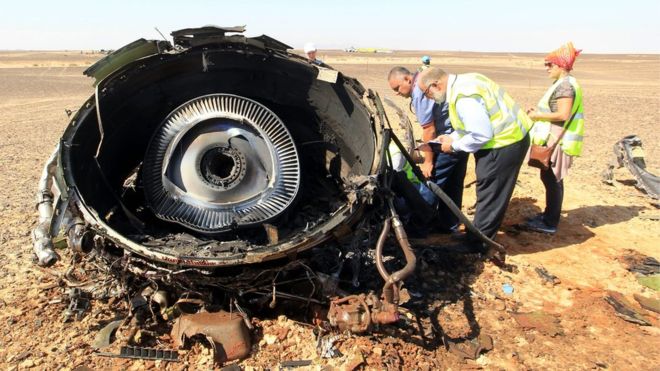
 Russian crash BBC

(Russian Plane crash in Sinai, Photo via BBC)

Main Headlines

 Monday

Tuesday

Wednesday

Thursday

Friday

 Saturday

 Sunday

Good Reports

 Good Read

From Twitter

 Plus

 Interview

Photo Gallery

 Video

Finally, here are Jayson Casper’s prayers for Egypt

Posted in Uncategorized | 3 Comments

The Islamic State’s Network in Turkey

This is a great piece by Aaron Stein and Noah Blaser explaining the detailed breakdown of the network behind Turkey’s ISS bomb attacks.

“The culprits of all four attacks were members of a single cell of Islamic State (ISIS) from Adiyaman, a pious, Kurdish majority city of 220,000 in southeastern Turkey. While the group has been cast in Turkish media as an opaque network of ISIS-inspired youth, its key members spent time in northern Syria in 2013 and 2014, and were all recruited by a single individual after returning to Turkey. At its peak, the cell numbered at least 31 core members, including at least four foreign wives who had connected with the group in Syria, according to information collected by the two authors.”

Read more here:
The Islamic State’s Network in Turkey

Posted in Uncategorized | Comments Off on The Islamic State’s Network in Turkey