Special Edition: Bassem Sabry (1982 – 2014)

Bassem Photo

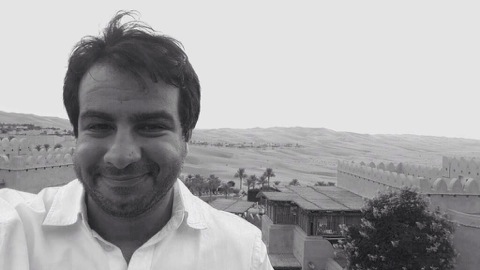
Egypt has lost one of its best bloggers, and democracy activists, Bassem Sabry. He was mourned by many across the globe.

Few thoughts about my friend Bassem

 I still feel numb. I have struggled to write since the tragic passing of Bassem Sabry. I kept reading one tribute after another; all were poignant, accurately describing the wonderful human being Bassem was ___ all made me more tearful and more numb.

 Tragic, sudden death is no stranger to me. As a child, my father passed away suddenly, and I had to endure my mother wearing mourning garments for seven successive years. It made me hate the color black with a venom; however, life has taught me that black is just a part of our lot in life; if it is not seen, it will be felt at some stage of our journey on this earth.

 What made Bassem different is not just how he died at a very young age, but what he stood for in his life as a writer __ balance and reasonableness. As H. A. Hellyer wrote: “Over the course of the Egyptian revolution, he marked out a space as one of Egypt’s most balanced and composed writers.” Bassem’s balance is what appealed to me since I first joined Twitter. We soon became friends – it was as if we had known each other for years. Interaction with Bassem became an integral part of my Twitter routine. I was lucky to meet him in Cairo in 2012. It was a really good opportunity to get to know him better and exchange views about life, Egypt, and democracy. He took me down a side street near the café where we met to show me a nice view of the Nile. I still remember his words: “Just remember, Egypt still has plenty of beauty spots.”

 Bassem was a great example of the bright side of social media; he had an ability to build bridges with many, regardless of their personalities and political views. Like a wealth builder, Bassem gained followers without compromising his views. I still remember how he wrote a piece disputing Tawwakal Kerman’s description of Morsi as the Arab Mandela, but with a kind tweet clarifying how much he respected Tawwakol. I never saw Bassem losing his composure, swearing or attacking any one. His serenity and wisdom were simply striking.

 Bassem excelled at winning the respect of Egyptians and foreigners alike – a quality very few possess in the Arab world. He has always reminded me of the late King Hussein of Jordan, not in terms of power or position, but rather with his communication skills that instinctively empowered him to tune in to various personalities from diverse cultures and backgrounds. That is why I used to agree strongly with those who predicted a bright future for him in Egyptian politics.

 Destiny works in mysterious ways; Bassem’s abilities as a skilled analyst and activist were unquestionable, and he brought urgency and pertinence to the question of what lies ahead for Egyptian politics. Sarah Carr wrote: “The end of his life coincides with the final death throes of that [Egyptian] uprising.” Certainly, her words reflect how many feel right now – a collective sense of despair over various setbacks in the course of our revolution. Commenting on Bassem’s death, one friend said that at least he did not have to endure the ugliness of our politics anymore. It has been heartbreaking to witness how many outsiders, including top diplomats, have mourned Bassem’s death, while few inside Egypt’s political establishment have even bothered to mention his passing.

 Nonetheless, amidst the despair, life always gives us some reasons for hope. The deep sense of grief following Bassem’s passing has reinvigorated the sense of unity and cause among many inside and outside Egypt. There is a strong desire to maintain his work and keep his legacy alive for the Egypt we love dearly, the country in which we aspire to build a better future for the younger generation.

 Finally, one polite notice to those who still insist on discussing the circumstances of his death: We were all shocked about Bassem’s death, and many thoughts have crossed our minds, but to suggest certain scenarios in public is, in my opinion, disrespectful to him and his family. I read a few comments on Facebook that deeply saddened me. Let us please express our love to Bassem in a more graceful way. Conspiracy theories and wild suggestions about his death will benefit no one; more importantly, they will never bring him back.

 I could not visit my dad’s crypt; I may not visit Bassem’s crypt; I rather maintain his memory inside my soul, remember his smile, his jokes, his words, and more importantly his dreams.

 Rest in peace my friend.

 Many elegantly have written about the death of Bassem Sabry. Here are some poignant examples:

Also here is one of Bassem’s best articles, republished here by Arabist

 Plus:

Photo from vigil for Bassem Sabry held in New York.

Posted in Best Read, Diary of Aak, Egypt | Tagged , , | 4 Comments

Egyptian Aak 2014- Week 17 ( April 21-27)

Main Headlines

 Monday

Tuesday

Wednesday

Thursday

Friday

Saturday

Sunday

 Good Report

 Good Read

Plus:

Photo gallery

Finally here are Jason Casper’s prayers for Egypt

Posted in Diary of Aak, Egypt | Tagged , , , , , , , , | 1 Comment

Sabahy’s challenge

photo

( a group of youth carry the required legal recommendations for Sabahy’s candidacy.

Via Twitter) 

Published in Daily News Egypt

Egypt’s leftist politician Hamdeen Sabahy has become the second candidate after ex-army chief Abdel-Fattah Al-Sisi to formally join Egypt’s presidential race. The Sisi/Sabahy presidential race evokes memories of the farcical Mubarak/Ayman Nour election in 2005. Nevertheless, some perceive Sabahy’s challenge as a brave one. However, regardless of the intentions of the military-backed interim authority and how it will conduct the presidential race, Sabahy has no choice now but to make the most of his presidential bid. Sabahy’s real challenge is neither the conduct nor the outcome of the 2014 election, but whether he can provide a workable civil model for the governance of Egypt.

During this election campaign, Sabahy faces a tough test. He has two options: either he plays the underdog, the victim of Sisi dominance, and proceed with a muddled campaign full of rhetoric and exchanged accusations that will probably earn him some sympathy and support, and probably a credible second position. Alternatively, he can grasp the opportunity history has offered to challenge himself and the wider society to address some tough questions about the foundation of contemporary Egypt. As a country that has been shaped by chronic rivalry between militarism and Islamism, Egypt badly needs a different, third approach to society and politics.

Sabahy ran a good election campaign in 2012, and therefore has gained some valuable experience. However, much has changed in Egypt since 2012. He faces a dual challenge: many of his previous supporters, now in a divided constituency, are now backing Sisi. Then there is the challenge to win over those Egyptians who still resent the removal of Morsi on July 3 last year, and whom Sabahy strongly supports. In addition, on a deeper level, Sabahy is facing what Morsi faced before, the inability of a civilian president to reconcile the state’s basic pillars under the leadership of a complete outsider. The past few months have also shown how the judiciary has gone astray, particularly after endorsing a constitution that literally federalises the state’s institutions. To bring this federalisation of institutions under a democratic civilian leadership and conduct the necessary checks and balances is a challenging task.

In terms of the economy, Sabahy is known for his opposition to IMF loans and for his leftist tendency towards state-owned projects. This Nasserite-leaning attitude will go nowhere in addressing Egypt’s economic woes. Sabahy has to address three tricky elements, as Daniel Stoker wrote: Foreign assistance, an austerity plan, and state versus free-market policies in addition to the current energy and water crisis. A modified Nasser format will not be enough to solve the current dire economical circumstances. Moreover, Egypt’s economy has become increasingly linked to the Gulf States’ support. Such a debtor status cannot easily be reversed in the foreseen future, which begs the question, can Sabahy appeal to Gulf donors with his populist-style economic plan? Donors and foreign investors are looking for a confident leader with a clear approach, who can stabilise the market and offer better opportunities for investment.

On the social front, Sabahy is facing a society with a completely torn social fabric struggling to accommodate its pious conservative nature in its eclectic liberal tendencies; this is a society that has been exploited by the political religious right and by the fake, secular elitist left. As a presidential candidate, Sabahy has to articulate how he can help Egypt recalibrate and achieve a balance between the freedom of individuals and the rights of society.

Furthermore, the temptation in any two-horse race is to appeal to voters on the basis of their antipathy to the other candidate. The liberal Dostour party and many youth groups are backing Sabahy, not because they agree with his leftist platform, but because they reject Sisi, the “military” candidate. The pitfall for such an approach is that it sends a signal of potential future fallout between such alliances of convenience. In 2012, Morsi effectively played the same tactic against his opponent, Shafiq, and won the backing of many non-Islamists, only to turn against them later. The public in Egypt has no appetite to test this approach again. They are after stability, not future bickering.

In a nutshell, Sabahy needs to focus on the task at hand and not the rival. With such an attitude, he can give hope to the youth who back him and the other political parties that put aside rivalries in order to support the only civilian candidate available. If Sabahy manages to produce a solid, cohesive plan without flowery rhetoric, then his project will not die, even after electoral defeat. People do not vote for autocrats because they love oppression, but because they lack alternatives. Sabahy can be the alternative, but only if he truly wants to be one.

Posted in Diary of Aak, Egypt | 3 Comments

Lebanon’s Presidential Elections

On the eve of the presidential election in Lebanon, this is a insightful Q&A with the Middle East Institute’s Paul Salem. Hope you find it worth reading.

Lebanon is facing presidential elections in the coming days. What are the main elements of the process?

On Wednesday, April 23, Lebanon’s parliament meets for the first of possibly several sessions to elect a president. The term of the current president, Michel Suleiman, ends on May 25. There is no formal campaigning process for the post and contenders do not have to declare their candidacy beforehand. A contender needs a two-thirds majority in parliament to win in the first round, but can win by simple majority in subsequent rounds. The rounds can be held on the same day, provided a quorum of two thirds of members is maintained. The speaker of parliament, Nabih Berri, can also suspend proceedings and schedule subsequent sessions for other days.

I find this particular paragraph interesting:

“If this too [ Geagea and Aoun] fails, attention could turn to candidates outside the two main camps, such as Army Chief Gen. Jean Qahwaji, Governor of the Central Bank Riad Salameh, parliamentarian Robert Ghanem, former deputy Jean Obeid, or former minister of interior and civil society activist Ziad Baroud.”

Continue reading here

On his FB page, Antoine Haddad, rightly pointed out that March14 camp looked united with a clear platform after endorsing Samir Geagea. that is very true, and important regardless of tomorrow’s outcome.

Posted in Lebanon, Middle East | Tagged , , | Leave a comment

Egyptian Aak 2014 – Week 16 ( April 14-20)

Main Headlines

Monday

Tuesday

Wednesday

Thursday

Friday

 Saturday

 Sunday

 Good Reports

Good Read

Plus

Photo Gallery

Finally, here are Jayson Casper’s prayers for Egypt

Posted in Diary of Aak, Egypt | Tagged , , , , , , | 2 Comments

The Erdogan/Gul Prisoner Dilemma

This is a good piece by Aaron Stein on the current Erdogan/Gul dynamics in Turkey.

aaronstein1's avatarTurkey Wonk: Nuclear and Political Musings in Turkey and Beyond

During the Cold War, strategists often turned to game theory to explain deterrence and the concept of mutually assured destruction (MAD). The United States and the Soviet Union, for example, were cast as players in an open-ended PD game, whereby the two sides had an immediate incentive to defect, i.e. launch a first strike, but realized that defecting would invite a devastating second-strike. Thus, the consequences of a nuclear exchange outweighed the payoff associated with a first strike and the two sides opted to cooperate – i.e. not launch first.

In the context of the Erdogan – Gul relationship, I can’t help but think that the two men are locked into a long-term iterated PD game. To start, the AKP faces no political rival. And, in carving out such a large swathe of the electorate they currently face no real political opposition. Absent the threat of a military coup, the AKP…

View original post 952 more words

Posted in Uncategorized | Leave a comment

Neither Erdoğan’s victory, nor the Muslim Brotherhood’s protests are an Ottoman slap

Published in Hurriyet Daily News

Following a trail of setbacks, Islamists in the Arab world have something to celebrate. Their hero, Recep Tayyip Erdoğan, has won in Turkey’s local elections, a victory Islamists in the Arab world are selling to their followers as their own.

The relationship between Erdoğan and his Arab Islamists is based on mutual exploitation. Erdoğan engineers more domestic popularity for himself by harping on the misfortunes of Islamists. At the same time, Arab Islamists market Erdoğan’s success as proof of the soundness of their ideology, and use his success as a tool to counter misgivings among their junior cadres and supporters.

The essence of this relationship is a mutual feed of victimhood that serves both sides’ interests. Despite the fact that most Arab Islamists acknowledge Erdoğan’s brand of political Islam (which does not promote Sharia) as being different to their own, they have lowered the bar and are willing to accept his “less than perfect ideology.”

Through first-class engineering, the Turkish leader supplies his Arab followers with the much-needed perception that he is the right man for them. He presents his facts, hype, and half-truths wrapped in a parcel that aims to entrench his followers’ belief of victimhood.

There is no doubt about the success of the perception campaign, and plenty of examples testify to it. These include the Rabaa sign (invented in Turkey after the tragic forced end of the Brotherhood sit-ins in Cairo), which Erdoğan has invoked repeatedly.

Then there is the Turkish Twitter hashtag #MısırdaKatliamVar or “massacre in Egypt,” referring to the abhorrent mass death sentences handed down to 529 Muslim Brotherhood affiliates, an event that was followed by protests across Turkey in condemnation of the execution order.

These strategies have worked effectively for Erdoğan, who, ironically, freely uses social media for his own benefit, but harshly criticizes it when it markets ideas contrary to his own. These campaigns are not aimed purely at fighting injustice, Turkish protesters were not reminded about other regional atrocities like the public executions in neighboring Iran.

Such a display of injustice is also used as a perfect shield that protects Brotherhood leaders from taking responsibility for their own failure to govern Egypt or to confront the criticism of them from thinkers such as Tarek Ramadan, who openly criticized the Arab Islamists’ rush to rule.

The current slogan that the Brothers are spreading among their cadres is, “Now is not the time,” and this slogan is being promoted indirectly by Erdoğan’s propaganda campaign.

On the other hand, playing the moral card was, and still is, paramount for Erdoğan. It does not just serve his grand Ottoman vision; raising the Rabaa sign and shedding tears for the innocents helps to reinforce his image as a defender of morality against evil enemies plotting his downfall — an image that worked well in the local election as a tactic to distract voters’ attention from alleged leaks and corruption charges.

Erdoğan chose to celebrate his victory in the local election by carefully picking an exotic metaphor from Ottoman history, “the Ottoman slap.” Arab Islamists fecklessly cheered for his slap, ignoring the fact that open-handed slaps were once used against their ancestors, who fought the Ottoman invaders.

Furthermore, the Islamists are now borrowing the metaphor to market non-existent achievements. In an Arabic statement, the anti-coup alliance in Egypt claimed their “million march” in Cairo was a “slap” against Catherine Ashton’s visit, which they viewed as hostile to them. Ironically, the “million march” numbered only a few thousand.

In contemplating the future of the Erdoğan-Arab Islamists alliance, the crucial question remains: How effective is the alliance, and can it continue risk free?

The dynamics in Turkey have changed subtly following the local election. The Turkish opposition has now picked the moral card, and is willing to use it too. The Turkish Parliament drafted a joint declaration against the Egyptian court’s decision on the mass execution of Brotherhood affiliates, and both the Republican People’s Party (CHP) and the Nationalist Movement Party (MHP) parties supported the declaration.

Although this declaration cements Egypt more inside the domestic Turkish arena, it is a direct challenge to Erdoğan’s super-morality narrative. Erdoğan, who was once accused of backing the ruthless al-Assad regime in Syria, cannot apply the same accusation to the Egyptian scenario. The Turkish opposition clearly does not back the coup in Egypt.

However, there are limits to the use of Egyptian injustice for domestic purposes: Its impact on the local crowd will either fade in time or feed into the flame of uncontrollable anger among Turkish youth, an anger that could prompt irrational violent consequences. Although the Egyptian death sentences will not be implemented, as it is a primary verdict in a long legal battle, the Egyptian authorities will be unlikely to tame their oppression of the Islamists just because of Erdoğan’s rhetoric.

The angry, pro-Justice and Development (AKP) Turkish crowds that simulate public executions in city squares may grow increasingly disillusioned with their government’s inability to reverse the perceived injustice in the Arab world, and may decide to resort to a more radical jihadi style to vent their frustration.

On the Arab side, Erdoğan has opted not to share his key recipe for success with his followers. As Sonar Çağaptay wrote, Erdoğan wins not because he sells ideology but because he sells good governance. Islamists in the Arab world needed a governance plan right after the Arab uprisings; however, “patron” Erdoğan did not help them on that crucial front. Even now in Tunisia, where Islamism did not suffer as huge a setback as in Egypt, Erdoğan did not make a substantive effort to help the country’s struggling economy.

Erdoğan, at heart, is a trader – a businessman; he wants followers, not competitors. His policy toward his Arab allies is the ultimate proof. He does not encourage Arab-Islamists to form a new platform that can appeal to the hostile, suspicious public in their native countries. Instead, Erdoğan is hyping their dystopian belief that the masses are behind them, which is simply untrue. The problem for the Brotherhood in Egypt is not just a bloody bunch of coup generals; it is far deeper and more complex – an inconvenient fact that is deliberately being ignored in the bazaar of shining perception.

Both Erdoğan and his Arab-Islamists have to abandon their pyrrhic alliance, and infuse a healthy dose of realism into their cooperative ties. Neither Erdoğan’s municipal victory, nor the Brotherhood’s angry protests are a slap of any kind. Erdoğan still has to face the challenge of the next general election, knowing that his nemeses, the CHP and the MHP, are bridging the gap between them ahead of future battles. However, Arab-Islamists do not need Turkish pain remedies, but effective recipes that can tackle their chronic maladies. Islamists need to redevelop a concrete project to govern, while Erdoğan needs to focus on his main appeal to the Turkish public: Governing effectively.

Posted in Best Read, Egypt, Middle East, Turkey | Tagged , , , , | 1 Comment

Egyptian Aak 2014 – Week 15 ( April 7-13)

Main Headlines

 Monday

Tuesday

Wednesday

Thursday

Friday

 Saturday

 Sunday

 Good Reports

Good Read

 Plus:

 Photo Gallery

Finally here are Jayson Casper’s prayers for Egypt

Posted in Diary of Aak, Egypt | Tagged , , , , , , | 2 Comments

The Brotherhood, and Britain. The “terrorists or us” theory

The British decision to launch an investigation into the Muslim Brotherhood and its alleged links with radical militancy has sparked widespread controversy. Many people are justifiably surprised by the sudden decision and the possibility that it is politically motivated by Saudi pressure. However, more alarming is the comment made by the Brotherhood’s most senior leader in the UK, Ibrahim Mounir, who said (according to the UK’s The Times) that banning the Brotherhood would leave Britain at greater risk of terrorist attacks. The problem with Mounir’s remarks is that they are based on a dichotomous and perilous view that holds “it is either the extremists or us,” which is wrong, dangerous, and counter-productive.

 The “terrorism or us” theory has been touted since 9/11 and classifies political Islam into two tiers: moderate and radical. It suggests that any conflict with alleged moderate Islamists will automatically force followers to subscribe to more radical forms of Islamism. This theory resurfaced after the forced ousting of Mohamed Morsi, the Muslim Brotherhood’s former president of Egypt, and has now gained new ground in the UK following the decision to investigate the Brotherhood. Although the “target-one-target all” theory is plausible, it is based on fundamentally flawed assumptions

 First, the existence of non-violent Islamic groups per se does not stop radicalism. Yes, the Muslim Brotherhood is a peaceful group, but it has also not suspended or disowned the radical teaching of one of its main thinkers, the late hawkish leader and Islamic theorist Sayyed Qutb, who is considered the father of contemporary Islamist extremists.

 In fact, many of the group’s current members are proud Qutb supporters, and often claim they only support his earlier views when he was more “moderate.” The problem is there is no mechanism to stop people from switching from following the non-violent early example of Qutb’s life to following the more radical later stage of his life. Ibrahim Mounir’s contemporary views indirectly reinforce this pitfall. The Brotherhood’s mercurial link with Qutb’s radical theories is the weakest link in its claim of peacefulness. The group needs serious recalibration of its internal teaching methods, not just to dispute Qutb’s radical views, but also to openly fight them. Many people do not know that Sayyid Qutb’s brother, supporter, and promoter, Mohamed Qutb, passed away just this April, and was widely mourned in social media by many, including many so called “moderate” Islamists.

 Second, oppression is not the only reason for radicalism. Looking at the history of fundamentalism in Egypt provides us with some clues. In the 70s, radicalism resurfaced in Egypt, not because of Nasser’s oppression of the Muslim Brotherhood, or the execution of Sayyid Qutb during the Nasser era, but because of the foreign policies of Nasser’s successor, Anwar Sadat. Although Sadat opted for a softer approach toward political Islam and released all Muslim Brotherhood cadres from prison, his appeasement policy failed to curb the anger of the radicals, who disapproved of his foreign policy. The peace deal with Israel, and the alliance with the US provoked many Islamists, and ultimately led to Sadat’s assassination (by the Egyptian Islamic Jihad).

 Third, the twisting of Western motives by radical teaching is the core reason behind attacks on Western targets. Many Islamists have openly and/or discreetly viewed Westerners as hypocrites who want to pursue their own interests. In 1952, during the so-called “moderate” stage of his life, Qutb wrote, “The Islam that America and its allies desire in the Middle East does not resist colonialism and tyranny, but rather resists Communism only.” If Qutb were alive, he would probably respond to the various analyses by warning of a new wave of global Jihadism as an inevitable outcome of the crackdown on the Muslim Brotherhood by rephrasing his famous quote, “The Islam America and its allies desire in the Middle East does not resist tyranny, but rather only resists Al-Qaeda.”

 The problem with the “terrorist or us” theory is that it reinforces the idea of Western opportunism suggested by Qutb and it attempts to reduce the concept of non-violent Islamism to an ideology that only serves Western interests. If it is framed in such narrow terms, it will not be authentic or convincing to fiery youth who may reject it as non-authentic.

 Fourth, hyping fear. We must consider how recent, more daring Western actions are viewed, such as the French mission in Mali. The French, who directly attacked Jihadi strongholds and killed many radicals, have thankfully ended their mission without encountering any retaliation inside France. Undoubtedly, if the French Government had blinked after threats and accepted bullying by a clutch of extremists, they could never have embarked on their mission. On the other hand, in terms of the scale of provocation, the British investigation into the Muslim Brotherhood seems a much less provocative act that should not lead to retaliation.

 Bluffing and creating fear by hyping up situations are well-known tactics that Muslims and non-Muslims alike fall for. It is plausible that the Muslim Brotherhood is now playing the fear card because it wants to protect its own interests, but we should not buy that argument, as fear only produces unhealthy relationships based on suspicion and not trust.

 Fifth, Muslims are not headless chickens and it is doubtful that advocates of the “terrorists or us” theory understand how offensive it is for ordinary Muslims, or how it can generate new and unnecessary Islamophobia. Portraying Muslims as people who are willing to channel their anger into violence whenever they are oppressed is a demeaning stereotype.

 While it is true Muslims are sensitive to any attack on their religion, it is also true that the media has exaggerated most Muslim responses and extrapolated local responses in hot spots such as Afghanistan to wider Muslim societies around the globe. To claim that certain groups, such as the Muslim Brotherhood, are the sole owners or sole representatives of Islam is a farce. The tragic events following the ousting of ex-president Morsi have proven one simple fact: not all Muslims are Islamists. In actuality, many pious Muslims do not agree with the ideologies of political Islamists, nor do they have a desire to enforce such an ideology on wider society. Therefore, subscribing to the political Islamist narrative of “terrorism or us” will alienate millions of peaceful Muslims around the globe.

 Will terrorists attack the U.K. in the future? Possibly, but it will not be because of the current investigation, even if radicals claim differently. Instead, it will be because of opportunities taken by some to target innocents, who will grab at any kind of flawed reasoning to justify their sick actions.

 Let us not succumb to bullies and their fear tactics. We need instead to stick to the values of transparency, accountability, and fairness. Britain had a history of collaboration with the Muslim Brotherhood during the 1940s and 1950s. The current investigation is a chance to clear up the past relationship, and establish a new basis that prevents the propagation of myths and lies. It is also important that the British Government dismisses any “dodgy” accusations against the Brotherhood from Egyptian or Saudi intelligence, and pursues only reliable evidence against the Brotherhood.

 The world expects a better standard from the UK. The truth about the Muslim Brotherhood’s position should set a new, open and healthy approach that ends both Islamist victimhood and the Egyptian government’s paranoia. This approach will shield rather than expose Britain to terrorism.

Published in Daily News Egypt

Posted in Diary of Aak, Egypt | Tagged , , | 11 Comments

Egyptian Aak 2014 – Week 14 (March 31- April 6)

Main Headlines

Monday

 Tuesday

Wednesday

 Thursday

 Friday

Saturday

 Sunday

Good Reports

Photo Gallery

Good read

Plus

Finally here are Jason Casper’s prayers for Egypt.

Posted in Diary of Aak, Egypt | Tagged , , , , | 2 Comments