No Shock and Awe: Israel should consider the Arab response to a military strike on Iran

Originally published in +972blog

On 7June 1981, Israel attacked and destroyed Iraq’s nuclear reactor at Osirak. That was the day the Arabs lost their nuclear ambition.

The code name was, Operation Opera, but the opera wasn’t Nabucco and its chorus of Hebrew slaves, but rather Aida and its triumphal march. The Israelis had managed to catch everyone by surprise, and the result was a perfect example of Sun Tzu’s philosophy and Donald Rumsfeld’s infamous slogan “shock and awe.”

As Israel seeks to reaffirm its long-term strategy of deterrence and pre-emption 30 years later, we are facing a similar scenario; but this time it is the Iranians’ turn. The world is pre-occupied with the possible military strike against Iran and its potential risks and benefits. However, very few have considered the implications for the Arab world and how the Arab street would respond to such an attack.

There is no doubt that predictions in such crises are unwise and even foolish, though there are some realities in the Arab world that would be unlikely to change regardless of the outcome of any military scenario, even if this outcome were decisive, successful and without any retaliation.

First, forget the shock: in contrast to 1981, when many Arabs didn’t know about Saddam’s nuclear reactor and those who knew didn’t expect it to be destroyed easily, the endless debate and the tough rhetoric from various Israeli leaders have eliminated any element of surprise this time round.  Even my taxi driver in Cairo, during my last visit, asked when –not if —  Israel would bomb Iran.

Second, forget the awe: The young Arab men and women who defied teargas, live ammunition, bombing and ruthless murderers are very different from earlier Arab generations. They were not deterred by dictators; and they won’t be frightened by an Israeli strike on Iran. Deterrence, a policy that has been ingrained in the psyche of Israel since its establishment, is detested by these fearless youth who view it as demeaning and counter-productive.

Third, the Islamic awakening: Islamists in many Arab countries are the new emerging power. They have fewer links with Iran, but share its hostility to Israel. Their sponsors in the Gulf States would probably be relieved if Iran lost its nuclear capabilities but would not be grateful to the Israelis and won’t change their ideology accordingly.

Fourth, old players won’t disappear. A defeated Iran would certainly weaken its allies in the region, but would not make them vanish from the scene. In Lebanon, Hezbollah has established itself firmly with a robust financial, economical and social network. The Party of Godmight abandon the Almighty, but would not disarm and can cause Israel an incurable migraine.

Any successful attack on Iran would be just like the one on Osirak- a Pyrrhic victory.  Following the initial “we did it again” celebration, Israel would soon realize that it had replaced a loud, reckless, distant enemy with one located geographically closer, equally hostile, but not as reckless. Islamic groups in the Arab world acknowledge their inability to fight Israel in the near future, but they haven’t dropped the idea from their long-term agenda- yet!

The era of easy territorial conquest is past. Any future war would be urban, with many potential non-conventional players involved. Sooner or later, Israel would be forced to revise its long–standing strategy.

For years, Arabs and Jews have been locked in a bitter conflict. Rather than focusing on a viable solution, both sides have invested so much in a meaningless cycle of deterrence versus resistance; neither concept is decisive, but both are hollow. Therefore, the conflict is likely to continue until someone is brave enough to break the futile cycle and invent a different wheel, hopefully a peaceful one this time.
Posted in Iran, Israel | Tagged | 4 Comments

Egypt, NGO and the Green Passport

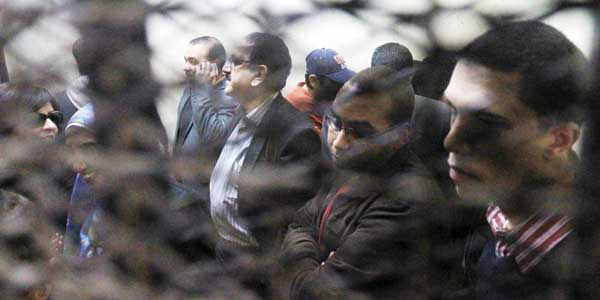
(Fourteen Egyptian activists who worked in Egypt with civil society groups stand inside a cage during their trial in Cairo on Feb. 26, 2012. AFP Photo/Khaled Desouki)

It must be a relief for all the foreign aid workers involved in the NGO”s case in Egypt. They were finally allowed to leave the country and be re-united with their loved ones. Their departure marked an end to their painful ordeal. On the other hand, their Egyptian colleagues were not as fortunate, their fate has not yet been decided.

So what exactly is their crime?  Maybe securing a decent job in a country plagued with high unemployment is a crime. Maybe proactivity and refusing to waste their time sipping coffee and tea and playing backgammon is a crime.  Or maybe advocating democracy and human rights in a country that has suffered from oppression for decades is the real crime.

After all, who really want true democracy in Egypt? The potential of a strong civil society can be scary. Some want democracy to be a game, a kind of cliché aimed at securing their interests and ambitions; others want a tamed democracy that does not threaten their power and influence.

The formal charges against those fourteen skilful, well-educated Egyptians are: receiving illegal “foreign” funding and working without a license.

So maybe “foreign” is the key word, but not every foreign organisation is under scrutiny. Part of these Egyptians’ misfortune is working for American organisations when the relationship between the U.S. and Egypt is, in high probability, heading towards divorce. With hindsight, they should have picked Saudi, Qatari or even Turkish organizations; funding and license wouldn’t be an issue then.

The xenophobic doctrine started after the 1952 revolution and Nasser rule. His idea of nationalism and patriotism was always mixed with anti-foreign rhetoric.  Nasser’s suspicion of foreigners’ motives led him to  “cleanse” them out of every Egyptian institution, even the film and fashion industries were not exempt: a quick glance at the cast of any Egyptian film from the forties would reflect the nature of a cosmopolitan Egypt that quickly changed from the late fifties onward.

Egyptians who worked with foreigners were also under surveillance. In fact, even a desire to leave the country for any Western destination was enough to raise questions, particularly for public servants (the vast majority of Egyptians under Nasser rule). Egyptians got to know the notorious “yellow paper”: a license to leave the country, known for its yellow colour and obtained from the Mogama, you couldn’t leave passport control without it. The unfortunate Egyptian had to obtain several signatures starting with that of his direct supervisor, and finally from an official of the Ministry of the Interior (MOI), a long, tedious process that might take a few weeks, or even months.

Xenophobia had a new boost following the downfall of Mubarak, the messy transitional period having reignited the passion for conspiracy theories. The devious foreign fingers became the easy excuse for every set back.  Justice and accountability is a hard rocky pass, not convenient for many who want to maintain the status quo and are willing to sacrifice a few scapegoats for the sake of some short-sighted political interests.

The practice is also considered as harmless; after all foreign countries would probably search high and low for solutions to help their trapped citizens, including bail out and secret dodgy deal in order to solve the crisis. But who really cares about their Egyptian colleagues?  Well, after his or her immediate families, the answer is: no one.

As the anger about the recent NGO crisis has pre-occupied many in Egypt, some have viewed the problem from the perspective of the tense relationship between US and Egypt, focusing mainly on the foreigners involved. The plight of the Egyptians NGOs workers was overlooked, which brings us back to my earlier question: what exactly is their crime? Or are they are just unfortunate because they don’t hold an exotic passport?  Indeed, none of them hold a dark blue American passport, a burgundy red EU passport, or even a navy blue Israeli passport; the only passport each one of them has is the green Egyptian passport. Is that a bonus or a penalty?

Sadly, the Egyptian government has opted for lifting the travel ban on the foreigners involved as a way out of the crisis, rather than the more graceful and fairer option of dropping the case completely – or even granting an amnesty. This decision would lead to a trial in absentia of foreign workers with a verdict that would be meaningless as far as they are concerned. It also means that the Egyptians involved would have to face the painful ordeal alone, even considered by some as traitors.

I certainly hope this would not be the case, I have full confidence in the Egyptian judiciary and I look forward to a fair verdict, which would rectify this injustice regardless of the legal position of these organisations. If the US and Germany care about their sons, Egypt should care about its sons too. These Egyptians and their families deserve the peace of mind that their foreign colleagues and their loved one are currently enjoying.

Posted in Egypt | Tagged | 4 Comments

What’s next for Egypt,Israel and the elusive peace treaty?

Originally published in +972 Blog

The Camp David Accords, the Egyptian-Israeli peace treaty brokered by President Jimmy Carter, survived 30  years under ousted president Hosni Mubarak. But the treaty was never popular amongst the people. Will it survive in the post-Mubarak era?


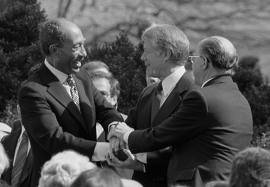
When Anwar Sadat signed the Camp David Peace Treaty in 1979, he probably did not foresee that he had only two years left to rule Egypt and that his successor Mubarak would rule the country for thirty long years after. It is probably also safe to say that the Arab Spring would never have entered his wildest imagination.

To his friends, Sadat was a wise leader who had done the best for his country, but to his foes he was a traitor who surrendered Egypt to the devil.

The controversy about Sadat was almost, though not completely, settled by his tragic death in 1981, but his treaty is still causing quite a stir in Egypt following the downfall of his successor Mubarak.

How did it reach that point?

Mubarak, a man who lacked charisma and vision, but had a deep desire to rule Egypt as long as possible, formulated a devious policy on Israel aiming to maintain the treaty without risking the fate of his predecessor.

In order to achieve this delicate balance, he declined to formally visit Israel so as to avoid the wrath of the Islamists. On the other hand, he established strong and occasionally secret channels with Israeli officials.

On the domestic front, he adopted a more sinister policy towards the country’s Islamists. A mixture of carrot and stick approaches: ruthlessly crushing them if they crossed the red line, while turning a blind eye to the growing xenophobia and even anti-Semitism in their teaching – as long as they behaved themselves.

The long oppressive reign of Mubarak had slowly reduced the Camp David Accords from a comprehensive peace treaty to a mere deal about security arrangements and financial aid, resented by the vast majority of Egyptians, from the Brotherhood to the belly dancers. Peace became a derogatory word, a kind of retro 70s style that is neither desirable nor acceptable.

On the other side, Israel welcomed Mubarak’s policy: it reduced 80 million Egyptians into a one-man nation. A wrong choice indeed, as the Arab Spring has brought the era of reliable authoritarianism to an end, along with leaders like Mubarak who put a lid his nation’s simmering problems. Israel invested in the lid and ignored the pot. Now the pot is wide open and it is at boiling point.

What‘s next?

The abuse of the treaty is bound to continue. If pseudo peace was Mubarak’s preferred choice, the newly emerged Islamist majority in Egypt prefers an ambiguous stalemate approach; a more hostile policy towards Israel, hostile enough to sever any remaining links with the “Zionists” without provoking a new war in the region.

Their approach is based on many considerations:

First, it is very popular: the toxic mix of inflammatory threats and rhetoric against the “Zionist” entity appeal to many in Egypt, from the ultra-conservative Salafis to the anarchists and leftist activists.

Second, ambiguity fits in well with the Islamist comfort zone. Without the obligations of peace or the commitments of war, Islamists can easily navigate their policies between the US and the West on one side and their traditional allies like Hamas on the other.

Third, and most importantly, the geopolitical reality of 2012 would prevent Israel from re-enacting the 1967 scenario. Sinai comes with strings attached: a major trap called the Gaza Strip. Israel cannot re-occupy Sinai (assuming it easily do so) without confronting Hamas and other militant groups in Gaza, and inheriting the 1.5 million Palestinian inhabitants cramped inside.

However, the Islamists should be careful with their game plan. Stalemate is not as easy as it looks, it can backfire badly:

-Stalemate creates uncertainty, which could damage the already ailing Egyptian economy and put off international investors.

-It could encourage Israel to wash its hands completely of any responsibility toward Gaza, forcing Egypt to deal with its economical and security challenges.  The recent electricity dealcould be just the start.

-Israel’s response, particularly with any security breach from Sinai would be difficult to predict, but the possibility of Israel trying to partially annex parts of South Sinai (there are 4 security zones stated in the treaty, Zone C near the Israeli border being the most vulnerable) to secure its Red Sea shore and prevent infiltration from Gaza shouldn’t be dismissed.

In theory, Egypt may not lose much by adopting a stalemate approach, while Israel may gain some sympathy as result of it. However, both sides should calculate their next move carefully. In the current unpredictable climate, and the continuous deterioration of security in Sinai, tension can easily flare up with unimaginable consequences. Sadat’s peace has gone, and the war-free era may soon come to an end. Though a 1967 moment is unlikely, a modified new version is not far-fetched.

Posted in Egypt, Israel | 4 Comments

From Maspero to Port Said.The Endless Cycle of Violence.

(AP Photo/Muhammed Muheisen)

Clashes, death, anger and tear gas. This is the endless cycle of violence that engulfs Egypt these days. The rotten regime of Mubarak has eroded the entire foundation of Egyptian society and left a country with weak fabrics fixed with cement as dodgy as that used in many of Cairo’s sore-eye tower blocks.

What the regime left behind is a base that is not easy to eradicate nor suitable for repair. Mubarak’s men are not those “Felool” who everybody talks about. As a matter of fact, we all are in one way or another Mubarak’s men and women.  We grew up inhaling his poisonous air and following his pathological mind. We learned not to take responsibility for our own actions and shout “conspiracy” every time we face troubles. It seems the entire world is conspiring against us from the kingdom of Middle Earth to the mountain of Zion, at least, that is how it feels.

The Port Said tragedy is a clear example of how Egyptians failed to abandon Mubarak’s approach towards life and politics. Rather than sharing the blame (the fans, security forces and political leadership), many opted for the easy option, pointing their fingers at an illusive entity: ‘Mubarak’s men” (the Felool).

No one wanted to admit the unpalatable fact that hooliganism is not just among football supporters (the Ultras) but a general attitude that has risen sharply within society.

It is true that the lack of accountability and credibility that marked Mubarak’s rule has continued after his fall. The trail of events from Maspero to Port Said shared many similarities, mainly the failure to bring those responsible to justice and the inclination to initiate any reforms within the security service. However, there are several other factors behind these that contributed to the repetitive pattern:

First, loss of police respect and deterrence; Fear has been replaced by a deep desire for revenge and settling old scores. Even if  the police interfered in Port Said to restore law and order (which indeed they should have done), they would probably have faced by strong resistance and even bloody confrontations.  In the current climate, the police would be doomed regardless.

Second, insults become the norm among a wide spectrum of the society. Even among the so-called Islamists. Being religious doesn’t necessarily means good manners these days. Football matches are  feasts for the insults dictionary, where opposing fans take pride in provoking each other.  But once law and order disintegrate, insults could simply be fatal.

Third, and perhaps the most important one is the Leadership failure.  Other than poetic anger, pointing fingers and assigning blame, the newly elected (and politically novice) parliamentary members have failed to provide any solution or road map out of the current crisis. These parties are no less autocratic than Mubarak’s regime and have a sacred respect for their own chain of command. No wonder they view the world only from the prism of their parties’ interests.

Other political figures’ and groups’ responses were also disappointing, from ElBaradei who is literally sulking in a corner, to the non- Islamists who failed to rise to the occasion by offering any vision or plan.

Fourth, the activists: it was alarming to see the lack of desire from within the activist groups to address the violent attitude of the demonstrators or the futility of the uncontrolled rage. The clashes stopped only when the anger was finally drained, but it can be easily reignited at any time.

The recent cycle of violence begs the question; will the end of military rule end the violence and bring back stability to Egypt or have we passed the point of no return?

There is no doubt that the badly managed transitional period has contributed immensely to the current volatile atmosphere in Egypt. The military council has lost its respected status and grace, and it is time for them to leave power and return to their barracks.

However, there is a serious risk that the end of military rule alone might not be enough to defuse the current convulsive situation. A civilian president may indeed face the same fate as Tantawi, unless:

1- Police reforms start immediately to achieve law and order but with transparency and accountability. It is not a tick box exercise, it actually may take years.

2- Egyptians should give any new government a chance- a period between 6- 12 months- before judging its performance. No government can work under the continuous pressure of sit–ins, strikes and violent disruptions.

3-  Activists need to learn that blind rage is futile, that the fight against tyranny needs a calm mind and proper planning. Reflection on practice is not a sign of weakness , but a sign of strength.

4- Islamists need to understand that they can not have their cake and eat it too. Their defensive actions while gloating about their parliamentary majority do not add up.

5- There is no place for conspiracy theories in the new Egypt. The revolution has gradually turned into a sick soap opera, in which we are trying to uncover plots and find the perpetrators.

Conspiracies are like bugs; they only invade weak bodies. It is about time to build a strong society and stop using conspiracies as a scapegoat for our troubles.

We have to stop the little Mubarak inside us and put an end to his self-righteous attitude, his desire to dominate others and his rejection of rational thinking. Only then will the revolution prevail.

Posted in Egypt | 5 Comments

Samak Laban Tamerind à la Tahrir

Cairo, January 2012- I did not quite know what to expect, I left the dreams, the plans, the assumptions behind me and I just headed to the most famous square in the Middle East, where the blossom of freedom had inspired the entire world. I went to see Tahrir.

At first glance, I noticed very little graffiti (apparently all the ant-SCAF graffiti has been painted on). One lady was selling post cards, a mix of famous leaders from the brotherhood’s Hassan al-Banna to Nasr, and from Che Guevara to Saddam Husain. The entire place had a unique smell, not off putting, just different, a mixture of sweet potato, smoke, pollution, and even garbage, thankfully there was no tear gas!

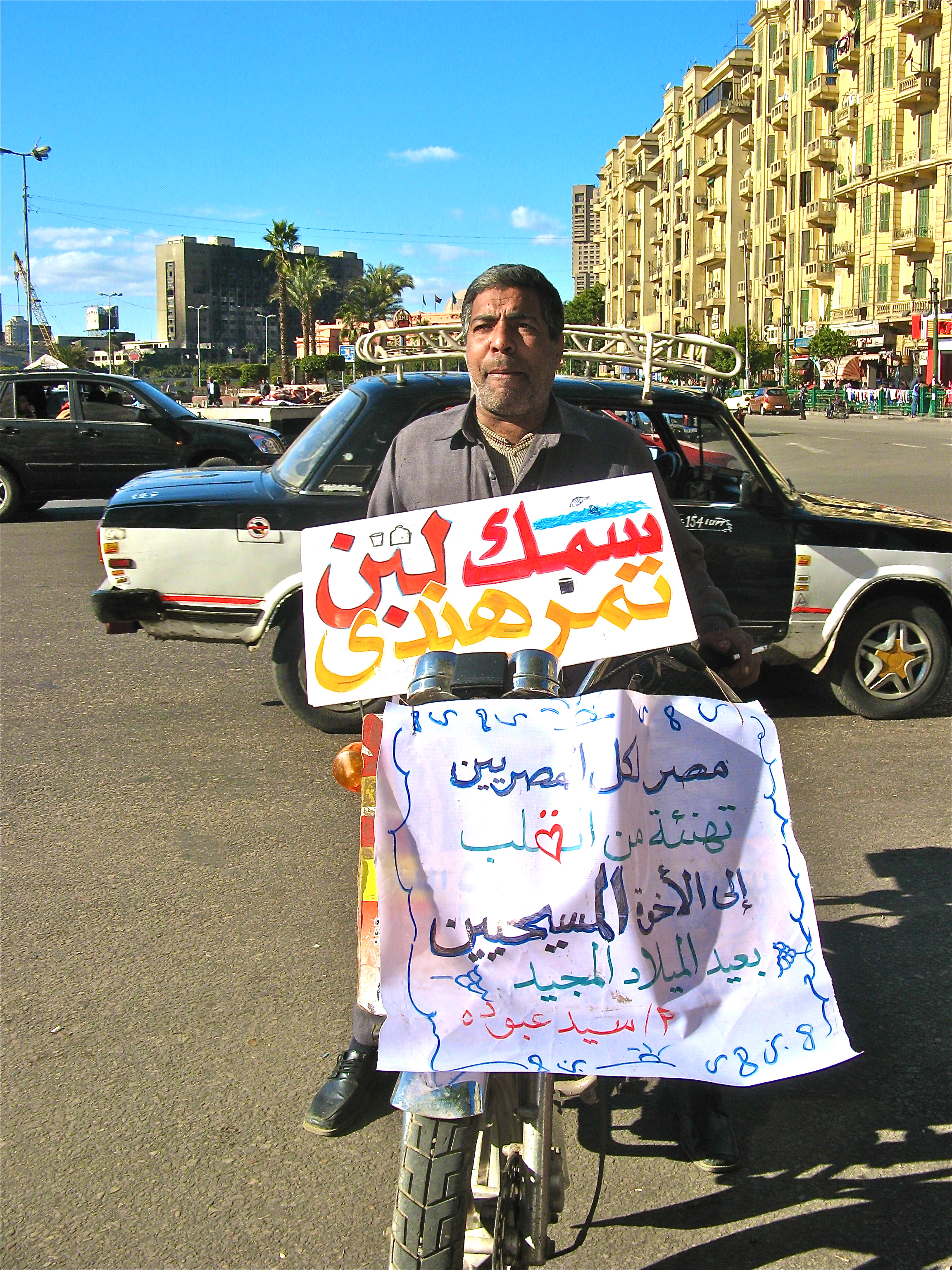
Then, I stumbled into Sayyed, a middle-aged man with modest clothing, sitting on his bike carrying a sign with three words; Samak (fish), Laban (milk), Tamerind (Egyptian local drink).

“I was here from day one of the revolution, I helped this American journalist who was assaulted (I think he meant Lara Logan), and I carried many injured on my bike during Mohamed Mahmoud’s events. Now I’ve had enough and I don’t like what I see, they are abusing Tahrir, this is not the way it should be.”  He said.

My conversation with Sayyed turned into a lively and passionate discussion when a group of men joined in. They all acknowledged how the situation is confusing, and messy. They expressed anger at everyone; the army, the Islamists, the non-Islamists parties and the activists. “Every one has his own agenda, they do not care about this country any more, they only care about their own glory,” one young guy said.

However, when I asked what is the right way forward? the agreement quickly evaporated and was replaced with heated argument. Some including Sayyed want no more sit-in Tahrir, whilst others insist that demonstrations are the only way forward until the revolution achieves all the demands. Some expressed mistrust towards the Islamists, others expressed confidence in them. The heated argument become louder and louder. An old guy whispered in my ear, “no one wants to listen, instead, each one wants to impose his views. It is a dirty battle of ideas, a form of mental thuggery.”

The debate in Tahrir was indicative of the wider poisonous political environment in Egypt. Sayyed’s sign -Fish, Milk and Tamarind- (a statement commonly used in Egypt to describe a cocktail of unrelated and totally mismatching stuff) reflect the sour and even pathological relationship between the military council, the revolutionary activists and the new Islamic parliamentary majority.  

Tahrir has become the Avatar of the New Egypt that is constantly changing its colours, and style in order to reflect the post-uprising dynamics in a complex fragile political order. Currently, not just politicians are divided about the future of Egypt; ordinary Egyptians seem also divided about the best way forward.

Egyptians are torn between their long-term addiction to stability, and their newly acquired fascination with demonstrations. Both the Islamists and the Military Council are happy to exploit their dilemma for political gains.

Therefore, it is crucial for Egyptians to understand that fake stability is not sustainable, and it is about time to wean  “our daddy” out of politics simply because it is not a healthy relationship any more. On the other hand, activists need to understand that angry demonstrations without a clear roadmap is simply pointless. Slogans like “down with military rule,” and  “bread, freedom and social justice” are great but need to be coupled with a clear process of how, when and why.

If the 25th of January 2011 was about throwing Mubarak out of  power, 25th of January 2012 should be about the new constitution. This constitution is the key for throwing the military out of power, and the safety valve that can protect the new democracy from any tyrannic tendency by the new Islamic parliamentary majority.  It should help Egypt to develop a strong civil society with reforms in education, minority rights, freedom of worship and independence of religious authority. These are the kind of demands, which I hope to see on Wednesday.

Both the Military and the Islamists need to understand that the days of  propaganda, rhetorics and playing with emotions are long gone, and the society is the new big brother that is continuously watching them.

As Sayyed in Tahrir aptly explained, the current political cocktail is not harmonious with smelly fish, curdled milk, and vinegary tamarind. Now it is the time for fresh ingredients  and political maturity in order to demystify the foggy political sphere. Purging of the old  toxic system needs more than anger. It needs time, shrewdness and political resilience. The damage limitation of the dodgy transitional period should start right now.

Posted in Egypt | 5 Comments

Egypt Revisited

I wrote this piece as guest post for Dr. Robert Danin blog “Middle East Matters.” http://blogs.cfr.org/danin/

Robert Danin is Eni Enrico Mattei Senior Fellow for Middle East and Africa Studies in the Council on Foreign Relations (CFR)

The Egypt I knew and grew up in was a laid-back country, almost resigned to its fate. Earlier this month, I came back to visit after some years abroad only to see a nation on the edge, anxious and confused. Egypt today is trying to come to terms with its past and present, and struggling to define its vision for the future. Rather than drawing a single unified conclusion about what Egypt is today, I left with a mélange of disparate impressions. Here are four:

View full text of the article on.cfr.org/xtdRMi

Over the next few weeks, I shall try to write a bit more about my visit. 

Posted in Egypt | 4 Comments

The Power of Listening

‘If they won’t listen to Moses and the prophets, they won’t listen even if someone rises from the dead.’  Luke 16:31

With hindsight, perhaps these “dark” days were the most influential and indeed beneficial days of my life. The temporarily loss of vision inevitably helped me to focus on my other senses. I learned how to pay attention to words, tone of voice and style of talking. I simply learned how to listen.

This grainy old photo did not just captured a crucial chapter of my life, but also served as a constant reminder that I should use all my senses properly and adequately with minimum selectivity and bias.

My brave and graceful mother did her utmost to look after me. She diligently read  many storybooks to me and patiently answered my questions. Her stories were incredible (that is how I felt) they made me look forward to the day when I could read them with my own eyes.  She reassured me that I would remember these days as “happy days.” She were right; it was happy days.

We may think that we are good listeners. In reality, we tend to be selective; love to listen to praise, and ignore criticism; pick convenient ideas, and ignore others more challenging ones. That is how dictators become tyrants, they surround themselves with an army of opportunists who know not only how to praise, but also how to make crimes look fair, and even essential for the over-all good of the society. Gradually, opinions become facts that should not be challenged or denied.

Social scientists  believe that powerful people do not usually listen. It may be true, however it is very shortsighted.  It is easier to pay attention when power slips and vulnerabilities creep, but it may be too little, too late.

Poor listening leads to hostility, miscommunication and ultimately leads to a break down in cohesion within the society. Deafness is not just a medical phenomenon, it could be a deliberate mental act to avoid facing reality and create pseudo -alternatives.

Arab leaders fall into this trap following the end of colonialism; rather than listening to their people, they listen to their own little voices. As a result, the society slowly slips into poverty, corruption, not to mention ethnic and religious tension.

If Nasr listened, he would never have initiated the six-days war. If Sadat listened, he would never have  flirted with the Islamists. If Mubarak Listened, he would have retired gracefully, and If Assad listened, many Syrian lives would have been saved.

However, it is not just dictators who are poor listeners, many of us treat any discussion as a competition, wrongly believe that we know all the answers and our sole aim is to influence and impress.

Watch any talk show- if you think al-Jazeera “The opposite direction” is a bad example, look at any respected Western alternative. Guests may be more civil, but they hardly listen to each other. They only explain their own views, exchange few words and leave the program without any change in their original thoughts.

A quick glance at social media, like Twitter (though technically is not listening) and you find this stark fact right in front of your eyes. Anyone who challenges any fixed idea is  bombarded by accusations, insults and may even be blocked.

Can we afford  ineffective listening in the post Arab-awakening Middle East?  The answer is undoubtedly no. At this crucial period where history is still in the making and societies are at cross roads, no one ( Arabs,Non-Arabs; friends, foes; majority, minority; Islamists and non-Islamists) can afford not to listen.

In 2012, the Arab-spring’s blossom would either yield lush green leaves of freedom or fade to a long term winter of discontent. The uncertain and intellectually demanding transitional period  is tedious in comparison to the passionate pro-active act of protesting. However it is a must; a test of character for everyone, no one is exempt. Our children would never forgive us if we failed to get it right.

At a certain stage in my life, I became a very bad listener (I thought I knew better). Now I am trying to regain my listening skills and I hope you can join me. Let’s get out of our bubble, stop the tyrannical voice inside our mind and listen to each other more effectively in 2012

Wishing you all a Happy New Year!

Nervana

Posted in Uncategorized | 8 Comments

Let’s Celebrate February 11th

Revolution versus Conter-revolution/ Vertical struggle versus horizontal struggle/  SCAF press conference versus Anti-SCAF press conference 

 Solution any one?

Egypt is in a lock down. In the current charged, volatile, and even convulsive mood, it is easy to be consumed by anger, rage and despair. However, we need a way out. A viable plan to get Egypt out of this cycle of violence.

Marc Lynch ( Associate professor at George Washington University) wrote in Foreign Policy Egypt’s Transition Can’t Wait bit.ly/tOSAVy  some welcomed his initiative, but many were sceptical, highlighting the potential pitfalls and problems.

In his article in FP Egypt’s Rodney King Moment  bit.ly/tUWVkt Ashraf Khalil ( Cairo -based author and correspondent) also called for accelerated transition of power to civilian leadership.

Today, Prof. Seif Abdelfattah suggested either a Parliament Chair to act as interim president or presidential elections by March 2012.  This suggestion was later dismissed by the Muslim Brotherhood Freedom and Justice party, “FJP  rejects initiatives for early power transfer to head of PA or interim president, and prefer to sticks to the timetable according to March’s referendum.”

The Pitfalls for early parlimentarily Elections as listed by Hasan Nafaa (Prof. of political science) in Marc Lynch’s piece are mainly: cancellation of the Upper House elections, no time to write the new constitution, and shorter campaign for presidential candidates.  The brotherhood also view the move as a way to bring the super- constitutional principals from the back door, no wonder they urgently met today and decisively reject it.

What are the alternatives? Can Egypt afford to wait till June? How can we stop the cycle of violence?  Lets face it, there is no perfect solution to this mess.

The only way to square the circle is to involve the four main parties within the Egyptian society; The military Council, the activists, the politicians and the general public in one plan which can bring some benefits to each one of them.

Here is a simple plan :

1- Stop the violence immediately.

2- Clear Tahrir following next Friday proposed Million march.

3-  Can we have a “Hodna”(time out) from swearing, insult and accusations?

4-  Presidential Election to be held on the 11th of February 2012.  Holding the election on the 11th of February is the best way -in my opinion- to celebrate the first anniversary of Mubarak departure. This move could unit all Egyptians, regardless of their political affiliations on one task. “Lets save the revolution.”

This proposal has also potential advantages to all parties:

1- Supreme Council of  the Armed Forces (SCAF):

By accepting an early presidential election, SCAF would show a true desire to hand over power and reaffirm its claim that they do not want to rule the country forever.  It also would save the image of the military forces that was tarnished following the disgraceful images of brutality on the streets.

2-  The Protestors:

The end of military rule is the main demand of the protestors. an early transition will calm the anger and defuse the current tense atmosphere. Plus, it would help them to focus on the political process and the campaign for a president who can fulfil their aspirations.

3-  The Politicians ( including the Brotherhood):

Despite their rejection of the proposal, I think the brotherhood stand a lot to gain from it:

a- It would  narrow the gap between them and Tahrir. After many has accused them of  opportunism and indifference to the loss of human lives, it is about time to show some flexibility, and more important some patriotism.

b-  It would refute any claim of potential secret alliance with the military council in order to reach power.

c-  It would give them with a better chance and longer time to write the constitution  (as March lynch pointed out in his piece)

Other political parties should also seize the opportunity  and focus on selecting and backing their favourite candidate for the presidential election.

4- The General Public:

The so called “silent majority”  has certainly started to lose patience with every body including “their beloved Military Council ” They are yearning for stability, jobs and security. and an accelerated process would certainly help them to achieve these demands.

Now, Do I want the like of Abu-Ismail as President ? Certainly not and I admit the the shorter campaign is a big problem. However, I frankly think most Egyptians have made their mind regarding who they like and who they do not among the current candidates. Plus, if the activists use the remaining few weeks efficiently and channel their anger in a door to door campaign, they stand a good chance to swing the undecided voters towards their favourite candidate.

Meanwhile, you have three options; You either agree with my proposal, amend it or provide an alternative one, but dismissing it is simply not an option!

Despair is not an option, this revolution has to prevail. The legendary writer Ihsan Abdel Kouddous  wrote “You can not switch of the sun-light”  and he is right, Egypt’s sun is eternal, no one can switch it off.

Nervana

Posted in Egypt | Tagged | 6 Comments

Few Thoughts on #OccupyCabinet

” Egypt is not struggling with its past, present and future. Egypt in not   struggling with its identity. Egypt is even struggling with the basic definition of what is right and what is wrong”

The dramatic events of the last two days have ignited  yet another debate between  the supporters  of the military council and those who are against it.

Rather than joining the pointless debate, I rather highlight few points:

1-  The confrontation was inevitable, Three week of sit-in was bound to build up tension between the two sides.

2-  Following months of unrest since the 25th of January, resident of down town Cairo has lost their privacy and peace and certainly feel under siege. Their growing hostility toward the protestors became evident during the events of Mohamed Mahmoud.  It is not surprising that they were hostile at the protestors as the army was trying to disperse the Occupy Cabinet sit -in. Yesterday, State TV made every effort to interview these resentful residents and highlight their problems.

3-  Egypt undoubtedly needs new street protest culture, where both protestors and police learn to respect the law of the land  and each other’s right and dignity.the law of If and when this happen,  we will never witness throwing rocks and Molotov between both sides.

4-  There are clear and well-known methods for dispersing angry crowds. These should start by a clear plan designed according to the severity of the situation. Simple methods like spreading leaflets warning protestors of planned evacuation, the use of water cannons should be tried first before things escalate. The whole operation should be conducted with discipline and professionalism.

5-   As I wrote in my previous piece “Rules Of Engagement” bit.ly/w0VJzO army and police need change and reform. Obviously neither the police nor the army are willing to embrace any. Some of the photos/videos of the army soldiers – yfrog.com/klo623j and  arb.st/t38WNWare frankly disgusting ( if true).

6-   Egyptian security forces (both police and army) seem to have lost both respect and deterrence.  Following years of indoctrination of ruthless tactics, January 25th revolution left them with low morals, humiliated and even anger. This was clearly reflected at their vicious treatment of the protestors.

7-    Tit for Tat have no place in a professional force, as @arabist mentioned in his piece http://t.co/7fE9ZQQg  “Why the hell are police and soldiers engaging in rock-throwing? Who is running this place? It’s an abdication of authority and responsibility” By reciprocating stone throwing is not just silly, but counter-productive and only lead to more causality

8-   The main aim should minimizing human loss, judging by events of Maspero/ Mohamed Mahmoud and occupy cabinet, these aim was not fulfilled -to say the least- Even if protestors provoked the police and the army, it is the duty of any force to deal with any provocation in a professional manner and absorb tension rather than aggravate it.

Meanwhile, the vast majority of Egyptians are indifferent to the recent development, and many turning against the protestors. As Tim Marshall  (Sky news Foreign affairs Editor) tweeted yesterday: “@Skytwitius Watching Cairo pics important 2 remember that 84M Egyptians are NOT taking part. If you don’t get that you dont get #Egypt

The wide gap between Twitter feed #OccupyCabinet and the general Egyptian public opinion is so alarming.  This gap reflect a serious crisis of the entire society and will not narrow unless those responsible held accountable for their own actions.

It is easy to label the protestors as thugs and criminals. Just a word of warning, those “thugs” are the sons you did not raise, the students you did not teach  and the youth you never cared about. 

A medical student was not a thug, Al-Azhar Sheik was also not a thug.

May all the martyrs rest in peace. 

Nervana

Posted in Egypt | Tagged | 3 Comments

Rules of Engagement: Egypt’s Military, Police need Change, Reform

Iniatlly published in bikyamasr

bit.ly/w0VJzO

Rules of Engagement (2000) a military courtroom drama that featured Tommy Lee Jones and Samuel L Jackson; it was not particularly a groundbreaking movie. Nonetheless, the director William Freidken explored uncharted water, namely, the role of the military in the post-War scenario, when soldiers are ordered to serve as policemen, deal with hostile civilians and work in the actual chaos of conflict.

 Outside Hollywood, the Rules of Engagement (ROE) provide carefully thought details of when and how force shall be used in military and police operations, it also synchronizes them with the political aspect in a clear strategy, and provides consistent and reliable standards.

Clarity and discipline of implementation are the two major factors that determine the outcome in any military or police engagement.

In Ismailia 1952, the Egyptian police had clear ROE, when a group of Fedayeen (Freedom Fighters) sought refuge within the Police barracks; they decided not to surrender them to the British army forces- who controlled the Suez Canal- under any circumstances.

The British also had clear ROE – Get the “terrorists’ out at any price – and that was what they achieved. Following hours of stand off, confrontation was inevitable, and the result was the death of 50 Egyptian police officers, and 4 British soldiers in a day that Egypt still commemorates as “Police day.”  The event in Ismailia led to spread of fury all over Egypt. Eventually, the British lost control over the Suez Canal following 1956 war.

Throughout the following Fifty-nine years, Egypt witnessed radical changes in the role of the police.  Rather than serving and protecting the people, the Police, and Central Security Forces (CSF) had become an instrument of oppression by the alternate dictators who ruled the country.  The love affair (between Police and people) gradually became a violent affair that ended up in full-scale confrontation on the 25th of January 2011( the day Egyptians revolted against Mubarak) when the police had failed miserably to control the crowd (despite their ruthless tactics) who for the first time defied their authority and power.

Later, The military council sent their men to the streets of Cairo with entirely different sets of orders. The crowds, whom the police had treated as mobs and rioters became legitimate peaceful protestors. The instructions were clear –do not shoot- as a result, the army won the hearts and mind of most Egyptians and the revolution had prevailed.

By serving as policemen in post revolution Egypt, the military has embarked on the tricky path of dealing with civilians during uncertain time. Unfortunately, They took the task lightly, relaying heavily on the false assumption that civilians will not turn against them.

The underestimated challenges were evident during the Maspero confrontations  (9th October 2011).  The poorly trained, ill-equipped Soldiers had to face angry crowds. They failed to handle it, and the result was the tragic loss of 23 innocent civilians lives.

Behaving as police, the army labeled the protestors as “rioters/ thugs with foreign fingers involved.“ In other words, it was perfectly legitimate to shoot at them.

By refusing to acknowledge the problem, another bloody confrontation was a matter of time. This one was in Mohamed Mahmoud street meters away from the Ministry of Interior. The army decided to lead from behind and left the Central Security Forces (CSF) to face the crowds.  Rather than saving lives as their predecessors in 1952, the police went on to shower protestors with relentless tear gas, bird pellets aiming at eyes, and head, Their dismal performance was counter-productive and heightened the determination and resolve amongst the defiant youth.

It becomes increasingly clear that the Rule of Engagements of the Security and Army forces was neither clear nor efficient. The military and police has lost both their deterrence and respect, by inflicting several civilian casualties without effectively controlling their ground. It also left the door open to countless conspiracy theories.

Yes, the army has issued an apology, but what is the point of an apology without regret, reflection and without reforms?

If the military truly wants to stop the trail of tragic loss of lives, they should publish the exact Rules of Engagement in both the Maspero and Mohamed Mahmoud events and should hold those responsible accountable for their crimes in order to avoid another tragedy from happening in the future.

On the other hand, it was heart breaking to watch some Egyptians labeling the protestors as thugs and foreign agents.  For a minute, I wished the security forces in Mohamed Mahmoud Street were not Egyptians, but British or Israelis. May be then the so-called “silent majority” would rally behind the defiant youth rather than cruelly turning against them.

There is no doubt that Egypt needs a new “Protest Culture” that guarantee the right of expression of liberty in an orderly disciplined manner.  This culture would never flourish unless the security forces implement several reforms aiming at effective crowd control, while avoiding the tragic loss of lives.

William Freidken drama was implausible with a flimsy end, but the military version of last week tragedy in Egypt was even more implausible, if not repugnant and abhorrent. We can afford to forget fiction, but we need to face up to reality and do what is right not what is convenient.

Nervana

Posted in Uncategorized | 2 Comments